2409 new objects were launched into space in 2022, that’s more than ever before.
Last year though, also saw a record number of satellites reenter Earth’s atmosphere.
The rising number of reentries is not necessarily a bad thing. Disposing of satellites efficiently is one of the most important things for keeping low-Earth orbits safe.
However, most objects reenter in an uncontrolled manner: they are switched off at the end of their mission and left to fall and burn up in Earth’s atmosphere.
There is good news though. Advancing technology has seen a recent increase in “controlled reentries” for rocket bodies. A controlled reentry allows operators to remove their hardware from protected regions more quickly and with greater control over where, when and how it reenters – and even lands – at the cost of allocating some fuel to do so.
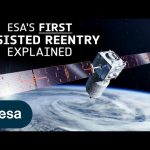
By the way, just because an older satellite wasn’t designed to be controlled during its descent doesn’t mean it’s impossible to do so. In July 2023, our teams guided the Aeolus satellite to burn up over uninhabited regions in the Atlantic and Antarctica, even though the satellite was designed in the late 1990s with no intention to control it in this way.
ESA’s wind mission Aeolus is coming home. After five years of improving weather forecasts, the satellite will return in a first-of-its-kind assisted reentry. At ESA’s Space Operations Centre in Germany, mission control will use the satellite’s remaining fuel to steer Aeolus during its return to Earth.
Find out more about the mission, its successes and how Aeolus is paving the way for safe reentries. 👉 https://www.esa.int/Aeolus
Credits: ESA – European Space Agency
★ Subscribe: http://bit.ly/ESAsubscribe and click twice on the bell button to receive our notifications.
We are Europe’s gateway to space. Our mission is to shape the development of Europe’s space capability and ensure that investment in space continues to deliver benefits to the citizens of Europe and the world. Check out https://www.esa.int/ to get up to speed on everything space related.
ESA’s Earth Explorer Aeolus satellite was launched in August 2018 on a trailblazing mission to show how profiling Earth’s winds from space can improve weather forecasts and climate models. Data from its pioneering wind-mapping laser, which at one stage was thought a nigh-impossible feat of engineering, has been used by leading weather forecasting services throughout Europe.
Marking the end of Aeolus’ remarkable mission, ESA worked with composer Jamie Perera to create a woodwind piece from data that spans the lifetime of the satellite’s life in orbit around Earth.
In the resulting orchestral piece, every second is a day in the life of Aeolus, with data represented by the following instruments:
Piccolo: Rayleigh Top Altitude (the tops of clouds) Flute: Rayleigh Observation Type (density of clouds) Oboe: Rayleigh Reference Temperature (wind temperature) Clarinet 1: Rayleigh Wind Velocity (wind velocity) Clarinet 2: Rayleigh Wind Reference Pressure (air pressure) Bassoon/Bass Clarinet: Rayleigh Bottom Altitude (Earth’s surface) Ambient Synth: Validity Flag 0 (Aeolus downtime)
You can also hear landmark events such as volcanic eruptions represented by drums, hurricanes represented by wind sound effects, and the Coronavirus pandemic represented by a pulsing synth.
We are Europe’s gateway to space. Our mission is to shape the development of Europe’s space capability and ensure that investment in space continues to deliver benefits to the citizens of Europe and the world. Check out https://www.esa.int/ to get up to speed on everything space related.