Tag: aerobraking

  • ExoMars at Mars

    ExoMars at Mars

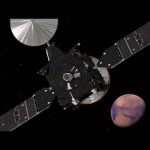
    Three days before arriving at Mars on 19 October 2016, the ExoMars Trace Gas Orbiter (TGO) will release its entry, descent and landing demonstrator, Schiaparelli, towards the Red Planet. ExoMars is several missions in one. Its orbiter is a science and relay mission. The TGO will search for evidence of gases, such as methane, that may be associated with geological or biological processes. The Schiaparelli lander is a technology demonstrator to test key technologies for future missions to Mars.

    The landing site is an elliptical region close to the equator about 100 km long and 15 km wide in the planet’s Meridiani Planum area. It is relatively flat, smooth and well studied as NASA’s Opportunity rover is on the ground and ESA’s Mars Express spacecraft, which will also act as one of the data relay orbiters, has been overhead since 2003.

    This video covers the landing and orbital manoeuvres, including the use of aerobraking – which ESA is using for the first time at Mars.
  • Venus Express plunging into the atmosphere

    Venus Express plunging into the atmosphere

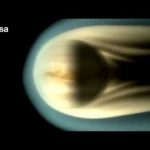
    After eight years in orbit, ESA’s Venus Express has completed routine science observations and is preparing for a daring plunge into the planet’s hostile atmosphere.

    Venus Express was launched on 9 November 2005, and arrived at Venus on 11 April 2006.

    It has been orbiting Venus in an elliptical 24-hour loop that takes it from a distant 66 000 km over the south pole — affording incredible global views — to an altitude of around 250 km above the surface at the north pole, close to the top of the planet’s atmosphere.

    With a suite of seven instruments, the spacecraft has provided a comprehensive study of the ionosphere, atmosphere and surface of Venus.

    This video includes interviews in English with Håkan Svedhem, ESA mission scientist and Patrick Martin, ESA Venus Express mission manager

  • Venus Express aerobraking

    Venus Express aerobraking

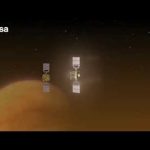
    Visualisation of the Venus Express aerobraking manoeuvre, which will see the spacecraft orbiting Venus at an altitude of around 130 km from 18 June to 11 July. In the month before, the altitude will gradually be reduced from around 200 km to 130 km. If the spacecraft survives and fuel permits, the elevation of the orbit will be raised back up to approximately 450 km, allowing operations to continue for a further few months. Eventually, however, the spacecraft will plunge back into the atmosphere and the mission will end.

    Credit: ESA–C.Carreau