Tag: AIM

  • ESA Euronews: Can we deflect asteroids?

    ESA Euronews: Can we deflect asteroids?

    In the edition of Space, Euronews correspondent Jeremy Wilks reports from the Observatory of the Côte d’Azur in the south of France on a unique mission to deflect an asteroid.

    Asteroids have the potential to cause a catastrophe – a small asteroid could wipe out an entire city, while a large one could mean the end for us all.

    It’s a threat we’re aware of, and which scientists and engineers are working to overcome.

    This video is also available in the following languages:
    German: https://www.youtube.com/watch?v=M1p6fl7sCGk
    French: https://www.youtube.com/watch?v=pCehifF8C78
    Italian: https://www.youtube.com/watch?v=Qyyjp7Rjip0
    Spanish: https://www.youtube.com/watch?v=UiUgVncmKo4
    Portuguese: https://www.youtube.com/watch?v=bddwRV07usc
    Hungarian: https://www.youtube.com/watch?v=F1dfH4BzeEI
    Greek: https://www.youtube.com/watch?v=OcL4oEAG-L8

  • The art of AIM

    The art of AIM

    ESA’s Asteroid Impact Mission and the US Double Asteroid Redirection Test together make up AIDA – the Asteroid Impact and Deflection Assessment (AIDA), a pioneering planetary defence test that will attempt to shift the orbit of an asteroid in 2022. Artist Didi Rodan performed a unique depiction of this initiative in sand, a highlight of a recent conference on AIM hosted by the GMV company in Madrid.

    Credit: ESA/GMV-Didi Rodan

  • Asteroid Impact Mission

    Asteroid Impact Mission

    The Asteroid Impact Mission (AIM) is a candidate mission currently undergoing preliminary design work.

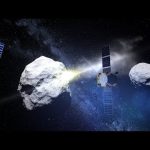
    Launched in October 2020, AIM would travel to a binary asteroid system – the paired Didymos asteroids, which will come a comparatively close 11 million km to Earth in 2022. The 800 m-diameter main body is orbited by a 170 m moon, informally called ‘Didymoon’.

    This smaller body is AIM’s focus: the spacecraft would perform high-resolution visual, thermal and radar mapping of the moon to build detailed maps of its surface and interior structure.

    The main AIM spacecraft is planned to carry at least three smaller spacecraft – the Mascot-2 asteroid lander, being provided by DLR (Mascot-1 is already flying on JAXA’s Hayabusa-2), as well as two or more CubeSats. AIM would test optical communications and inter-satellite links in deep space, essential technology for future exploration.

    If approved, AIM would also be Europe’s contribution to the larger Asteroid Impact & Deflection Assessment mission: AIDA. In late 2022, the NASA-led part of AIDA will arrive: the Double Asteroid Redirection Test, or DART, probe will approach the binary system – then crash straight into the asteroid moon at about 6 km/s.

    AIM is intended to be watching closely as DART hits Didymoon. In the aftermath, it will perform detailed before-and-after comparisons on the structure of the body itself, as well as its orbit, to characterise DART’s kinetic impact and its consequences.

    This video is also available in the following languages:
    French: https://youtu.be/8GjVhBQsISc
    German: https://youtu.be/Sht_Kmaf5sU
    Spanish: https://youtu.be/KpmuzduOjhE

    Credits: ESA/ScienceOffice.org