Tag: Animation (TV Genre)

  • LISA Pathfinder launch animation

    LISA Pathfinder launch animation

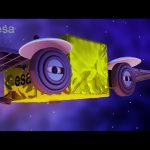
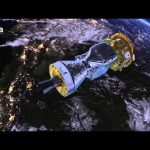
    Artist’s impression of the launch of LISA Pathfinder, ESA’s technology demonstration mission that will pave the way for future gravitational-wave observatories in space.

    Scheduled to lift off on a Vega rocket from Europe’s Spaceport in French Guiana in late 2015, LISA Pathfinder will operate at the Lagrange point L1, 1.5 million km from Earth towards the Sun. After launch, the spacecraft will take about eight weeks to reach its operational orbit around L1.

    The Vega rocket is designed to take small payloads into low-Earth orbit. The animation shows the rocket shortly after launch, rising above our planet and releasing the fairing.

    Vega will place the spacecraft onto an elliptical orbit with perigee at 200 km, apogee at 1540 km and angled at about 6.5° to the equator. Then, LISA Pathfinder will continue on its own, using its separable propulsion module to perform a series of six manoeuvres and gradually raise the apogee of the initial orbit.

    Eventually, LISA Pathfinder will cruise towards its final orbiting location, discarding the propulsion system along the way, one month after the last burn. Once in orbit around L1, the spacecraft will begin its six months of operations devised to demonstrate key technologies for space-based observation of gravitational waves.

    More about LISA Pathfinder:
    http://www.esa.int/Our_Activities/Space_Science/LISA_Pathfinder_overview

    Credit: ESA/ATG medialab
  • Journey to the surface of a comet

    Journey to the surface of a comet

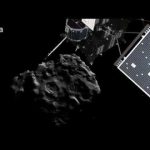
    Rosetta’s deployment of Philae to land on Comet 67P/Churyumov–Gerasimenko.

    The animation begins with Philae still on Rosetta, which will come to within about 22.5 km of the centre of the nucleus to release the lander on 12 November 2014.

    The animation then shows Philae being ejected by Rosetta and deploying its own three legs, and follows the lander’s descent until it reaches the target site on the comet about seven hours later.

    The animation is speeded up, but the comet rotation is true: in the time it takes for Philae to descend, the nucleus has rotated by more than 180º (the comet’s rotation period is 12.4 hours).

    The final steps of Philae’s descent towards the comet are shown as seen by a hypothetical observer close to the landing site on the comet.

    Acknowledgement: The background image of the sequence showing Philae closing in on the landing site was taken by Rosetta’s OSIRIS narrow-angle camera (ESA/Rosetta/MPS for OSIRIS Team MPS/UPD/LAM/IAA/SSO/INTA/UPM/DASP/IDA) on 14 September 2014 from a distance of about 30 km.

    Philae was provided by a consortium led by DLR, MPS, CNES and ASI.

    Credit: ESA/ATG medialab

  • Rosetta orbiting around the comet

    Rosetta orbiting around the comet

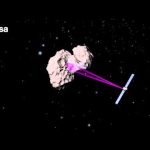
    Rosetta orbiting Comet 67P/Churyumov–Gerasimenko and scanning its surface to make scientific measurements. The colours of the beams and their shape on the surface represent two different instruments imaging and analysing the comet.

    The Rosetta orbiter has a total of 11 instruments to study the characteristics and environment of the comet. Rosetta is taking images of the comet at a variety of different wavelengths, measuring its gravity, mass, density, internal structure, shape and rotation, and assessing the properties of its gaseous, dust-laden atmosphere, or coma. It is also probing the surrounding plasma environment and analysing how it interacts with the solar wind.

    Rosetta also carries a small lander, Philae, which will descend to the surface of the comet and make in situ measurements using its suite of 10 instruments.

    The animation is not to scale; the comet is about 4.1 km wide and Rosetta is 32 m across including its solar wings, and it conducts scientific investigations at a range of altitudes. The comet shape is based on a true comet shape model.

    Credits: ESA

  • ESA presents… Clean Space

    ESA presents… Clean Space

    Clean Space is the European Space Agency’s initiative to safeguard the terrestrial and orbital environments, while boosting the innovation and competitiveness of Europe’s space sector. This animated guide follows a newly-launched satellite as it first enters orbit, in the process explaining the various branches of the Clean Space effort and the different future Clean Space aims to build.

    Now with English, French, German, Dutch, Italian, Greek, Romanian and Swedish subtitles. More languages will be added as they become available.