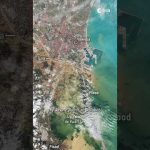
As recently reported by Copernicus ECMWF in its European State of the Climate Report, Europe experienced several climate extremes like glacier ice loss, severe floods, wildfires, and heatwaves. But the continent didn’t experience the same weather uniformly: data show a distinct east‑west contrast during 2024, with eastern areas generally sunny and warm while western areas were cloudier and wetter.
📹 European Space Agency (ESA) 📸 Contains modified CopernicusEU Sentinel data (2022 & 2024), processed by ESA CC BY-SA 3.0 IGO 📊 C3S/Copernicus ECMWF/KNMI
Another power-generating spacewalk outside the space station, a commercial resupply spacecraft heads to the station, and sharing the experience of a ride aboard the space station … a few of the stories to tell you about – This Week at NASA!
Another partner for space exploration, a Mars experience right here on Earth, and a promising find outside our solar system … a few of the stories to tell you about – This Week at NASA!
Video Producer: Andre Valentine, Haley Reed Video Editor: Andre Valentine Narrator: Andre Valentine Music: Universal Production Music Credit: NASA
Researchers have confirmed the presence of an exoplanet, a planet that orbits another star, using James Webb Space Telescope for the first time. Formally classified as LHS 475 b, the planet is almost exactly the same size as our own, clocking in at 99% of Earth’s diameter.
Among all operating telescopes, only Webb is capable of characterising the atmospheres of Earth-sized exoplanets. The team attempted to assess what is in the planet’s atmosphere by analysing its transmission spectrum. Although the data show that this is an Earth-sized terrestrial planet, they do not yet know if it has an atmosphere.
Webb also revealed that the planet is a few hundred degrees warmer than Earth, so if clouds are detected it may lead the researchers to conclude that the planet is more like Venus, which has a carbon dioxide atmosphere and is perpetually shrouded in thick cloud.
📹 @EuropeanSpaceAgency 🖥️ @NASA , ESA, @canadianspaceagency , L. Hustak
★ Subscribe: http://bit.ly/ESAsubscribe and click twice on the bell button to receive our notifications.
We are Europe’s gateway to space. Our mission is to shape the development of Europe’s space capability and ensure that investment in space continues to deliver benefits to the citizens of Europe and the world. Check out https://www.esa.int/ to get up to speed on everything space related.
While Webb and other space telescopes, including the NASA/ESA Hubble Space Telescope, have previously revealed isolated ingredients of this heated planet’s atmosphere, the new readings provide a full menu of atoms, molecules, and even signs of active chemistry and clouds. The latest data also give a hint of how these clouds might look up close: broken up rather than as a single, uniform blanket over the planet.
📹 @EuropeanSpaceAgency
📸 @NASA, ESA, @canadianspaceagency , J. Olmsted (STS)
★ Subscribe: http://bit.ly/ESAsubscribe and click twice on the bell button to receive our notifications.
We are Europe’s gateway to space. Our mission is to shape the development of Europe’s space capability and ensure that investment in space continues to deliver benefits to the citizens of Europe and the world. Check out https://www.esa.int/ to get up to speed on everything space related.
Another power-packed spacewalk outside the space station, highlighting a pretty cool comet, and a key piece of Space Launch System hardware is on the move … a few of the stories to tell you about – This Week at NASA!
Plans for human space exploration in the next decades are to leave Earth orbit and go to destinations such as the Moon and Mars. But what are the challenges associated with human survival in space and what kind of research is needed to address these challenges?
Life-support systems expert Lucie Poulet participated in four Mars analogue missions as a crew member and has over eight years of experience working on regenerative life-support systems with various groups such as the Micro-Ecological Life-Support System Alternative (MELiSSA) project and the German Aerospace Center, DLR, in Bremen, Germany.
Space Bites hosts the best talks on space exploration from the most inspiring and knowledgeable speakers from the field. Held at the technical heart of the European Space Agency in The Netherlands, the lectures illustrate challenges of space.
We are Europe’s gateway to space. Our mission is to shape the development of Europe’s space capability and ensure that investment in space continues to deliver benefits to the citizens of Europe and the world. Check out https://www.esa.int/ to get up to speed on everything space related.