
Tag: Asteroid Impact

  • Asteroid impact 2028: Protecting our planet

    Asteroid impact 2028: Protecting our planet

    It’s the year 2028, and we’ve been carefully monitoring a worrying situation: an enormous asteroid is en route to strike Earth, although the exact point of impact is not yet clear.

    National governments are planning to evacuate millions of people, an undertaking that will cause untold human misery and disruption on a gigantic scale. If the asteroid’s impact zone can be fixed, perhaps such chaos can be avoided.

    As precious hours pass, find out how our Planetary Defence Office is able to obtain crucial information on this potential disaster as part of the Agency’s Space Safety and Security activities.

    Back to the present day: Find out more about how we are preparing to protect our pale blue dot, its inhabitants and the vital satellite systems on which we have become so dependent.

    Space Safety & Security at ESA: www.esa.int/spacesafety
    Planetary Defence: www.esa.int/planetarydefence

    ★ Subscribe: http://bit.ly/ESAsubscribe and click twice on the bell button to receive our notifications.

    Check out our full video catalog: http://bit.ly/SpaceInVideos
    Follow ESA on Twitter: http://bit.ly/ESAonTwitter
    On Facebook: http://bit.ly/ESAonFacebook
    On Instagram: http://bit.ly/ESAonInstagram
    On Flickr: http://bit.ly/ESAonFlickr

    ESA is Europe’s gateway to space. Our mission is to shape the development of Europe’s space capability and ensure that investment in space continues to deliver benefits to the citizens of Europe and the world. Check out http://www.esa.int/ESA to get up to speed on everything space related.

    Copyright information about our videos is available here: http://www.esa.int/spaceinvideos/Terms_and_Conditions

    #ESA
    #PlanetaryDefence
    #AsteroidImpact
  • Hera mission

    Hera mission

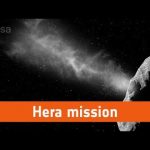
    Hera is the European contribution to an ESA-NASA double-spacecraft mission intended to test whether a kinetic deflection technique can be used to shift the orbit of an asteroid. The target of the mission is a double asteroid system, called Didymos, which will come a comparatively close 11 million km to Earth in 2022. The 800-m diameter main body is orbited by a 170-m moon, informally called ‘Didymoon’.

    In 2022 NASA’s DART spacecraft will first perform a kinetic impact on the smaller of the two bodies, then Hera will follow-up with a detailed post-impact survey that will turn this grand-scale experiment into a well-understood and repeatable planetary defence technique.

    Hera will also gather crucial scientific data on asteroids as a whole by carefully studying the exterior and interior properties of both bodies in the system. The spacecraft will also host two 6-unit cubesats that will be deployed near Didymos to perform, for the first time ever, multi-point measurements in a “mother-daughter” configuration. A novel intersatellite link will be used to establish a flexible communications network supporting the close-proximity operations in very low-gravity conditions, a crucial step for future exploration activities around small bodies.

    Hera, a further optimisation of ESA’s earlier proposed Asteroid Impact Mission, is currently in Phase B1 of mission development in preparation of the Agency’s Council of Ministers at European Level in late 2019.

    ★ Subscribe: http://bit.ly/ESAsubscribe

    Learn more: bit.ly/ESAHera