
Monday 2 November 2020 marks 20 years of continuous human presence on the International Space Station. Relive a few memorable moments from the unique orbital outpost in this clip covering 20 years of the International Space Station in 60 seconds.Since Crew One took up residence on 2 November, 240 people including 18 ESA astronauts have lived and worked on the orbital outpost, carrying out essential research to benefit life on Earth.The next ESA mission to the International Space Station is set for 2021, when Thomas Pesquet will become the first European to fly on a SpaceX Crew Dragon spacecraft for his Alpha mission.
Tag: Astronauts working
-
Pangaea 2016: Taking astronauts to other planets – on Earth
ESA is now training astronauts in identifying planetary geological features for future missions to the Moon, Mars and asteroids. This Pangaea course – named after the ancient supercontinent – will help astronauts to find interesting rock samples as well as to assess the most likely places to find traces of life on other planets.
This video was made during the second part of the Pangaea course held in Lanzarote, one of the Spanish Canary Islands in 2016 with ESA astronauts Luca Parmitano, Pedro Duque and Matthias Maurer and features interviews with the instructors and astronauts.
The students were tasked with interpreting geological features to understand the history of how the island formed. The goal is to help astronauts choose the best places to explore and collect rock samples.
This session put into practice a week’s training in Bressanone, Italy, where they learned about Earth and planetary geological processes as well as how to recognise rocks and meteorites.
The trio went on progressively difficult day trips, ending with a free exploration of the countryside searching for interesting samples while keeping in contact via radio with scientists at ‘mission control’.
Lanzarote was chosen for this course because of its geological similarity with Mars, such as a volcanic origin, mild sedimentary processes owing to a dry climate, hardly any vegetation and a well-preserved landscape.
More about the Pangeae course:
http://blogs.esa.int/caves/ -

ESA Euronews: Canada’s robot masters
Robots are an essential companion to mankind in space, and many of the modern-day masters of these robots are to be found in Montreal, home to the Canadian Space Agency.
Euronews Space has unique access to the team, among them operations engineer Mathieu Caron, who can steer the Canadarm 2 directly from his control room, or instruct astronauts piloting it in space.
This video is available in the following languages:
English https://www.youtube.com/watch?v=VizQJUAmegQ
German https://www.youtube.com/watch?v=y2ES9dggnjs
French https://www.youtube.com/watch?v=HA110F9db2g
Italian https://www.youtube.com/watch?v=4NGg1hv6RIE
Spanish https://www.youtube.com/watch?v=WzGZHJBFdH4
Portuguese https://www.youtube.com/watch?v=TeFFCzIZaa8
Hungarian https://www.youtube.com/watch?v=cKjQhvKb5_M
Greek https://www.youtube.com/watch?v=bUqP2swWllE -
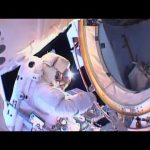
Tim’s spacewalk highlights
On 15 January ESA astronaut Tim Peake and NASA astronaut Tim Kopra stepped outside of the International Space Station to replace a failed power regulator and install cabling.
The meticulously planned and executed sortie was stopped early after Tim Kopra reported a small amount of water building up in his helmet. The two Tims worked in close cooperation with each other to return to the Space Station, with NASA commander Scott Kelly and cosmonaut Sergei Volkov waiting inside to help them out of their suits.
They left the confines of the weightless research laboratory at 12:48 GMT after their five-hour preparations to don their spacesuits and purge their bodies of nitrogen to avoid decompression sickness.
Tim Kopra went first to the far end of the Station’s starboard truss, with Tim Peake following with the replacement Sequential Shunt Unit. Swapping the suitcase-sized box was a relatively simple task but one that needed to be done safely while the clock was ticking.
With their main task complete, the Tims separated for individual jobs for the remainder of their time outside but was told by Mission Control to return to the airlock earlier than planned.
The 4 hour 43 minute spacewalk was the first for a British astronaut. The spacewalk officially ended at 17:31 GMT when the Tims began the repressurisation of the Quest airlock.