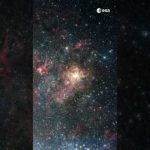
This video takes the viewer on a journey that zooms through space to reveal the Tarantula Nebula.
Thousands of never-before-seen young stars are spotted in the stellar nursery called 30 Doradus, captured by the NASA/ESA/CSA James Webb Space Telescope. It is nicknamed the Tarantula Nebula for the appearance of its dusty filaments in previous telescope images, the nebula has long been a favourite for astronomers studying star formation. In addition to young stars, Webb reveals distant background galaxies, as well as the detailed structure and composition of the nebula’s gas and dust.
Credit: NASA, ESA, CSA, STScI, ESO, E. Slawik, N. Risinger, D. De Martin, D. Lennon, E. Sabbi, N. Bartmann, M. Zamani Music: tonelabs – Happy Hubble
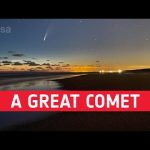
Discovered in March 2020, Comet NEOWISE became visible to the naked eye in July, gifting observers in the northern hemisphere with one of the most scenic comets in over 20 years. The comet, which is on an almost parabolic orbit and had its closest approach to the Sun, or perihelion, in early July, reaches its closest point to Earth on 22–23 July, before zipping back towards the outer Solar System.
In this video, ESA Research Fellows Rachana Bhatawdekar and Sandor Kruk share their experience and explain how to observe and image the comet in the sky. Next, ESA Research Fellow Charlotte Götz tells us more about comets and their tails, and how ESA’s future Comet Interceptor mission, to be launched in 2028, is going to wait for such a ‘great’ comet that has not been discovered yet. The spacecraft will sit in a parking orbit around the Lagrange point L2, 1.5 million kilometres away from Earth, until an interesting ‘pristine’ comet visits the inner Solar System. It will then intersect the comet’s orbit to study its nucleus, gases, dust, and plasma environment.
Jump to the different segments of the video: 00:00 – 1:22 – How to see comet NEOWISE 1:23 – 2:42 – How to take a picture of comet NEOWISE 2:43 – 6:17 – Comets and Comet Interceptor
Image credits: Rachana Bhatawdekar, Sandor Kruk, Mark McCaughrean, Kai Noeske (2020) Thumbnail image: Courtesy Mark McCaughrean, 12 July 2020 (Wassenaar, The Netherlands)
★ Subscribe: http://bit.ly/ESAsubscribe and click twice on the bell button to receive our notifications.
We are Europe’s gateway to space. Our mission is to shape the development of Europe’s space capability and ensure that investment in space continues to deliver benefits to the citizens of Europe and the world. Check out http://www.esa.int/ESA to get up to speed on everything space related.