🚩 After a string of victories, Charles XII of Sweden decided to take the war to Russia. If successful in reducing Peter the Great’s army, the Swedes would likely take Russian cities of Pskov, Novgorod, and possibly Arkhangelsk. Charles XII would also likely gain control over Courland and Polish Livonia, as well as becoming protector of Poland. In return Poland would receive territories lost to the Russian in the latter half of the 17th century.
📚 Sources: Konstam, Angus Poltava 1709: Russia Comes of Age 17 Oct,1994 Osprey Publishing Englund, Peter The Battle that Shook Europe: Poltava and the Birth of the Russian Empire 15 Apr, 2013 I.B Tauris
NASA is on a Journey to Mars and commercial space is a key component of our strategy to send American astronauts to the Red Planet in the 2030s.
In 2010 when President Obama laid out his vision for space exploration, it may have been hard to believe that six years later we’d be regularly transporting cargo to the International Space Station on commercial spacecraft, or that we’d be on the verge of returning launches of American astronauts to the Station from U.S. soil on the spacecraft built by American companies.
Today, that’s our reality.
SpaceX and Orbital ATK are the first commercial space companies to deliver cargo to the ISS.
We’ve also ordered the first missions from SpaceX and The Boeing Company — the first American companies that will carry American astronauts to space. The first astronauts are now training for test flights aboard commercial spacecraft in preparation for those missions.
We are closer than ever before to sending American astronauts to Mars. We’re “insourcing” American jobs and empowering American entrepreneurs and innovators to expand the new commercial market in low-earth orbit.
Today, we’re marking another significant milestone. We are announcing the companies that will continue our successful commercial cargo program until at least 2024. This phase of the program will allow us to continue using the Space Station as our springboard to the rest of the solar system and a test bed for human health in space.
Our investment in commercial space is creating jobs and it’s bringing us closer to sending American astronauts to Mars. With the commercial cargo successes to date and our announcement today – I am very confident that commercial space will continue to propel our nation into the future – we’ll continue to Launch America.
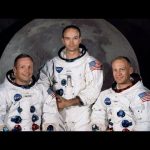
This month, our nation will mark the 45th anniversary of the Apollo 11 landing on the moon – a remarkable American accomplishment and a “giant leap” for humankind. Today, at NASA, we’re working on the next giant leap – a human mission to Mars, standing on the shoulders of astronauts Neil Armstrong, Buzz Aldrin and Michael Collins.
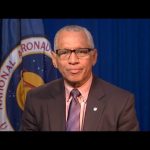
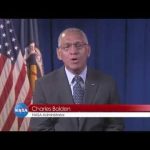
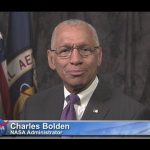
As I near the end of my fifth year as NASA administrator, I take great pride in the many amazing things our nation’s space program continues to accomplish. From an incredible five Earth science missions heading to space this year, to the first flight test of the Orion spacecraft that will one day carry astronauts to Mars and the continued success of our commercial partners in their missions to the International Space Station (ISS), we’re building on the Apollo program’s legacy to test and fly transformative, cutting-edge technologies today for tomorrow’s missions.
Around this 45th anniversary, we look ahead on our path to Mars and the milestones within our grasp. We’re treading that path with a stepping stone approach that takes the extraordinary work our crews have been doing aboard the Space Station for more than 13 years preparing us to travel farther into our solar system. Technology drives exploration, and we’ll be testing new technologies in the proving ground of deep space on our mission to an asteroid, eventually becoming Earth independent as we reach Mars.
Just this past week we were pleased that one of our private sector partners, Orbital Sciences, once again successfully launched a cargo mission to the ISS from U.S. soil. Along with another commercial partner, SpaceX, they’ve demonstrated with their Cygnus and Dragon spacecraft, respectively, that American industry can help us reach low Earth orbit and create good jobs and value for NASA at the same time. Later this year, we plan to award commercial contracts for transporting our astronauts to space from American soil by 2017, ending our reliance on others to get into space and freeing up scarce resources to focus on our even bolder Mars mission.
Our science missions also continue to turn science fiction into science fact. Today in Washington, we are hosting a public event, “The Search for Life in the Universe,” about our work on one of the most fundamental questions in exploration, “Are we alone?” Top scientists will share insights on how close we are to answering that question, what we know today from NASA missions and what we may find out soon.
In September, MAVEN arrives at Mars to study the planet’s upper atmosphere even as Curiosity and Opportunity continue to rove the surface and help prepare us for human missions to the Red Planet. Next year New Horizons arrives at Pluto and the year after, Juno arrives at Jupiter, even as we prepare our next Great Observatory, the James Webb Space Telescope, for launch in 2018 to peer back at the oldest light in the cosmos.
You can see that today’s astronauts, scientists and engineers continue to be inspired by the Apollo 11 mission. I’m proud and privileged to head a space agency that is accomplishing so much today with the legacy of the Apollo 11 crew and the thousands of ground support personnel who facilitated their success. As the world’s leader in exploration, we have so much to look forward to in the coming years.
Below is a link to a video I recorded about my personal remembrances of the first moon landing. I’m sure every one of you who was old enough also remembers exactly where you were at the time.
In the spirit of this brave crew, we look forward to a new generation of NASA achievements in space.
ESA’s Mars500 crewmembers Diego Urbina and Romain Charles recorded 15 video diaries from all phases of their simulated mission to Mars, plus hundreds of photos and other video clips. Most of these are available on ESA’s Mars500 website (www.esa.int/Mars500), but here is a compilation of their YouTube videos.
Relive this great adventure with Romain and Diego!