Tag: charon

  • NASA | Charon at 40: The Discovery of Pluto’s Largest Moon

    NASA | Charon at 40: The Discovery of Pluto’s Largest Moon

    The largest of Pluto’s five moons, Charon, was discovered on June 22, 1978, by James Christy and Robert Harrington at the U.S. Naval Observatory in Flagstaff, Arizona.
    Read the story: https://www.nasa.gov/feature/charon-at-40-four-decades-of-discovery-on-pluto-s-largest-moon
    Charon was discovered only about six miles from where Pluto itself was discovered at Lowell Observatory. They weren’t even looking for satellites of Pluto – Christy, examining a series of grainy telescope images, trying to refine Pluto’s orbit around the Sun.

    Christy and others tell the story of this amazing scientific find, which fueled Pluto’s transformation from a telescopic dot into an actual planetary system – and a source of many discoveries to come.
  • New Horizons science update on This Week @NASA – July 24, 2015

    New Horizons science update on This Week @NASA – July 24, 2015

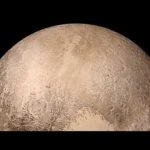
    A July 24 update at NASA headquarters, featured new surprising imagery and science results from the recent flyby of Pluto, by the New Horizons spacecraft. These included an image from the Long Range Reconnaissance Imager or (LORRI) – looking back at Pluto – hours after the historic flyby that revealed a haze in the planet’s sunlit atmosphere that extends as high as 80 miles above Pluto’s surface – much higher than expected. Models suggest that the hazes form when ultraviolet sunlight breaks apart methane gas. LORRI images also show evidence that exotic ices have flowed – and may still be flowing across Pluto’s surface, similar to glacial movement on Earth. This unpredicted sign of present-day geologic activity was detected in Sputnik Planum – an area in the western part of Pluto’s heart-shaped Tombaugh Regio. Additionally, new compositional data from New Horizons’ Ralph instrument indicate that the center of Sputnik Planum is rich in nitrogen, carbon monoxide, and methane ices. Also, Kepler discovers Earth’s “bigger cousin”, New crew launches to space station, EPIC view of Earth, Newman continues NASA center visits and Small Class Vehicle launch pad complete!