Tag: Come

  • What’s Gonna Come Out of these Beakers???

    What’s Gonna Come Out of these Beakers???

    What’s Steve doing now? ► https://linktr.ee/stevespangler
    For business inquiries, contact +1-855-228-8780 or steve@stevespangler.com

    This channel provides STEM ideas for classroom teachers and educators.

    Follow Steve’s Daily Posts on…
    INSTAGRAM ► https://www.instagram.com/stevespangler/
    FACEBOOK ► https://www.facebook.com/stevespangler
    TIKTOK ► https://www.tiktok.com/@stevespangler

    Other Channels…
    The Spangler Effect ► https://www.youtube.com/user/TheSpanglerEffect
    Spangler Science TV ► https://www.youtube.com/user/SpanglerScienceTV

    Watch Steve’s syndicated television series ► https://bit.ly/2KaO0fT
    Purchase Steve Spangler’s books at
    https://stevespangler.com/easy-science-experiments-stem-challenges-books/

    Steve Spangler is a bestselling author, STEM educator and Emmy award-winning television personality with more than 2,100 television appearances to his credit. Steve appeared as a regular guest on the Ellen DeGeneres Show from 2007-2022 (27 appearances).

    Learn more about Steve at https://stevespangler.com

    The SICK Science® series was created by Steve Spangler in 2008. For licensing inquiries, contact +1-855-228-8780 or steve@stevespangler.com

    © 2006 – 2025 Steve Spangler, Inc. All Rights Reserved.

  • Where Do Moons Come From? We Asked a NASA Scientist

    Where Do Moons Come From? We Asked a NASA Scientist

    Where do moons come from? From cataclysmic impacts to gravitational capture, NASA planetary scientist Joe Renaud walks us through some of the many theories of how the unique and captivating moons in our solar system came to be. https://solarsystem.nasa.gov/moons/overview/

    Producers: Scott Bednar, Jessica Wilde
    Editor: James Lucas

    Credit: NASA

  • Welcome Home Bob & Doug: Social Media Welcomes #LaunchAmerica Astronauts Home

    Welcome Home Bob & Doug: Social Media Welcomes #LaunchAmerica Astronauts Home

    NASA Astronauts Robert Behnken and Douglas Hurley splashed down in the Dragon Endeavour capsule at 2:48 p.m. EDT on Sunday, Aug. 2, off the coast of Pensacola, Florida.

    Demo-2 is SpaceX’s final test flight and is providing data on the performance of the Falcon 9 rocket, Crew Dragon spacecraft and ground systems, as well as in-orbit, docking, splashdown, and recovery operations. The data will inform NASA’s certification of the SpaceX crew transportation system for regular flights carrying astronauts to and from the space station. SpaceX is readying the hardware for the first rotational mission that will occur following NASA certification, which is expected to take about six weeks.

    Download Link: https://images.nasa.gov/details-NHQ_2020_0804_Welcome%20home%20Bob%20&%20Doug

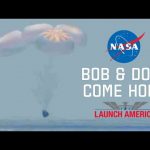
  • Splashdown Recap: Bob & Doug Come Home

    Splashdown Recap: Bob & Doug Come Home

    NASA Astronauts Robert Behnken and Douglas Hurley splashed down in the Dragon Endeavour capsule at 2:48 p.m. EDT on Sunday, Aug. 2, off the coast of Pensacola, Florida.

    The Crew Dragon hatch was opened at 3:59 p.m., and Behnken and Hurley exited the spacecraft onto the Go Navigator for initial medical checks before returning to shore by helicopter. Once returned to shore, both crew members will immediately board a waiting NASA plane to fly back to Ellington field in Houston.

    Hurley and Behnken arrived to the International Space Station May 31 and spent 62 days supporting science and research aboard the orbiting laboratory as part of Expedition 63.

    Demo-2 is SpaceX’s final test flight and is providing data on the performance of the Falcon 9 rocket, Crew Dragon spacecraft and ground systems, as well as in-orbit, docking, splashdown, and recovery operations. The data will inform NASA’s certification of the SpaceX crew transportation system for regular flights carrying astronauts to and from the space station. SpaceX is readying the hardware for the first rotational mission that will occur following NASA certification, which is expected to take about six weeks.

    Download link: https://images.nasa.gov/details-Splashdown%20Recap%20-%20Bob%20&%20Doug%20Come%20Home

  • How to come up with an idea for Mission Space Lab

    How to come up with an idea for Mission Space Lab

    For those looking for ideas for Mission Space Lab, this video offers some tips on how to come up with experiments by taking into account the AstroPi sensors available as well as some practical constraints.

    Learn more about Mission Space Lab: http://bit.ly/AstroPiESA

    ★ Subscribe: http://bit.ly/ESAsubscribe and click twice on the bell button to receive our notifications.

    Check out our full video catalog: http://bit.ly/SpaceInVideos
    Follow us on Twitter: http://bit.ly/ESAonTwitter
    On Facebook: http://bit.ly/ESAonFacebook
    On Instagram: http://bit.ly/ESAonInstagram
    On Flickr: http://bit.ly/ESAonFlickr

    We are Europe’s gateway to space. Our mission is to shape the development of Europe’s space capability and ensure that investment in space continues to deliver benefits to the citizens of Europe and the world. Check out http://www.esa.int/ESA to get up to speed on everything space related.

    Copyright information about our videos is available here: http://www.esa.int/spaceinvideos/Terms_and_Conditions

    #ESA
    #AstroPi
    #MissionSpaceLab

  • ESA Open Day, ESTEC, 2018

    ESA Open Day, ESTEC, 2018

    The date is fixed: you are invited to the annual ESA Open Day at ESTEC, ESA’s technical heart in the Netherlands, on Sunday, 7 October.

    The theme this year is ‘A voyage through space with Europe’. We’ll have all ESA establishments represented on site, either with speakers giving talks or live link-ups to the different centres. You’ll be able to meet astronauts, scientists and engineers, plus some special guests. You’ll see how we design space missions, how we develop the technologies needed to go into space and how we simulate space on the ground. With the help of our colleagues from the other ESA centres, we’ll complete the life-cycle of a mission and see how it is launched and controlled once in space!

    Find out more: http://bit.ly/ESAOpenDay2018

    ★ Subscribe: http://bit.ly/ESAsubscribe

  • ESOC: Where missions come alive

    ESOC: Where missions come alive

    ESOC – European Space Operations Centre 2017

    As a centre of excellence for mission operations since 1967, ESA’s ‘mission control’ delivers expertise and experience in a unique mix that serves the scientific and engineering goals of ESA, and enables economically vital European programmes like Copernicus and Galileo.

    ESOC is home to highly specialised teams who control and navigate spacecraft, manage ESA’s worldwide tracking station network, and build the ground systems that enable satellites to conduct their missions. Spacecraft flown from ESOC are studying our planet and helping us understand climate change through realtime Earth data, and are exploring our Sun and Solar System or peering deep into the mysteries of time and space.

    The centre is unique and unparalleled in its ability to control sophisticated probes, and to design, develop and build everything needed on ground to successfully fly satellites in space.

    Our world is about systems, communication and exploration; our passion is for humanity’s voyages into the Universe.

    In 2017, ESOC celebrates its 50th anniversary #esoc50
    http://www.esa.int/esoc
    http://www.esa.int/esoc50

    This video is also available in the following languages:
    German: https://www.youtube.com/watch?v=Tl4W91VF_SM />French: https://www.youtube.com/watch?v=8-VHgc6kWMQ