Tag: Comet 67P/Churyumov–Gerasimenko

  • Latest from Rosetta

    Latest from Rosetta

    Three years after the Rosetta mission officially ended in 2016, scientists met at ESA’s ESTEC facility in The Netherlands to discuss the latest findings at the final Science Working Team (SWT) meeting.

    From the launch in 2004, to its arrival at comet 67P in 2014, Rosetta has been an emotional and inspiring mission. Its findings have furthered our understanding of comets and changed our perceptions of how the Solar System formed.

    The mission produced an enormous amount of data which will keep many scientists busy for years. The OSIRIS camera, for example, took 100 000 images. These are archived – with the analysis of images recently providing further insight into the comet’s activity.

    Rosetta’s legacy of cometary science and data is not just continuing to produce more work, however, it’s also inspiring the next generation of scientists. Some began working on Rosetta as students and are now taking their experience forward onto ESA’s future Comet Interceptor mission.

    Further insight into the comet’s activity: http://bit.ly/CometCollapsingCliffsAndBouncingBoulders

    ★ Subscribe: http://bit.ly/ESAsubscribe and click twice on the bell button to receive our notifications.

    Check out our full video catalog: http://bit.ly/SpaceInVideos
    Follow us on Twitter: http://bit.ly/ESAonTwitter
    On Facebook: http://bit.ly/ESAonFacebook
    On Instagram: http://bit.ly/ESAonInstagram
    On Flickr: http://bit.ly/ESAonFlickr

    We are Europe’s gateway to space. Our mission is to shape the development of Europe’s space capability and ensure that investment in space continues to deliver benefits to the citizens of Europe and the world. Check out http://www.esa.int/ESA to get up to speed on everything space related.

    Copyright information about our videos is available here: http://www.esa.int/spaceinvideos/Terms_and_Conditions

    #ESA
    #Rosetta
    #SpaceExploration

  • Rosetta: the story continues

    Rosetta: the story continues

    This short movie shares an impression of some of the scientific highlights from Rosetta’s mission at Comet 67P/Churyumov–Gerasimenko, as told through the voices of scientists working with Rosetta’s vast dataset, two years after the mission ended.

    Rosetta launched in 2004 and travelled for ten years to its destination before deploying the lander Philae to the comet’s surface. Following the comet along its orbit around the Sun, Rosetta studied the comet’s surface changes, its dusty, gassy environment and its interaction with the solar wind. Even though scientific operations concluded in September 2016 with Rosetta’s own descent to the comet’s surface, analysis of the mission’s data will continue for decades.

    Credits: This is an ESA Web TV production. The video contains artist impressions of the spacecraft (credit: ESA/ATG medialab) and animations/infographics by ESA. Images of the comet are from Rosetta’s OSIRIS and NAVCAM cameras, as well as Philae’s CIVA camera (credits: ESA/Rosetta/MPS for OSIRIS Team MPS/UPD/LAM/IAA/SSO/INTA/UPM/DASP/IDA – CC BY SA 4.0; ESA/Rosetta/NavCam – CC BY-SA IGO 3.0; ESA/Rosetta/Philae/CIVA). Ground-based images were provided by Colin Snodgrass/Alan Fitzsimmons/Liverpool Telescope. The plasma visualisation is based on modelling and simulation by Technische Universität Braunschweig and Deutsches Zentrum für Luft- und Raumfahrt, and visualised by Zuse-Institut Berlin. The animation of Philae’s flight across the surface is based on data from Philae’s ROMAP, RPC-MAG, OSIRIS, ROLIS, CIVA CONSERT, SESAME and MUPUS instrument teams, the Lander Control Centre at DLR and the Science Operation and Navigation Center at CNES.

    Learn more about #Rosetta: http://bit.ly/RosettaMissionESA

    ★ Subscribe: http://bit.ly/ESAsubscribe

    Check out our full video catalog: http://bit.ly/SpaceInVideos
    Follow ESA on Twitter: http://bit.ly/ESAonTwitter
    On Facebook: http://bit.ly/ESAonFacebook
    On Instagram: http://bit.ly/ESAonInstagram
    On Flickr: http://bit.ly/ESAonFlickr

    ESA is Europe’s gateway to space. Our mission is to shape the development of Europe’s space capability and ensure that investment in space continues to deliver benefits to the citizens of Europe and the world. Check out http://www.esa.int/ESA to get up to speed on everything space related.

    Copyright information about our videos is available here: http://www.esa.int/spaceinvideos/Terms_and_Conditions

  • Philae facing eternal hibernation

    Philae facing eternal hibernation

    15 months after Philae made its historic landing on a comet, its legacy is enormous even if Rosetta’s lander is facing eternal hibernation.

    Mission teams are now looking ahead to the grand finale: making a controlled impact of the Rosetta orbiter on the comet next September.Rosetta arrived at Comet 67P/Churyumov–Gerasimenko on 6 August 2014 and Philae was delivered to the surface on 12 November. After touching down Philae bounced several times and completed 80% of its planned first science sequence before falling into hibernation. 

    A contact was made with the lander on 13 June and intermittent contacts were made up to 9 July. However the results of Philae mission are unique and complement all the science harvested by the orbiter Rosetta who is continuing its quest before being sent directly to the surface of 69P late September.

  • Rosetta Philae landing: one year

    Rosetta Philae landing: one year

    It’s been an extraordinary year for the Rosetta comet mission since Philae landed on the surface of Comet 67P/Churyumov-Gerasimenko on 12 November 2014.

    Continual data from the orbiter, together with information collected over several days from the lander, is providing a comprehensive picture of a remnant from our Solar System.

    This film covers the most recent science news from the Rosetta mission, as well as selected scientific highlights from the last year. It includes the comet’s unusual surface terrace structure, its formation from two colliding objects producing the unusual rubber duck shape, how water is transported from inside the comet towards the surface, and the surprising detection of molecular oxygen – familiar on Earth but not on a comet.

    Find out more about the Rosetta mission: http://rosetta.esa.int/

  • Once upon a time… #cometlanding

    Once upon a time… #cometlanding

    Rosetta and Philae were ready for their biggest challenge yet: landing on Comet 67P/Churyumov-Gerasimenko. As Rosetta bid her lander farewell and sent him to the comet’s surface, the whole world looked on, anxious to see what would happen next…

    This video is also available in the following languages:
    German: http://youtu.be/zo00t_DloWo
    Spanish: http://youtu.be/f5OIme-pCZY
    Italian: http://youtu.be/DdTJItbD_4M
    French: http://youtu.be/r3HbauwhdTY

    Previous videos in the series are available in this playlist:
    https://www.youtube.com/playlist?list=PLbyvawxScNbui_Ncl9uQ_fXLOjS4sNSd8

    Credits: ESA

  • Journey to a comet and science on the surface

    Journey to a comet and science on the surface

    Rosetta’s deployment of Philae to land on Comet 67P/Churyumov–Gerasimenko.

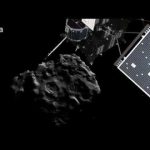
    The animation begins with Philae still on Rosetta, which will come to within about 22.5 km of the centre of the nucleus to release the lander on 12 November 2014.

    The animation then shows Philae being ejected by Rosetta and deploying its own three legs, and follows the lander’s descent until it reaches the target site on the comet about seven hours later.

    The animation is speeded up, but the comet rotation is true: in the time it takes for Philae to descend, the nucleus has rotated by more than 180º (the comet’s rotation period is 12.4 hours).

    The final steps of Philae’s descent towards the comet are shown as seen by a hypothetical observer close to the landing site on the comet.

    Finally, the animation shows Philae landing on the comet.

    Because of the comet’s extremely low gravity, landing gear will absorb the small forces of landing while ice screws in the probe’s feet and a harpoon system will lock the probe to the surface. At the same time a thruster on top of the lander will push it down to counteract the impulse of the harpoon imparted in the opposite direction. Once it is anchored to the comet, the lander will begin its primary science mission, based on its 64-hour initial battery lifetime. The animation shows a number of the science instruments in action on the surface.

    Acknowledgement: The background image of the sequence showing Philae closing in on the landing site was taken by Rosetta’s OSIRIS narrow-angle camera (ESA/Rosetta/MPS for OSIRIS Team MPS/UPD/LAM/IAA/SSO/INTA/UPM/DASP/IDA) on 14 September 2014 from a distance of about 30 km.

    Philae was provided by a consortium led by DLR, MPS, CNES and ASI.

    Credit: ESA/ATG medialab

  • Journey to the surface of a comet

    Journey to the surface of a comet

    Rosetta’s deployment of Philae to land on Comet 67P/Churyumov–Gerasimenko.

    The animation begins with Philae still on Rosetta, which will come to within about 22.5 km of the centre of the nucleus to release the lander on 12 November 2014.

    The animation then shows Philae being ejected by Rosetta and deploying its own three legs, and follows the lander’s descent until it reaches the target site on the comet about seven hours later.

    The animation is speeded up, but the comet rotation is true: in the time it takes for Philae to descend, the nucleus has rotated by more than 180º (the comet’s rotation period is 12.4 hours).

    The final steps of Philae’s descent towards the comet are shown as seen by a hypothetical observer close to the landing site on the comet.

    Acknowledgement: The background image of the sequence showing Philae closing in on the landing site was taken by Rosetta’s OSIRIS narrow-angle camera (ESA/Rosetta/MPS for OSIRIS Team MPS/UPD/LAM/IAA/SSO/INTA/UPM/DASP/IDA) on 14 September 2014 from a distance of about 30 km.

    Philae was provided by a consortium led by DLR, MPS, CNES and ASI.

    Credit: ESA/ATG medialab

  • Philae’s descent: closing in on the landing site

    Philae’s descent: closing in on the landing site

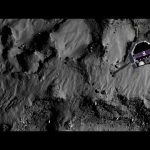
    The final steps of Philae’s descent towards Comet 67P/Churyumov–Gerasimenko on 12 November 2014, as seen by a hypothetical observer close to the landing site on the comet.

    The background image was taken by Rosetta’s OSIRIS narrow-angle camera on 14 September 2014 from a distance of about 30 km.

    Philae was provided by a consortium led by DLR, MPS, CNES and ASI.

    Credit: ESA/ATG medialab; background image: ESA/Rosetta/MPS for OSIRIS Team MPS/UPD/LAM/IAA/SSO/INTA/UPM/DASP/IDA

  • Rosetta — the story so far

    Rosetta — the story so far

    This short movie tells the story of Rosetta’s journey through the Solar System so far, through the voices of some of the many people involved in this exciting mission. ESA’s Rosetta spacecraft launched in March 2004 and has since been chasing down comet 67P/Churyumov-Gerasimenko, where it will become the first space mission to orbit a comet, the first to attempt a landing on a comet’s surface, and the first to follow a comet as it swings around the Sun. In the last ten years Rosetta has made 3 flybys of Earth and 1 of Mars, and passed by and imaged asteroids Steins and Lutetia. Operating on solar energy alone, in June 2011 Rosetta was placed into deep space hibernation as it cruised nearly 800 million kilometres from the warmth of the Sun, close to the orbit of Jupiter. On 20 January, Rosetta will wake up at 673 million kilometres from the Sun and about 9 million km from the comet, ready for the next leg of its epic adventure.

    Credits: ESA

  • How Rosetta wakes up from deep space hibernation

    How Rosetta wakes up from deep space hibernation

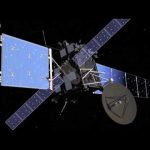
    Visualisation of how the Rosetta spacecraft wakes up from deep space hibernation, 673 million kilometres from the Sun, on 20 January 2014.

    Prior to entering hibernation on 8 June 2011, Rosetta was oriented so that its solar arrays faced the Sun, and it began rotating once per minute for stability. The only devices left running were its computer and several heaters.

    Rosetta’s computer is programmed to carry out a sequence of events to re-establish contact with the Earth on 20 January, starting with an ‘alarm clock’ at 10:00 GMT. Immediately after, the star trackers begin to warm up. Around 6 hours later the thrusters are fired and the slow rotation stops. A slight adjustment is made to Rosetta’s orientation to ensure that the solar arrays now face the Sun. Then the star trackers switch on to determine its attitude. The spacecraft rotates towards Earth, and the transmitter is switched on. Then Rosetta’s high-gain antenna points to Earth and the signal is sent. The journey takes 45 minutes before the signal is received and mission controllers can begin to check Rosetta’s health, ready for the next phase of the mission.

    The first opportunity for receiving a signal on Earth is between 17:30 GMT and 18:30 GMT.

    Credits: ESA/ATG medialab; music: B. Lynne.