Tag: Deep

  • Euclid’s first deep dive into the Universe

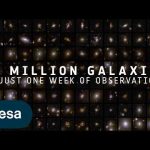
    Euclid’s first deep dive into the Universe

    The European Space Agency’s Euclid space telescope mission has scouted out the three areas in the sky where it will eventually provide the deepest observations of its mission.

    In just one week of observations, with one scan of each region so far, Euclid already spotted 26 million galaxies. The farthest of those are up to 10.5 billion light-years away.

    In the coming years, Euclid will pass over these three regions tens of times, capturing many more faraway galaxies, making these fields truly ‘deep’ by the end of the nominal mission in 2030.

    The first glimpse of 63 square degrees of the sky, the equivalent area of more than 300 times the full Moon, already gives an impressive preview of the scale of Euclid’s grand cosmic atlas when the mission is complete. This atlas will cover one-third of the entire sky – 14 000 square degrees – in this high-quality detail.

    Explore the three deep field previews in ESASky:

    – Euclid Deep Field South: https://sky.esa.int/esasky/?hide_welcome=true&hide_banner_info=true&hips=DES-DR2+ColorIRG&sci=false&layout=esasky&euclid_image=EDFS

    – Euclid Deep Field Fornax: https://sky.esa.int/esasky/?target=202.469575%2047.195258333333335&hips=DSS2+color&fov=1&projection=TAN&cooframe=J2000&sci=false&lang=en&layout=esasky />
    – Euclid Deep Field North:
    https://sky.esa.int/esasky/?target=202.469575%2047.195258333333335&hips=PanSTARRS+DR1+color+(i%2C+r%2C+g)&fov=1&projection=TAN&cooframe=J2000&sci=false&lang=en&layout=esasky />
    Read more:
    https://www.esa.int/Science_Exploration/Space_Science/Euclid/Euclid_opens_data_treasure_trove_offers_glimpse_of_deep_fields

    —————————————————
    Credits: ESA/Euclid/Euclid Consortium/NASA, image processing by J.-C. Cuillandre, E. Bertin, G. Anselmi, M. Walmsley, M. Huertas-Company; ESA/Gaia/DPAC; ESA/Planck Collaboration
    —————————————————

    ★ Subscribe: http://bit.ly/ESAsubscribe and click twice on the bell button to receive our notifications.

    Check out our full video catalog: http://bit.ly/SpaceInVideos
    Follow us on Twitter: http://bit.ly/ESAonTwitter
    On Facebook: http://bit.ly/ESAonFacebook
    On Instagram: http://bit.ly/ESAonInstagram
    On LinkedIn: https://bit.ly/ESAonLinkedIn
    On Pinterest: https://bit.ly/ESAonPinterest
    On Flickr: http://bit.ly/ESAonFlickr

    We are Europe’s gateway to space. Our mission is to shape the development of Europe’s space capability and ensure that investment in space continues to deliver benefits to the citizens of Europe and the world. Check out https://www.esa.int/ to get up to speed on everything space related.

    Copyright information about our videos is available here: https://www.esa.int/ESA_Multimedia/Terms_and_Conditions

    #ESA #Euclid #Space

  • Mars’ vast system of deep and steep valleys 🔴 #shorts

    Mars’ vast system of deep and steep valleys 🔴 #shorts

    Noctis Labyrinthus is vast system of deep and steep valleys that stretches out for around 1190 km, roughly the length of Italy here on Earth.

    It is nestled between the colossal martian ‘Grand Canyon’ (Valles Marineris) and the tallest volcanoes in the Solar System (the Tharsis region).

    The intense volcanism in the nearby Tharsis region is to blame for the formation of these features; this volcanism caused large areas of martian crust to arch upwards and become stretched and tectonically stressed, leading to it thinning out, faulting and subsiding.

    📹 ESA – European Space Agency
    🖥️ ESA/DLR/FU Berlin

    #ESA #Mars #Space

  • Deep Voice Gas – Sulfur Hexafluoride

    Deep Voice Gas – Sulfur Hexafluoride

    View More Experiments: https://stevespangler.com/experiments/

    Are you a teacher? Check out our 5E science lessons, escape rooms and my monthly LIVE professional development at https://lessons.keslerscience.com/courses/skwelcome-gift-bundle?ref=32f838 />
    The SICK Science series is created by Steve Spangler. © 2010 Steve Spangler, Inc. All Rights Reserved

    What’s Steve doing now? ► https://linktr.ee/stevespangler

    Watch Steve’s syndicated television series ► https://bit.ly/2KaO0fT

    Follow Steve’s Daily Posts on…

    INSTAGRAM ► https://www.instagram.com/stevespangler/
    FACEBOOK ► https://www.facebook.com/stevespangler
    TIKTOK ► https://www.tiktok.com/@stevespangler

    Steve Spangler is a bestselling author, STEM educator and Emmy award-winning television personality with more than 1,800 television appearances to his credit.

    Other Channels…

    The Spangler Effect ► https://www.youtube.com/user/TheSpanglerEffect
    Spangler Science TV ► https://www.youtube.com/user/SpanglerScienceTV

  • Ep. 18 Inteligența artificială & Proteinele || Google Deep Mind

    Ep. 18 Inteligența artificială & Proteinele || Google Deep Mind

    🔸 DEVINO MEMBRU ►https://bit.ly/35Q8vXC
    🔸 SPRIJINĂ ►https://patreon.com/cristianpresura
    🔸Distribuie pe Instagram! https://joinsnippet.com/

    ❗TikTok ► https://www.tiktok.com/@cristianpresura
    ❗Discord ► https://www.discord.gg/presura
    ❗Instagram ► https://www.instagram.com/cristianpresura/
    ❗Facebook ► https://www.facebook.com/presura
    ❗Facebook page ► https://www.facebook.com/pg/stiintaclub/posts/
    ❗Asociația “Știinta pentru toți” ► https://www.presura.ro

    Urmareste aici toata #seriacool din care acest video face parte:
    https://www.youtube.com/playlist?list=PLcod69NUBSYiWVp2QL98wG0hTZYO1JL7X
    Aceste videoclipuri sunt editate și conțin materiale precum animații/muzică realizate de Radu Ungureanu Grozea . ❗Instagram ► raduungureanu1996

    🔊 Spotify Podcast ► https://spoti.fi/3dbvYo6
    🔊 MixCloud Podcas ► https://www.mixcloud.com/StiintaClub/

    📙 Carte ► “O calatorie prin Univers”: https://bit.ly/3pdOfGp
    📙 Cartea ► “Fizica Povestita”: https://bit.ly/2YsKaAc
    📙 Carte ► “Care e diferența dintre un copil și un laptop?” https://bit.ly/3h4auLZ

  • Steve Spangler on The Ellen Show – Halloween – October 2010

    Steve Spangler on The Ellen Show – Halloween – October 2010

    Steve returns to The Ellen DeGeneres Show with some explosive experiments. You won’t believe your eyes when Steve makes a boat float on air, creates a giant wall of foam, and sets off a massive explosion with a bouquet of balloons!

    About Steve Spangler…

    Steve Spangler is a celebrity teacher, science toy designer, speaker, author and an Emmy award-winning television personality. Spangler is probably best known for his Mentos and Diet Coke geyser experiment that went viral in. Spangler is the founder of www.SteveSpanglerScience.com, a Denver-based company specializing in the creation of science toys, classroom science demonstrations, teacher resources and home for Spangler’s popular science experiment archive and video collection. Spangler is a frequent guest on the Ellen DeGeneres Show and Denver 9 News where he takes classroom science experiments to the extreme. For teachers, parents or DIY Science ideas – check out other sources of learning:

    Join the Science Club and check out other cool science experiments at – http://www.SteveSpanglerScience.com

    Sign up to receive a FREE Experiment of the Week- http://www.stevespanglerscience.com/experiment-of-the-week

    Attend a Spangler Hands-on Science Workshop for Teachers – http://www.stevespanglerscience.com/training

    Watch Steve on Local and National Media Appearances on YouTube at: https://www.youtube.com/user/SpanglerScienceTV

  • Sonification of a Hubble Deep Space Image

    Sonification of a Hubble Deep Space Image

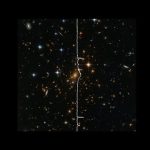
    Space becomes “sonified” in this visualization of a cluster of galaxies imaged by NASA’s Hubble Space Telescope. Time flows left to right, and the frequency of sound changes from bottom to top, ranging from 30 to 1,000 hertz. Objects near the bottom of the image produce lower notes, while those near the top produce higher ones. Most of the visible specks are galaxies housing countless stars. A few individual stars shine brightly in the foreground. Stars and compact galaxies create short, clear tones, while sprawling spiral galaxies emit longer notes that change pitch. The higher density of galaxies near the center of the image — the heart of this galaxy cluster, known as RXC J0142.9+4438 — results in a swell of mid-range tones halfway through the video. Hubble’s Advanced Camera for Surveys and Wide Field Camera 3 acquired this image on Aug. 13, 2018.

    Download this video:
    https://svs.gsfc.nasa.gov/cgi-bin/details.cgi?aid=13061

    Credit: NASA/Hubble/SYSTEM Sounds (Matt Russo/Andrew Santaguida)

  • AI vs Machine Learning vs Deep Learning | Machine Learning Training with Python | Edureka

    AI vs Machine Learning vs Deep Learning | Machine Learning Training with Python | Edureka

    🔥 NIT Warangal Post Graduate Program on AI and Machine Learning: https://www.edureka.co/nitw-ai-ml-pgp
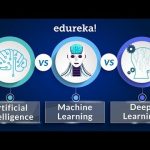
    This Edureka Machine Learning tutorial (Machine Learning Tutorial with Python Blog: https://goo.gl/fe7ykh ) on “AI vs Machine Learning vs Deep Learning” talks about the differences and relationship between AL, Machine Learning and Deep Learning. Below are the topics covered in this tutorial:

    1. AI vs Machine Learning vs Deep Learning
    2. What is Artificial Intelligence?
    3. Example of Artificial Intelligence
    4. What is Machine Learning?
    5. Example of Machine Learning
    6. What is Deep Learning?
    7. Example of Deep Learning
    8. Machine Learning vs Deep Learning

    Machine Learning Tutorial Playlist: https://goo.gl/UxjTxm

    – – – – – – – – – – – – – – – – –

    Subscribe to our channel to get video updates. Hit the subscribe button above: https://goo.gl/6ohpTV

    Instagram: https://www.instagram.com/edureka_learning
    Facebook: https://www.facebook.com/edurekaIN/
    Twitter: https://twitter.com/edurekain
    LinkedIn: https://www.linkedin.com/company/edureka
    Telegram: https://t.me/edurekaupdates

    – – – – – – – – – – – – – – – – –

    #edureka #AIvsMLvsDL #PythonTutorial #PythonMachineLearning #PythonTraining

    How it Works?
    1. This is a 5 Week Instructor led Online Course,40 hours of assignment and 20 hours of project work
    2. We have a 24×7 One-on-One LIVE Technical Support to help you with any problems you might face or any clarifications you may require during the course.
    3. At the end of the training you will be working on a real time project for which we will provide you a Grade and a Verifiable Certificate!

    – – – – – – – – – – – – – – – – –

    About the Course

    Edureka’s Python Online Certification Training will make you an expert in Python programming. It will also help you learn Python the Big data way with integration of Machine learning, Pig, Hive and Web Scraping through beautiful soup. During our Python Certification training, our instructors will help you:

    1. Master the Basic and Advanced Concepts of Python
    2. Understand Python Scripts on UNIX/Windows, Python Editors and IDEs
    3. Master the Concepts of Sequences and File operations
    4. Learn how to use and create functions, sorting different elements, Lambda function, error handling techniques and Regular expressions ans using modules in Python
    5. Gain expertise in machine learning using Python and build a Real Life Machine Learning application
    6. Understand the supervised and unsupervised learning and concepts of Scikit-Learn
    7. Master the concepts of MapReduce in Hadoop
    8. Learn to write Complex MapReduce programs
    9. Understand what is PIG and HIVE, Streaming feature in Hadoop, MapReduce job running with Python
    10. Implementing a PIG UDF in Python, Writing a HIVE UDF in Python, Pydoop and/Or MRjob Basics
    11. Master the concepts of Web scraping in Python
    12. Work on a Real Life Project on Big Data Analytics using Python and gain Hands on Project Experience
    – – – – – – – – – – – – – – – – – – –

    Why learn Python?

    Programmers love Python because of how fast and easy it is to use. Python cuts development time in half with its simple to read syntax and easy compilation feature. Debugging your programs is a breeze in Python with its built in debugger. Using Python makes Programmers more productive and their programs ultimately better. Python continues to be a favorite option for data scientists who use it for building and using Machine learning applications and other scientific computations.
    Python runs on Windows, Linux/Unix, Mac OS and has been ported to Java and .NET virtual machines. Python is free to use, even for the commercial products, because of its OSI-approved open source license.
    Python has evolved as the most preferred Language for Data Analytics and the increasing search trends on python also indicates that Python is the next “Big Thing” and a must for Professionals in the Data Analytics domain.

    For more information, please write back to us at sales@edureka.co or call us at IND: 9606058406 / US: 18338555775 (toll-free).

    Customer Review

    Sairaam Varadarajan, Data Evangelist at Medtronic, Tempe, Arizona: “I took Big Data and Hadoop / Python course and I am planning to take Apache Mahout thus becoming the “customer of Edureka!”. Instructors are knowledge… able and interactive in teaching. The sessions are well structured with a proper content in helping us to dive into Big Data / Python. Most of the online courses are free, edureka charges a minimal amount. Its acceptable for their hard-work in tailoring – All new advanced courses and its specific usage in industry. I am confident that, no other website which have tailored the courses like Edureka. It will help for an immediate take-off in Data Science and Hadoop working.”

  • ExoMars/TGO Deep Space Hangout

    ExoMars/TGO Deep Space Hangout

    Google hangout with ExoMars mission experts for an update on the cruise to Mars, the crucial mid-course manoeuvre on 28 July and the upcoming preparations for the arrival phase. The hangout was held on 26 July at 16:00 CEST/14:00 GMT.

    Since launch on 14 March, ESA’s ExoMars Trace Gas Orbiter and the Schiaparelli landing demonstration module have been en route to the Red Planet.

    The hangout included mission updates and a live Q&A with ESA experts and scientists, focusing on the crucial milestones during the spacecraft’s seven-month cruise to the Red Planet.  

    The hangout was hosted by Daniel Scuka (ESA Spacecraft Operations Editor) who was joined by:

    ** Michel Denis – ExoMars Flight Director, ESOC
    ** Silvia Sangiorgi – ExoMars Deputy Spacecraft Operations Manager, ESOC
    ** Michael Khan – Mission Analyst, ESOC
    ** Ian Thomas – NOMAD (spectrometer) Project Manager, Royal Belgian Institute for Space Aeronomy

    Background info on #ExoMars :
    http://www.esa.int/Our_Activities/Space_Science/ExoMars
    http://www.esa.int/Our_Activities/Operations/ExoMars_TGO_operations

  • From Earth to Deep Space: NASA 2013 Highlights

    From Earth to Deep Space: NASA 2013 Highlights

    NASA highlights its accomplishments in air and space for 2013.

  • Tracking spacecraft deep across the void

    Tracking spacecraft deep across the void

    ESA operates some of the world’s most sophisticated deep-space tracking stations, enabling spacecraft to maintain contact with Earth while voyaging deep into our Solar System. The essential task of all ESA stations is to communicate with our missions, sending telecommands and receiving vital scientific data and spacecraft status information.

    The Agency’s three Deep Space Antenna (DSA) stations are located in Australia, Spain and Argentina, and are centrally controlled from the ESOC Operations Centre in Germany. They are equipped with large, 35 m-diameter parabolic dish reflectors, weighing in at 610 tonnes, that can be rotated and pointed with extreme accuracy.

    Using signal data from the stations and an advanced navigational technique known as ‘delta-DOR’, engineers can pinpoint the orbit of a spacecraft exploring Mars or Venus – a distance of over 100 million kilometres from Earth – to an accuracy within 1 kilometre.

  • Full orbit: How an astronaut will view Mars from orbit – with distance counter

    Full orbit: How an astronaut will view Mars from orbit – with distance counter

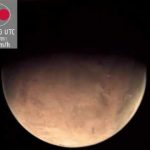
    This movie was generated from 600 individual still images captured by the Visual Monitoring Camera (VMC) on board Mars Express during the 8194th orbit on 27 May 2010 between 02:00 and 09:00 UTC (04:00-11:00 CEST) and were transmitted to Earth a few hours later via ESA’s 35m New Norcia deep space station in Australia.

    The portion of the movie where the planet beneath the spacecraft was dark has been largely removed since no detail was visible.

    The images show the spacecraft’s slow descent from high above the planet, speeding up as closest approach is passed and then slowing down again as the distance increases. Towards the start of the video, the giant Martian volcanoes can be seen followed by the beginning of the ice coverage around the South Pole as the spacecraft crosses over to the night side of the planet. Shortly after emerging back onto the day side of the planet, the beautiful North Pole can be observed, followed by the long climb away from the planet over the equator. Finally, at the end of the movie, the disk of Phobos can be seen crossing from top to bottom of the image.

    Credit: ESA – European Space Agency, CC BY-SA 3.0 IGO

    Copyright Notice:

    This work is licenced under the Creative Commons Attribution-ShareAlike 3.0 IGO (CC BY-SA 3.0 IGO) licence. The user is allowed to reproduce, distribute, adapt, translate and publicly perform this publication, without explicit permission, provided that the content is accompanied by an acknowledgement that the source is credited as ‘ESA/DLR/FU Berlin’, a direct link to the licence text is provided and that it is clearly indicated if changes were made to the original content. Adaptation/translation/derivatives must be distributed under the same licence terms as this publication. To view a copy of this license, please visit http://creativecommons.org/licenses/by-sa/3.0/igo/

  • Steve Spangler Show – Making Science Fun!

    Steve Spangler Show – Making Science Fun!

    Steve Spangler explains the secret to making science fun. Ignite your family’s love for learning and experimenting by watching more experiments at: http://www.stevespanglerscience.com/lab/experiments

    About Steve Spangler…

    Steve Spangler is a celebrity teacher, science toy designer, speaker, author and an Emmy award-winning television personality. Spangler is probably best known for his Mentos and Diet Coke geyser experiment that went viral in. Spangler is the founder of www.SteveSpanglerScience.com, a Denver-based company specializing in the creation of science toys, classroom science demonstrations, teacher resources and home for Spangler’s popular science experiment archive and video collection. Spangler is a frequent guest on the Ellen DeGeneres Show and Denver 9 News where he takes classroom science experiments to the extreme. For teachers, parents or DIY Science ideas – check out other sources of learning:

    Join the Science Club and check out other cool science experiments at – http://www.SteveSpanglerScience.com

    Sign up to receive a FREE Experiment of the Week- http://www.stevespanglerscience.com/experiment-of-the-week

    Attend a Spangler Hands-on Science Workshop for Teachers – http://www.stevespanglerscience.com/training

    Watch Steve on Local and National Media Appearances on YouTube at: https://www.youtube.com/user/SpanglerScienceTV