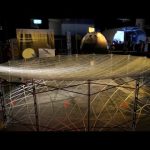
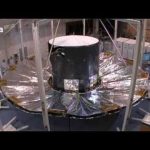
A 5 m-diameter antenna reflector, designed for orbital operations, seen during a test deployment during ESA’s latest Large Deployable Antenna Workshop.
Large-scale antenna reflectors are increasingly required for telecommunications, science and Earth observation missions.
This metal mesh reflector has a ‘double pantograph’ design to form a deployable ring. Once deployed it tensions two opposing, but connected, parabolic shaped nets, one on the top and one on the bottom.
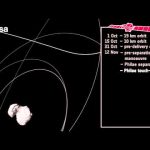
Animation showing Rosetta’s orbit in the lead up to, during and after lander separation.
The animation begins on 1 October 2014, when Rosetta is orbiting about 19 km from Comet 67P/Churyumov–Gerasimenko (all distances refer to the comet’s centre). The animation shows the transition to the close 10 km orbit by mid-October, and then the steps taken to move onto the pre-separation trajectory.
On the day of landing, 12 November, Rosetta makes a further manoeuvre 2–3 hours before separation to move to 22.5 km from the comet centre to deploy the lander, Philae. While Philae descends to the surface over a period of seven hours, Rosetta makes another manoeuvre to maintain visibility with the lander. A series of ‘relay phase’ manoeuvres then move Rosetta out to a distance of about 50 km, before moving first to a 30 km orbit and later to an orbit at about 20 km by early December.
The speed of the animation slows during the separation and lander phase to better highlight these events. The comet shape and rate of rotation is real – the comet rotates with a period of about 12.4 hours.
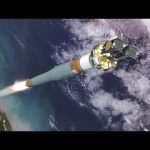
On 21 August, at 12:31 UTC/14:31 CEST, a Soyuz rocket will launch the fifth and six Galileo satellites from Europe’s Spaceport in Kourou, French Guiana.
These are the first ‘Full Operational Capability’ satellites for the deployment phase of Galileo, following the so-called ‘In Orbit Validation’ (IOV) phase, which allowed the European Space Agency to make sure that the design of the Galileo system provided its expected performance both in space and on the ground.
Now it is time to build the full Galileo constellation, allowing full deployment to take place, the IOV satellites having paved the way for this European navigation programme, the first civilian system with worldwide services.
This phase of the Galileo programme is being managed and funded by the European Commission, with ESA acting as design and procurement agent on behalf of the Commission.
This video recalls the success of the In Orbit Validation phase and explains what will be the mission of these fifth and sixth Galileo satellites.
It includes an interview with Sylvain Loddo, Galileo Ground Segment Manager.
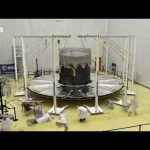
Time-lapse sequences from the deployment test of the Gaia Deployable Sunshield Assembly (DSA) on 10 October 2013, in the cleanroom at Europe’s spaceport in Kourou.
Since the DSA will operate in microgravity, it is not designed to support its own weight in the one-g environment at Earth’s surface. Therefore, during deployment testing on the ground, the DSA panels are attached to a system of support cables and counterweights that bears their weight, preventing damage and providing a realistic test environment.
Once in space, the sunshield has two purposes: to shade Gaia’s sensitive telescopes and cameras, and to provide power to operate the spacecraft. Gaia will always point away from the Sun, so the underside of the skirt is partially covered with solar panels to generate electricity.
Gaia Deployable Sunshield Assembly (DSA) integrated onto the spacecraft and undergoing deployment testing at Astrium Toulouse. Since the DSA will operate in microgravity, it is not designed to support its own weight in the one-g environment at Earth’s surface. During deployment testing, the DSA panels are attached to a system of support cables and counterweights that bears their weight, preventing damage and providing a realistic test environment. The support system is clearly visible in the video.
As the DSA deploys, the flight model thermal tent comes into view and the mechanically representative dummy payload can be seen through the aperture in the tent. Towards the end of the deployment sequence, the flight model service module comes into view.
This test demonstrated correctness of alignment following integration, confirmed the deployment functionality and verified the flatness of the deployed DSA.
The video shows an edited, time-lapse sequence from the deployment of the DSA during a test campaign; the entire deployment sequence takes about 20 minutes.