NASA astronauts Michael Barratt, Matthew Dominick, and Jeanette Epps and Roscosmos cosmonaut Alexander Grebenkin are returning to Earth after several months aboard the International Space Station conducting scientific experiments and technology demonstrations for the agency’s SpaceX Crew-8 mission.
ESA’s Euclid mission will create a 3D-map of the Universe that scientists will use to measure the properties of dark energy and dark matter and uncover the nature of these mysterious components. The map will contain a vast amount of data, it will cover more than a third of the sky and its third dimension will represent time spanning 10 billion years of cosmic history.
But dealing with the huge and detailed set of novel data that Euclid observations will produce is not an easy task. To prepare for this, scientists in the Euclid Consortium have developed one of the most accurate and comprehensive computer simulations of the large-scale structure of the Universe ever produced. They named this the Euclid Flagship simulation.
Running on large banks of advanced processors, computer simulations provide a unique laboratory to model the formation and evolution of large-scale structures in the Universe, such as galaxies, galaxy clusters, and the filamentary cosmic web they form. These state-of-the-art computational techniques allow astrophysicists to trace the motion and behavior of an extremely large number of dark-matter particles over cosmological volumes under the influence of their own gravitational pull. They replicate how and where galaxies form and grow, and are used to predict their distribution across the celestial sphere.
Explore the Euclid Flagship simulation in this video and get a sneak preview of the structure of the dark Universe, as we currently model it. New insights will be brought to you by the Euclid mission in the coming years.
Credits: ESA/Euclid Consortium/Cacao Cinema The authors kindly acknowledge the use of the Splotch package: http://www.mpa-garching.mpg.de/~kdolag/Splotch
★ Subscribe: http://bit.ly/ESAsubscribe and click twice on the bell button to receive our notifications.
We are Europe’s gateway to space. Our mission is to shape the development of Europe’s space capability and ensure that investment in space continues to deliver benefits to the citizens of Europe and the world. Check out https://www.esa.int/ to get up to speed on everything space related.
ESA’s Euclid mission is designed to explore the composition and evolution of the dark Universe. The space telescope will create a great map of the large-scale structure of the Universe across space and time by observing billions of galaxies out to 10 billion light-years, across more than a third of the sky. Euclid will explore how the Universe has expanded and how structure has formed over cosmic history, revealing more about the role of gravity and the nature of dark energy and dark matter.
Euclid is a fully European mission, built and operated by ESA, with contributions from NASA. The Euclid Consortium – consisting of more than 2000 scientists from 300 institutes in 13 European countries, the US, Canada and Japan – provided the scientific instruments and scientific data analysis. ESA selected Thales Alenia Space as prime contractor for the construction of the satellite and its Service Module, with Airbus Defence and Space chosen to develop the Payload Module, including the telescope. NASA provided the near-infrared detectors of the NISP instrument.
More about Euclid: esa.int/euclid
★ Subscribe: http://bit.ly/ESAsubscribe and click twice on the bell button to receive our notifications.
We are Europe’s gateway to space. Our mission is to shape the development of Europe’s space capability and ensure that investment in space continues to deliver benefits to the citizens of Europe and the world. Check out https://www.esa.int/ to get up to speed on everything space related.
What happens next for the new 2022 class of ESA astronauts? Which upcoming launch to a faraway planet and its moons is getting everyone excited? And which anniversary will we be celebrating on 12 March? Get all the answers and more in our new edition of Space Round Up, your news gateway to space.
We are Europe’s gateway to space. Our mission is to shape the development of Europe’s space capability and ensure that investment in space continues to deliver benefits to the citizens of Europe and the world. Check out https://www.esa.int/ to get up to speed on everything space related.
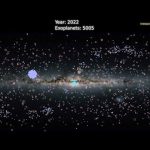
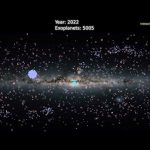
On March 21, 2022, the number of known exoplanets passed 5,000 according to the NASA Exoplanet Archive. This 360-degree animation and sonification tracks humanity’s discovery of the planets beyond our solar system over time. Turning NASA data into sounds allows users to hear the pace of discovery with additional information conveyed by the notes themselves.
As each exoplanet is discovered, a circle appears at its position in the sky. The size of the circle indicates the relative size of the planet’s orbit and the color indicates which planet detection method was used to discover it. The music is created by playing a note for each newly discovered world. The pitch of the note indicates the relative orbital period of the planet. Planets that take a longer time to orbit their stars are heard as lower notes, while planets that orbit more quickly are heard as higher notes.
Please note: Not all browsers support viewing 360 videos. YouTube supports their playback on computers using Chrome, Firefox, MS Edge, and Opera browsers. For the best experience on a mobile device, play this video in the YouTube app.
Credit: NASA/JPL-Caltech/M. Russo, A. Santaguida (SYSTEM Sounds)
On March 21, 2022, the number of known exoplanets passed 5,000 according to the NASA Exoplanet Archive. This animation and sonification tracks humanity’s discovery of the planets beyond our solar system over time. Turning NASA data into sounds allows users to hear the pace of discovery, with additional information conveyed by the notes themselves.
As each exoplanet is discovered, a circle appears at its position in the sky. The size of the circle indicates the relative size of the planet’s orbit and the color indicates which planet detection method was used to discover it. The music is created by playing a note for each newly discovered world. The pitch of the note indicates the relative orbital period of the planet. Planets that take a longer time to orbit their stars are heard as lower notes, while planets that orbit more quickly are heard as higher notes.
Credit: NASA/JPL-Caltech/M. Russo, A. Santaguida (SYSTEM Sounds)
Hubble makes an exoplanet discovery, the next space station crew gets ready to launch, and back to work in Florida after weathering the storm … a few of the stories to tell you about – This Week at NASA!
This video is available for download from NASA’s Image and Video Library: https://images.nasa.gov/details-NHQ_2019_0913_An%20Exoplanet%20Discovery%20from%20Hubble%20on%20This%20Week%20@NASA%20%E2%80%93%20September%2013,%202019.html
On Jan. 4, NASA announced the selection of two missions to explore previously unexplored asteroids. The first mission, called Lucy, will study asteroids, known as Trojan asteroids, trapped by Jupiter’s gravity. The Psyche mission will explore a very large and rare object in the solar system’s asteroid belt that’s made of metal, and scientists believe might be the exposed core of a planet that lost its rocky outer layers from a series of violent collisions. Lucy is targeted for launch in 2021 and Psyche in 2023. Both missions have the potential to open new windows on one of the earliest eras in the history of our solar system – a time less than 10 million years after the birth of our sun.
Experience what it’s like to leave Earth, traveling to over 90,000 feet into the stratosphere. Never before has a 360 video been recorded at these heights – so buckle up and enjoy the view as Seeker takes you on a journey to the Edge of Space.
Members of the CAVES 2013 crew talk about exploring inside the Sa Grutta cave – comparing their experience to arriving on the surface of a planet like Mars, where you don’t quite know what to expect.
CAVES, ESA’s unique training programme for astronauts, takes place over a couple of weeks in Sardinia’s Supramonte. Six astronauts spend two weeks deep in caves, in the dark and cold. They are separated from the outside world, doing scientific research and daily tasks together, as a group, just like in space. Moving in the cave system is also comparable to spacewalking with the use of harnesses and safety devices.
Read more about CAVES on our dedicated website (esa.int/caves) and read more about the CAVES 2013 campaign in the blog (blogs.esa.int/CAVES2013)
Space Shuttle Discovery, atop its Shuttle Carrier Aircraft, NASA 905, is shown from various vantage points around the National Capital region on April 17 on the final leg of its ferry flight from NASA’s Kennedy Space Center in Florida to Dulles International Airport in Virginia.
ESA has updated its application for iPhone and iPad.
With the launch of the ESA App V2, users can see ESA’s latest satellite imagery from Envisat in near-real time, complementing the latest news and discoveries in space exploration and Earth observation.
Making full use of the iPhone and iPad touch features, ESA App V2 puts videos, images, facts and figures, ESA’s Twitter feeds, YouTube links and other information in a convenient mobile package.
Download ESA App V2 here: http://itunes.apple.com/us/app/esa-european-space-agency/id441518639?mt=8
The ascent of space shuttle Discovery from NASA’s Kennedy Space Center on Feb. 24 is shown from a number of unique angles recorded by multiple engineering cameras situated at and around Launch Pad 39A.
A new target launch date has been selected for STS-133, allowing ample time for repairs to space shuttle Discovery. Also, NASA’s chief technologist and planetary science director were among more than 20 speakers featured at the second TEDxNASA conference in Newport News, Virginia. Hosted by the Langley Research Center, TEDx focused on education, innovation, family, technology, art and space travel. Plus, X-15 astronaut Joe Wagner joins Aerospace Hall of Fame; HQ Honor Awards; and Herrington helps celebrate American Indian & Alaska Native Heritage Month.
Space shuttle Discovery and seven astronauts ended a two-week journey of more than 6.2 million miles with a Tuesday morning landing at NASA’s Kennedy Space Center in Florida. Returning to Earth aboard the orbiter were STS-131 Commander Alan Poindexter, Pilot Jim Dutton, and Mission Specialists Stephanie Wilson, Rick Mastracchio, Clay Anderson, Dottie Metcalf-Lindenburger and Naoko Yamazaki of the Japan Aerospace Exploration Agency. The STS-131 mission to the International Space Station included three spacewalks, the installation of equipment outside the ISS, and the transfer of thousands of pounds of cargo and supplies from the orbiter’s payload bay to various locations on the station.
Highlights of ESA astronaut Christer Fuglesang’s 14-day Alissé mission to the International Space Station between 29 August and 12 September 2009. Fuglesang was part of the seven-strong STS-128 crew launched to the ISS with Space Shuttle Discovery. STS-128 delivered new supplies and equipment to the ISS. The crew also performed three spacewalks to continue Station construction.
Space Shuttle Discovery lands at Edwards Air Force Base, California, on 12 September concluding ESA astronaut Christer Fuglesang’s 14-day Alissé mission to the the International Space Station.
ESA astronauts Frank De Winne and Christer Fuglesang met up on the International Space Station in September 2009. Fuglesang was visiting the ISS during his 14-day Alissé mission. De Winne, on his six-month OasISS mission, was already on the ISS as part of the resident ISS Expedition 20 crew.
With seven astronauts and a host of experiments and equipment on board, space shuttle Discovery completed a flawless ascent into orbit Friday night to begin a two-day chase of the International Space Station. With Commander Rick “C.J. ” Sturckow at the controls, the shuttle lifted off on-time at 11:59 p.m. EDT from NASA’s Kennedy Space Center in Florida. The crew will rendezvous and dock with the station Sunday and the crew will begin transferring equipment to the outpost during the 13-day mission.
After flying up on Discovery, Nicole Stott will trade places with station resident Tim Kopra, who went into space last month aboard Endeavour. Equipment and science racks for the orbiting laboratory are riding inside the Leonardo cargo module, which is secured tightly inside Discovery’s payload bay. The module will be lifted out of Discovery and locked onto the station so the crew can transfer the gear efficiently. The treadmill named for comedian Stephen Colbert also is aboard Discovery and destined for the station.
After an epic space journey, the European Huygens probe landed on Saturn’s moon Titan, a mysterious satellite that has perplexed astronomers for decades. On 14 January 2005, Huygens made the farthest touchdown of any human-built object sent to land on another world.