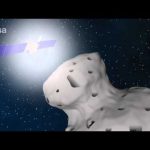
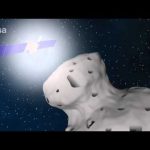
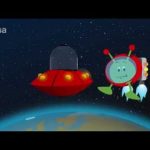
Volg Paxi tot de rand van onze zonnestelsel om een wereld van kometen te ontdekken, en te leren over de verbazingwekkende Rosetta missie naar de komeet 67P/Churyumov-Gerasimenko.
In deze video, met als doelgroep kinderen tussen de 6 en 12 jaar oud, neemt Paxi kinderen met hem mee om kometen en Rosetta te ontdekken, de verbazingwekkende ESA ruimtevaartuig die naast komeet 67P/Churyumov-Gerasimenko vliegt en op 12 November 2014 een poging zal doen om een lander te landen.
Deze video is de derde in een animatie serie waarin Paxi, de mascotte van ESA Education, verschillende aspecten van het zonnestelsel, het universum, de geheimen van planeet aarde, en nog veel meer zal toelichten.
Credit: ESA; produced by Science Office, illustrations by Kaleidoscope Design, NL
Ga mee met Paxi op een reis door onze zonnestelsel, van de rotsachtige planeten dichtbij de zon, voorbij de reuzenplaneten, tot de ijskoude rand waar kometen zich bevinden.
In deze video, met als doelgroep kinderen tussen de 6 en 12 jaar oud, neemt Paxi ons mee op een tour door ons zonnestelsel, waar we acht planeten zullen bezoeken en andere kleinere lichamen zoals asteroïden, kometen en de dwergplaneet Pluto.
Deze video is de tweede in een animatie serie waarin Paxi, de mascotte van ESA Education, verschillende aspecten van het zonnestelsel, het universum, de geheimen van planeet aarde, en nog veel meer zal toelichten.
Credit: ESA; produced by Science Office, illustrations by Kaleidoscope Design, NL
Sigue a Paxi hasta los confines del Sistema Solar para descubrir el mundo de los cometas y aprender sobre la asombrosa misión Rosetta hacia el cometa 67P/ Churyumov-Gerasimenko.
En este vídeo, destinado a niños de entre 6 y 12 años, Paxi se lleva a los niños con él a descubrir cometas y Rosetta, la asombrosa nave de la ESA que vuela junto al cometa 67P/ Churyumov-Gerasimenko al que intentará, el 12 de Noviembre 2014, aterrizar mediante un módulo de aterrizaje.
Este vídeo es el tercero de una serie de animaciones en las que Paxi, la mascota de la Oficina de Educación de la ESA, explica diferentes aspectos del Sistema Solar, el Universo, los secretos del planeta Tierra y mucho más.
Credit: ESA; produced by Science Office, illustrations by Kaleidoscope Design, NL
Únete a Paxi en su viaje a través de nuestro Sistema Solar, desde los planetas interiores rocosos cercanos al Sol, pasando por los planetas gigantes hasta los confines congelados, hogar de los cometas.
En este vídeo, destinado a niños de entre 6 y 12 años, Paxi nos lleva de viaje a través de nuestro Sistema Solar, visitando todos los ocho planetas y objetos menores como asteroides, cometas y el planeta enano Plutón.
Este vídeo es el segundo de una serie de animaciones en las que Paxi, la mascota de la Oficina de Educación de la ESA, explica diferentes aspectos del Sistema Solar, el Universo, los secretos del planeta Tierra y mucho más.
Credit: ESA; produced by Science Office, illustrations by Kaleidoscope Design, NL
Conoce a Paxi, la mascota de la Oficina de Educación de la ESA: de dónde viene, qué le gusta de los viajes espaciales, quienes son sus amigos…
Este video, destinado a niños de entre 6 y 12 años, presenta a Paxi, un pequeño alienígena que proviene del planeta Ally-O y que ha venido a la Tierra para hacer nuevos amigos en un viaje de exploración espacial lleno de aventuras. Este es el primero de una serie de animaciones en las que Paxi, la mascota de la Oficina de Educación de la ESA, explica diferentes aspectos del Sistema Solar, el Universo, los secretos del planeta Tierra y mucho más.
Credit: ESA; produced by Science Office, illustrations by Kaleidoscope Design, NL
This video is part of a series of educational videos that ESA is releasing based on the five visionaries that lent their name to Europe’s space freighters.
Jules Verne, Johannes Kepler, Edoardo Amaldi, Albert Einstein and Georges Lemaître form the inspiration to explain the principles of physics to young and older audiences.
Presented by Anu Ojha, this video offers a good basis to introduce schoolchildren and the general public to concepts of orbital mechanics.
Accompanying these videos are also a new set of resources that ESA education is producing: Teach with Space, a large set of demonstrations and teacher guides intended to bring the excitement of space into the classroom to inspire the next generation.
All it takes is a slight tug and the long string of beads literally pull itself out of the container and onto the floor. Best of all, fifty feet of beads empty from the container in under five seconds! How does it work?
Have you ever seen a blue flame? What about green or purple? When you’re expecting a regular flame, these colorful changes can be an incredible surprise! What you may not know is these spectacular colors result from the presence of specific metals. We’re going to show you a couple of household materials that contain metals that are easily identifiable during a Flame Test!
We’ve been performing the Mentos Soda Geyser here at Steve Spangler Science for years. We’ve launched so many geysers, in fact, that we created a tool to help streamline the process of creating the eruption. While the Geyser Tube is, hands-down, the best way to create a soda geyser that can be 30 feet tall, you might not be able to get your hands on one right away. So we’re going to teach you how to create a Homemade Geyser Tube with stuff you have at home.
This presentation is about a potential shortcut to artificial intelligence by trading mind-design for world-design using artificial evolution. Evolutionary algorithms are a pump for turning CPU cycles into brain designs. With exponentially increasing CPU cycles while our understanding of intelligence is almost a flat-line, the evolutionary route to AI is a centerpiece of most Kurzweilian singularity scenarios. This talk introduces the Polyworld artificial life simulator as well as results from our ongoing attempt to evolve artificial intelligence and further the Singularity.
Polyworld is the brain child of Apple Computer Distinguished Scientist Larry Yaeger, who remains the primary developer of Polyworld:
Speaker: Virgil Griffith
Virgil Griffith is a first year graduate student in Computation and Neural Systems at the California Institute of Technology. On weekdays he studies evolution, computational neuroscience, and artificial life. He did computer security work until his first year of university when his work got him sued for sedition and espionage. He then decided that security was probably not safest field to be in and he turned his life to science.
Steve Spangler teaches teachers, and people in general, how to create unforgettable learning experiences with humor and attention-grabbing science demonstrations. See Steve in action showing teachers how to be amazing with fun science demonstrations.
About Steve Spangler Science…
Steve Spangler is a celebrity teacher, science toy designer, speaker, author and an Emmy award-winning television personality. Spangler is probably best known for his Mentos and Diet Coke geyser experiment that went viral in 2005 and prompted more than 1,000 related YouTube videos. Spangler is the founder of www.SteveSpanglerScience.com, a Denver-based company specializing in the creation of science toys, classroom science demonstrations, teacher resources and home for Spangler’s popular science experiment archive and video collection. Spangler is a frequent guest on the Ellen DeGeneres Show where he takes classroom science experiments to the extreme. Check out his pool filled with 2,500 boxes of cornstarch!
On the education side, Spangler started his career as a science teacher in the Cherry Creek School district for 12 years. Today, Steve travels extensively training teachers in ways to make learning more engaging and fun. His hands-on science boot camps and summer institutes for teachers inspire and teach teachers how to prepare a new generation for an ever-changing work force. Over the last 15 years, he has also made more than 500 television appearances as an authority on hands-on science and inquiry-based learning.
On the business side, Spangler is the founder and CEO of Steve Spangler Science, a Denver-based company specializing in the creation of educational toys and kits and hands-on science training services for teachers. The companys unique business strategies and viral creations have been featured in the Wall Street Journal, Inc. Magazine, Wired and TIME Magazine where online readers voted Steve Spangler #18 in the Top 100 Most Influential People of the Year for 2006 (what were they thinking?). You’ll find more than 140 Spangler created products available online at SteveSpanglerScience.com and distributed to toy stores and mass-market retailers worldwide.
Spangler joined NBC affiliate 9News in 2001 as the science education specialist. His weekly experiments and science segments are designed to teach viewers creative ways to make learning fun. His now famous Mentos Geyser experiment, turning 2-liter bottles of soda into erupting fountains, became an Internet sensation in September 2005 when thousands of people started posting their own Mentos explosions on YouTube.com.
As founder of SteveSpanglerScience.com, Spangler and his design team have developed more than 140 educational toys and science-related products featured by mass-market retailers like Target, Wal-Mart, Toys R’ Us, Discovery Channel Stores and over 1,400 independent specialty toy stores. His educational science catalog and on-line business offers more than a thousand science toys and unique learning resources. Recently, Spangler has been featured in the Wall Street Journal, Inc. Magazine, WIRED, the History Channel, Food Network and TIME Magazine where on-line readers voted Steve Spangler #18 in the Top 100 Most Influential People of the Year for 2006.
His recent appearances on the Ellen DeGeneres Show have taught viewers how to blow up their food, shock their friends, create mountains of foam, play on a bed of nails, vanish in a cloud of smoke and how to turn 2,500 boxes of cornstarch and a garden hose into a swimming pool of fun.