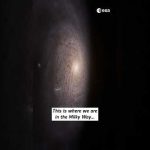
This stunning artist’s animation of the Milky Way is based on data from ESA’s Gaia space telescope. Gaia has completely reshaped our understanding of our home galaxy—revealing unexpected details about its spiral arms, central bar, and overall structure.
We can’t take a selfie of the Milky Way, but thanks to Gaia, we’re seeing it clearer than ever! And with more data releases on the way, our view will only get sharper.
This is a new artist’s animation of our galaxy, the Milky Way, based on data from ESA’s Gaia space telescope.
Gaia has changed our impression of the Milky Way. Even seemingly simple ideas about the nature of our galaxy’s central bar and the spiral arms have been overturned. Gaia has shown us that it has more than two spiral arms and that they are less prominent than we previously thought. In addition, Gaia has shown that its central bar is more inclined with respect to the Sun. No spacecraft can travel beyond our galaxy, so we can’t take a selfie, but Gaia is giving us the best insight yet of what our home galaxy looks like. Once all of Gaia’s observations collected over the past decade are made available in two upcoming data releases, we can expect an even sharper view of the Milky Way.
We are Europe’s gateway to space. Our mission is to shape the development of Europe’s space capability and ensure that investment in space continues to deliver benefits to the citizens of Europe and the world. Check out https://www.esa.int/ to get up to speed on everything space related.
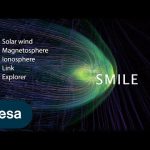
Smile is the Solar wind Magnetosphere Ionosphere Link Explorer, a brand-new space mission currently in the making. It will study space weather and the interaction between the solar wind and Earth’s environment.
Unique about Smile is that it will take the first X-ray images and videos of the solar wind slamming into Earth’s protective magnetic bubble, and its complementary ultraviolet images will provide the longest-ever continuous look at the northern lights.
In this first of several short videos, David Agnolon (Smile Project Manager) and Philippe Escoubet (Smile Project Scientist) talk about the why and the how of Smile. You’ll see scenes of the building and testing of the spacecraft’s payload module by Airbus in Madrid, including the installation of one of the European instruments, the Soft X-ray Imager from the University of Leicester.
Smile is a 50–50 collaboration between the European Space Agency (ESA) and the Chinese Academy of Sciences (CAS). ESA provides the payload module of the spacecraft, which carries three of the four science instruments, and the Vega-C rocket which will launch Smile to space. CAS provides the platform module hosting the fourth science instrument, as well as the service and propulsion modules.
Credit: ESA/Lightcurve Films
Acknowledgements: Direction, main camera, sound, editing, post-production by Lightcurve Films. Original music by William Zeitler. Artwork shown in the video is by Eryka Isaak and CAS.
★ Subscribe: http://bit.ly/ESAsubscribe and click twice on the bell button to receive our notifications.
We are Europe’s gateway to space. Our mission is to shape the development of Europe’s space capability and ensure that investment in space continues to deliver benefits to the citizens of Europe and the world. Check out https://www.esa.int/ to get up to speed on everything space related.
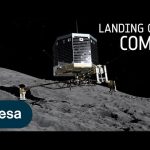
On 12 November 2014, after a ten-year journey through the Solar System and over 500 million kilometres from home, Rosetta’s lander Philae made space exploration history by touching down on a comet for the first time. On the occasion of the tenth anniversary of this extraordinary feat, we celebrate by taking a look back over the mission’s highlights.
Rosetta was an ESA mission with contributions from its Member States and NASA. It studied Comet 67P/Churyumov-Gerasimenko for over two years, including delivering lander Philae to the comet’s surface. Philae was provided by a consortium led by DLR, MPS, CNES and ASI.
Credits: ESA – European Space Agency
★ Subscribe: http://bit.ly/ESAsubscribe and click twice on the bell button to receive our notifications.
We are Europe’s gateway to space. Our mission is to shape the development of Europe’s space capability and ensure that investment in space continues to deliver benefits to the citizens of Europe and the world. Check out https://www.esa.int/ to get up to speed on everything space related.