A dél-spanyolországi Rio Tinto nevű hely gyakorlatilag a Mars a Földön. Ha itt van élet, vajon lehet a vörös bolygón is?
Tag: ESAC
-

ESA Euronews: Se há vida na Terra, porque não em Marte?
A Euronews esteve em Huelva, onde conheceu o Rio Tinto, cujas margens e sedimentos se parecem em todos os aspetos aos do Planeta Vermelho.
Um grupo de cientistas procura sinais de vida noutros planetas do nosso sistema solar. E fazem-no com a recolha de amostras dos lugares mais inesperados. -
ESA Euronews: Mars on Earth
The Rio Tinto river snakes through the Spanish countryside for 100 kilometres, a dark, blood-red stain of acid water and rusty-looking rocks that scientists love to study. Both ESA and NASA experts regularly spend weeks in the Rio Tinto, examining the life underground, and using it as a test bed to look for life on Mars.
This video is also available in the following languages:
German: https://youtu.be/K2D8T5i_Myk
French: https://youtu.be/7cynIaX5O0I
Italian: https://youtu.be/LOYgvHSR84g
Spanish: https://youtu.be/YI9Prr0ZVrw
Portuguese: https://youtu.be/VSDmRn-rRTE
Greek: https://youtu.be/7KW2SJc2Yjo
Hungarian: https://youtu.be/M0c6Ev63acs -

ESAC Research Fellows – Ginevra Favole
Ginevra Favole is an ESAC research fellow working on the large-scale structures of the universe. Her main scientific field is emission-line galaxies, galaxy clustering and weak gravitational lensing. She also works with mock catalogues and N-body cosmological simulations.
Go to https://www.cosmos.esa.int/web/esac-science-faculty/home to learn more.
-
ESAC Research Fellows – Maggie Lieu
Maggie Lieu is an ESAC research fellow working on Euclid, a visible and near-infrared space telescope due to launch in 2021. By measuring the shapes of distant galaxies we can determine the mass of the largest systems in the Universe, galaxy clusters. Euclid will achieve unprecedented shape measurements of galaxies covering almost half of the extragalactic sky.Maggie is developing statistical methods to deal with this upcoming big, noisy dataset, so that we can better understand the physics of galaxy clusters and theirrolein the Dark Universe.
Go to https://www.cosmos.esa.int/web/esac-science-faculty/home to learn more.
-

JWST 2016 – Welcome: ESA Space Science Programme (M. Kessler)
The first workshop in this series took place at ESA’s European Space Astronomy Center (ESAC) near Madrid on September 26-28, 2016. The main goal of this first workshop was to present to help prospective JWST users to select the best observing modes to achieve their science goals.
-
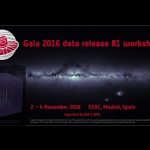
Gaia: The Visualisation of Gaia Data
André Moitinho – Lisbon University
Presentation recorded during the first Gaia data workshop at ESA’s European Space Astronomy Centre (ESAC) 2-4 November 2016.
The slides to this presentation are available here: http://www.cosmos.esa.int/documents/915837/915858/Moitinho_visualisation_v2.pdf
-
Gaia: Science-driven introduction to the archive
Alcione Mora – ESA
Presentation recorded during the first Gaia data workshop at ESA’s European Space Astronomy Centre (ESAC) 2-4 November 2016.
The slides to this presentation are available here:
http://www.cosmos.esa.int/documents/915837/915858/2016_11_02_dr1Workshop_AlcioneMora.pdf -
Gaia: Mission Overview
Timo Prusti – ESA
Presentation recorded during the first Gaia data workshop at ESA’s European Space Astronomy Centre (ESAC) 2-4 November 2016.
The slides to this presentation are available here:
http://www.cosmos.esa.int/documents/915837/915858/20161102_Gaia_TPrusti_web.pdf -
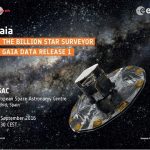
Press Conference: First Data Release from ESA’s Gaia Mission
Launched in December 2013, Gaia is destined to create the most accurate map yet of the Milky Way. By making accurate measurements of the positions and motions of stars in the Milky Way, it will answer questions about the origin and evolution of our home galaxy.
The first intermediate data release, containing among other things three-dimensional positions and two-dimensional motions of a subset of two million stars, demonstrates that Gaia’s measurements are as precise as planned, paving the way to create the full map of one billion stars to be released towards the end of 2017.
-

ESA Euronews: The real-life space cadets: Abbie, Marc and Maria
Meet the space cadets, three young engineers with enviable jobs that are quite literally out of this world. This edition of Space focuses on three professionals who’ve turned their dreams of working in space into real down-to- Earth careers.
In the UK, 26-year-old Abbie Hutty, a spacecraft structures engineer at Astrium, is a proud member of the ExoMars team. She is developing the structure of the mission’s rover, ensuring that the actual body of the vehicle and other components are all structurally strong enough to withstand the launch from Earth, and landing on Mars.
Twenty-seven-year-old Marc Costa Sitjà, Science Operations Engineer at the European Space Agency, uses the huge antenna at Cebreros, west of Madrid, to ‘drive’ ESA’s Venus Express spacecraft around the planet. Every day he sends commands and receives data to and from the spacecraft from the agency’s ESAC facility near the Spanish capital.
Maria Komu, a 27-year-old researcher at the Finnish Meteorological Institute, works on Finnish mini satellite Aalto-1, and has a hands-on role developing a weather instrument for ESA’s ExoMars EDM mission.
Space is a childhood dream turned reality for all three. For Abbie the realisation that space wasn’t just science fiction came when she was still at school and she heard of the Beagle 2 mission to Mars, a lander that was developed in the UK by British engineers. Maria tells the story of a book about a school visit around the solar system that enchanted her as a young girl. Meanwhile Marc cites a vivid blue image of Venus as an inspiration to his career.
Abbie, Marc and Maria are all educated to masters level, while Maria continues studying towards a doctorate. They’re on the first steps of the career ladder, and that means plenty of learning ‘on-the-job’. Maria had to master soldering, programming, and testing, Marc developed his skills by creating software that helped a mission to better fulfill its purpose, while Abbie had to understand better the behaviour of particular materials in the cold vacuum of space.
The excitement of working in space is summed up by Abbie: “I think the space industry is quite a privileged industry to work in, because whilst you are still managing projects and meeting schedules and deadlines, and creating a product, at the end of the day that requires a certain amount of processes down on it, you can also come down to the clean rooms and look through the window and see your part of a spaceship, and think ‘that’s going to Mars, and I did that bit’, and you don’t get that anywhere else.”
-
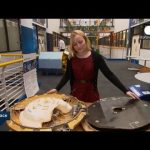
ESA Euronews: Δουλεύοντας στο διάστημα… από τη Γη
Η Μαρία, ο Μαρκ και η Άμπι είναι τρεις νέοι μηχανικοί κι έχουν τρεις διαφορετικές ιστορίες, αλλά με ένα κοινό γνώρισμα. Η δουλειά τους είναι στη Γη, αλλά φεύγει από τα όριά της. Και οι τρεις πραγματοποίησαν το όνειρό τους: δουλεύουν στη διαστημική βιομηχανία. Και δηλώνουν ευτυχισμένοι γι’αυτό.
Λίγο μετά τα είκοσί τους χρόνια, ήδη έχουν σημαντικές ευθύνες.
Η Μαρία εργάζεται σε έναν φινλανδικό μίνι δορυφόρο και σε εργαλεία πρόγνωσης καιρού για την αποστολή ExoMars της ESA. Η Άμπι αναπτύσσει τη δομή του οχήματος της αποστολής. Ο Μαρκ σχεδιάζει τις επιχειρήσεις του δορυφόρου Venus Express της ESA.
Η Άμπι και ο Μαρκ έχουν μεταπτυχιακές σπουδές, ενώ η Μαρία είναι υποψήφια διδάκτωρ. Και οι τρεις λένε πως εμπνεύστηκαν από την ιδέα της εξερεύνησης του ηλιακού μας συστήματος.
Πλοήγηση δορυφόρων, κατασκευή διαστημικών οχημάτων και μετεωρολογικών σταθμών για τον Άρη. Όλα αυτά απαιτούν δεξιότητες, γνώση και αφοσίωση.
Δυσκολίες υπάρχουν σίγουρα. Όμως κανείς εκ των τριών δεν χάνει από το βλέμμα του τη μοναδική φύση μιας καριέρας στο διάστημα.
-
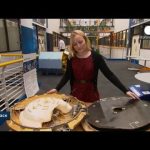
ESA Euronews: La nouvelle génération de l’espace
L’espace fascine bon nombre d’entre nous, mais bien peu ont la chance de travailler dans le domaine de la recherche spatiale. Nous avons rencontré trois jeunes ingénieurs qui ont entamé une carrière, la tête dans les étoiles et les pieds sur Terre.
A Helsinki, Maria Komu nous fait découvrir son lieu de travail : l’Institut météorologique finlandais qui dispose d’un laboratoire spatial. “Il y a à peine cinq ans, mon plus grand rêve, c’était simplement de pouvoir toucher quelque chose qui allait dans l’espace,” nous confie la jeune femme. “Aujourd’hui, je conçois des instruments qui vont dans l’espace, c’est incroyable !” s’enthousiasme-t-elle. Maria travaille sur un mini-satellite et des instruments météo pour le démonstrateur EDM de la mission ExoMars de l’Agence spatiale européenne (ESA).
Au nord de Londres, découvrons à présent, l’univers d’Abbie Hutty, ingénieur spatial structures chez Astrium. Son travail qui d’ailleurs, la passionne : s’assurer que “le corps du rover ExoMars est assez solide pour pouvoir supporter notamment le lancement, l’arrivée au sol et l’entrée dans l’atmosphère,” nous explique-t-elle.
En Espagne, à Cebreros, près de Madrid, Marc Costa Sitjà nous présente l’antenne à gain élevé qui permet à son équipe de communiquer avec le satellite Venus Express (ESA) pour gérer son pilotage. La parabole permet aux scientifiques d’envoyer des ordres de commande à l’engin et de recevoir des données en sa provenance comme une image de Vénus unique qu’ils ont réussi à constituer à partir de toute une série d’observations.
Nos trois jeunes ingénieurs ont choisi ces métiers pour explorer notre système solaire et peut-être éclaircir ses mystères. Une motivation qui les anime parfois depuis l’enfance. Chacun reconnaît avoir de la chance de mener une vie professionnelle dans un secteur qui les fascine. La Finlandaise Maria Komu aimerait poursuivre son rêve éveillé en visitant “d’immenses chambres à vide et peut-être des simulateurs solaires :c’est ce que je préfèrerais,” nous lance-t-elle avant de conclure : “et bien sûr, si je pouvais assister en vrai au lancement d’une fusée, ce serait vraiment cool !”