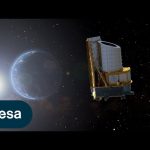
Euclid’s two instruments have captured their first test images. The mesmerising results indicate that the space telescope will achieve the scientific goals that it has been designed for – and possibly much more
Although there are months to go before Euclid delivers its true new view of the cosmos, reaching this milestone means the scientists and engineers behind the mission are confident that the telescope and instruments are working well.
📹 ESA – European Space Agency
★ Subscribe: http://bit.ly/ESAsubscribe and click twice on the bell button to receive our notifications.
We are Europe’s gateway to space. Our mission is to shape the development of Europe’s space capability and ensure that investment in space continues to deliver benefits to the citizens of Europe and the world. Check out https://www.esa.int/ to get up to speed on everything space related.
If you think its only possible be held in orbit around a central body of mass – say a planet or a star – you’d be wrong. It is in fact possible to orbit around an invisible point, an oasis of forces, infinitesimal in size. ESA’s Euclid mission was launched on 1 July 2023 to uncover the secrets of the dark universe. Its destination? Like many astronomy missions before it, Lagrange point 2.
‘L2’ is an ideal location for astronomy missions because they can keep the Sun, Earth and Moon behind them at all times, so they don’t interfere with observations, while at the same time getting a clear view of deep space and pointing an antenna back to Earth to remain in close communication. The permanent sunlight on Euclid at L2 also keeps the telescope thermally stable, allowing for the extremely high stability required for the instrument’s long exposure observations. Euclid’s orbit around Lagrange point 2 is big. In terms of distance, the ‘radius’ of Euclid’s orbit varies from about 400 000 kilometres at its closest to the centre, and up to 800 000 kilometres at its furthest. By the time Euclid has completed one full revolution around L2, the Moon will have circled the Earth six times.
The reason for this large orbit is that it is almost free, in terms of fuel, to get there. The better the accuracy of the rocket that launches a mission into such a large halo orbit around L2, the less fuel that’s needed to perform correction manoeuvres – and Euclid only required a tiny correction manoeuvre after its near-perfect launch on a Space X Falcon 9.
This animation, created using “Gaia Sky”, shows Euclid’s path from Earth to this unique and useful position in space. Located about 1.5 million kilometres from Earth in the opposite direction from the Sun, the second Lagrange point (or Libration point) is about four times further away than our Moon.
Euclid will spend about a month getting to ‘L2’ followed by a planned six years in orbit, from where it will study the mysterious nature of dark matter and dark energy, that make up 95% of our Universe, but about which very little is known.
Credits: ESA/Gaia/DPAC, CC BY-SA 3.0 IGO
★ Subscribe: http://bit.ly/ESAsubscribe and click twice on the bell button to receive our notifications.
We are Europe’s gateway to space. Our mission is to shape the development of Europe’s space capability and ensure that investment in space continues to deliver benefits to the citizens of Europe and the world. Check out https://www.esa.int/ to get up to speed on everything space related.
ESA’s latest astrophysics mission, Euclid, lifted off on a Space X Falcon 9 from Cape Canaveral in Florida, USA, at 17:12 CEST on 1 July 2023.
Euclid has now started its month-long journey to Sun-Earth Lagrange point L2, located 1.5 million kilometres from Earth, in the opposite direction from the Sun.
The telescope will survey one third of the sky with unprecedented accuracy and sensitivity. By observing billions of galaxies out to 10 billion light-years, it will create the most extensive 3D-map of the Universe, with the third dimension representing time.
ESA’s Euclid mission is designed to explore the composition and evolution of the dark Universe. Euclid will chart how the Universe has expanded and how large-scale structure is distributed across space and time, revealing more about the role of gravity and the nature of dark energy and dark matter.
Four weeks after launch, Euclid will enter its orbit around L2. Once in orbit, mission controllers will start the activities to verify all functions of the spacecraft, check out the telescope and finally turn the instruments on. Following this, scientists and engineers will be engaged in an intense two-month phase of testing and calibrating Euclid’s scientific instruments, and preparing for routine observations. The telescope begins its early phase of the survey of the Universe three months after launch.
We are Europe’s gateway to space. Our mission is to shape the development of Europe’s space capability and ensure that investment in space continues to deliver benefits to the citizens of Europe and the world. Check out https://www.esa.int/ to get up to speed on everything space related.
ESA’s latest astrophysics mission, Euclid, lifted off on a Space X Falcon 9 from Cape Canaveral in Florida, USA, at 17:12 CEST on 1 July 2023.
Euclid has now started its month-long journey to Sun-Earth Lagrange point L2, located 1.5 million kilometres from Earth, in the opposite direction from the Sun.
The telescope will survey one third of the sky with unprecedented accuracy and sensitivity. By observing billions of galaxies out to 10 billion light-years, it will create the most extensive 3D-map of the Universe, with the third dimension representing time.
ESA’s Euclid mission is designed to explore the composition and evolution of the dark Universe. Euclid will chart how the Universe has expanded and how large-scale structure is distributed across space and time, revealing more about the role of gravity and the nature of dark energy and dark matter.
Four weeks after launch, Euclid will enter its orbit around L2. Once in orbit, mission controllers will start the activities to verify all functions of the spacecraft, check out the telescope and finally turn the instruments on. Following this, scientists and engineers will be engaged in an intense two-month phase of testing and calibrating Euclid’s scientific instruments, and preparing for routine observations. The telescope begins its early phase of the survey of the Universe three months after launch.
We are Europe’s gateway to space. Our mission is to shape the development of Europe’s space capability and ensure that investment in space continues to deliver benefits to the citizens of Europe and the world. Check out https://www.esa.int/ to get up to speed on everything space related.