Tag: Eugene Parker

  • National Space Council Meets on This Week @NASA – October 6, 2017

    National Space Council Meets on This Week @NASA – October 6, 2017

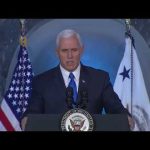
    Vice President Mike Pence called for renewed U.S. leadership in space during the first meeting of the National Space Council – outlining exploration goals that include returning American astronauts to the Moon, to build the foundation needed to send Americans to Mars and beyond. The October 5 council meeting, held at the Smithsonian National Air and Space Museum’s Steven F. Udvar-Hazy Center, outside Washington, brought together representatives from all aspects and sectors of the national space enterprise, for the first time in a quarter century – including NASA’s Acting Administrator, Robert Lightfoot. Also, U.S. Spacewalk aboard the Space Station, Eugene Parker Views Solar Probe Spacecraft, Scientists Find Giant Black Hole Pairs, and Parachute Test Platform Launched!

    This video is available for download from NASA’s Image and Video Library: https://images.nasa.gov/#/details-NHQ_2017_1006_National%20Space%20Council%20Meets%20on%20This%20Week%20@NASA%20%E2%80%93%20October%206,%202017.html

  • NASA names Unique Solar Mission after University of Chicago Physicist Eugene Parker

    NASA names Unique Solar Mission after University of Chicago Physicist Eugene Parker

    On May 31, NASA renamed humanity’s first mission to fly a spacecraft directly into the sun’s atmosphere in honor of Professor Eugene Parker, a pioneering physicist at the University of Chicago. This is the first time in agency history a spacecraft has been named for a living individual. Parker, the S. Chandrasekhar Distinguished Service Professor Emeritus in Physics, is best known for developing the concept of solar wind—the stream of electrically charged particles emitted by the sun.

    Previously named Solar Probe Plus, the Parker Solar Probe will launch in summer 2018. Placed in orbit within four million miles of the sun’s surface, and facing heat and radiation unlike any spacecraft in history, the spacecraft will explore the sun’s outer atmosphere and make critical observations that will answer decades-old questions about the physics of how stars work. The resulting data will improve forecasts of major space weather events that impact life on Earth, as well as satellites and astronauts in space.