The first ESA instrument to land on the Moon has detected the presence of negative ions on the lunar surface produced through interactions with the solar wind.
The European team working with the Negative Ions at the Lunar Surface (NILS) instrument confirmed the success of this scientific mission that flew to the far side of the Moon aboard the Chang’e-6 spacecraft.
The discovery of a new component of plasma at the surface of the Moon opens a new window for space physics and for human and robotic missions in an era of renewed lunar exploration.
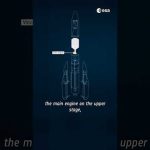
Europe’s newest rocket Ariane 6 has an upper stage engine, Vinci, that can restart up to four more times once in space!
This allows Ariane 6 to reach a larger range of orbits and deliver multiple payloads on a single launch.
Vinci does this using an auxiliary propulsion unit that heats up the same liquid oxygen and hydrogen fuel used by the main engine. It then turns it into gas that is expelled from the upper stage to provide a small amount of thrust. The effect is barely noticeable, but the forces are just enough to keep the liquid fuel at the bottom of the tank and ready for reignition.
📹 ESA – European Space Agency 📸 ESA – European Space Agency
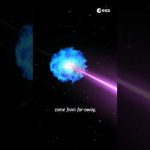
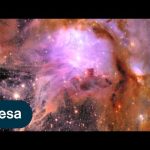
In November 2023 our Integral telescope spotted a sudden explosion from a rare object. For only a tenth of a second, a short burst of energetic gamma-rays appeared from the direction of the bright galaxy M82.
Only a few hours later, our XMM-Newton telescope searched for an afterglow from the explosion but found none. Astronomers realised that the burst must have been an extra-galactic flare from a magnetar, a young neutron star with an exceptionally strong magnetic field.
🎥 ESA – European Space Agency
📸 ESA/Integral, ESA/XMM-Newton, INAF/TNG, M. Rigoselli (INAF)
📸NASA, ESA and the Hubble Heritage Team (STScI/AURA)
Proba-3 is ESA’s – and the world’s – first precision formation flying mission. A pair of satellites will fly together relative to the Sun so that one casts a precisely-controlled shadow onto the other, to create a prolonged solar eclipse in orbit. In the process the mission will open up the Sun’s faint surrounding coronal atmosphere for sustained study. Normally this corona is rendered invisible by the brilliant face of the Sun, like a firefly next to a bonfire.
Due for launch together this autumn, the two Proba-3 satellites will fly 144-m apart for up to six hours at a time to create these eclipses. Beside its scientific interest, this experiment will be a perfect method to demonstrate the precise positioning of the two platforms. It will be enabled using a novel combination of guidance technologies. In this video the Proba-3 team details the mission concept.
We are Europe’s gateway to space. Our mission is to shape the development of Europe’s space capability and ensure that investment in space continues to deliver benefits to the citizens of Europe and the world. Check out https://www.esa.int/ to get up to speed on everything space related.
Europe’s new rocket Ariane 6 has three main stages each with their own engines.
Ariane 6 uses one of the world’s most powerful single-piece boosters, the P120C boosters, to get off the ground.
These motors run on 142 000 kg of solid fuel, which is completely consumed in just two minutes, reaching 53 km altitude when they are eventually discarded.
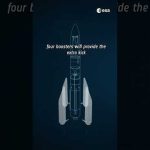
We can choose to either have two or four boosters per Ariane 6 launch. For many missions two boosters is more than enough to get into space, but if you need to launch heavier satellites or want to reach destinations farther away from Earth four boosters provide the extra kick to do the trick.
We now have a target launch date! We are currently aiming to get Ariane 6 off the ground on 9th July, be sure to set your reminders and follow along for more updates.
Europe’s new rocket Ariane 6 will soon be launched from Europe’s Spaceport in French Guiana. But how does it get off the launch pad?
Ignited first at liftoff is the Vulcain 2.1, the rocket motor for the cryogenic main stage. The engine sits at the bottom end of Ariane 6 and fires for up to 8 minutes to help the rocket reach space! The boosters ignite 7 seconds after the Vulcain for liftoff thrust.
ESA supports Europe’s space transportation visionaries and entrepreneurs through Boost! This video shows just some of the companies that have received co-funding from ESA’s Boost! programme: Orbex with its Prime launcher, D-Orbit offering orbital transportation and precise payload delivery with InOrbitNow, Skyrora’s XL launcher, HyImpulse’s SL1, ForgeStar from SpaceForge preparing for manufacturing in microgravity and returning them to Earth, Isar Aerospace’s Spectrum launcher, Rocket Factory Augsburg’s RFA One and PLD Space’s Miura.
Space is open for business – space transportation gets you there! With its Boost! programme, ESA is boosting commercial initiatives that offer transportation services to space, in space, and returning from space.
To achieve this, ESA nurtures industrial entrepreneurship and stimulates growth and competitiveness within the privately led and funded space sector in Europe via Boost! – ESA’s Commercial Space Transportation Services and Support programme.
This programme also supports ESA Member States in implementing national space transportation objectives in the field of spaceports, testing facilities and associated services.
We are Europe’s gateway to space. Our mission is to shape the development of Europe’s space capability and ensure that investment in space continues to deliver benefits to the citizens of Europe and the world. Check out https://www.esa.int/ to get up to speed on everything space related.
Oxia Planum contains one of the largest exposures of rocks on Mars that are around 3.9 billion years old and clay-rich, indicating that water once played a role here. The site sits in a wide catchment area of valley systems with the exposed rocks exhibiting different compositions, indicating a variety of deposition and wetting environments.
A European rover, Rosalind Franklin, is part of the ExoMars programme that will explore the surface of Mars. The rover will be the first mission to combine the capability to move across the surface and to study Mars at depth.
Mars’s surface is covered in all manner of scratches and scars. Its many marks include the fingernail scratches of Tantalus Fossae, the colossal canyon system of Valles Marineris, the oddly orderly ridges of Angustus Labyrinthus, and the fascinating features captured in today’s video release from Mars Express: the cat scratches of Nili Fossae.
Nili Fossae comprises parallel trenches hundreds of metres deep and several hundred kilometres long, stretching out along the eastern edge of a massive impact crater named Isidis Planitia.
This new video features observations from Mars Express’s High Resolution Stereo Camera (HRSC). It first flies northwards towards and around these large trenches, showing their fractured, uneven appearance, before turning back to head southwards. It ends by zooming out to a ‘bird’s eye’ view, with the landing site of NASA’s Perseverance rover, Jezero Crater, visible in the lower-middle part of the final scene. (You can explore this crater further via ESA’s interactive map.)
The trenches of Nili Fossae are actually features known as ‘graben’, which form when the ground sitting between two parallel faults fractures and falls away. As the graben seem to curve around Isidis Planitia, it’s likely that they formed as Mars’s crust settled following the formation of the crater by an incoming space rock hitting the surface. Similar ruptures – the counterpart to Nili Fossae – are found on the other side of the crater, and named Amenthes Fossae.
Scientists have focused on Nili Fossae in recent years due to the impressive amount and diversity of minerals found in this area, including silicates, carbonates, and clays (many of which were discovered by Mars Express’s OMEGA instrument). These minerals form in the presence of water, indicating that this region was very wet in ancient martian history. Much of the ground here formed over 3.5 billion years ago, when surface water was abundant across Mars. Scientists believe that water flowed not only across the surface here but also beneath it, forming underground hydrothermal flows that were heated by ancient volcanoes.
Because of what it could tell us about Mars’s ancient and water-rich past, Nili Fossae was considered as a possible landing site for NASA’s Curiosity rover, before the rover was ultimately sent to Gale Crater in 2012. Another mission, NASA’s Perseverance rover, was later sent to land in the nearby Jezero Crater, visible at the end of this video.
Mars Express has visited Nili Fossae before, imaging the region’s graben system back in 2014. The mission has orbited the Red Planet since 2003, imaging Mars’s surface, mapping its minerals, studying its tenuous atmosphere, probing beneath its crust, and exploring how various phenomena interact in the martian environment. For more from the orbiter and its HRSC, see ESA’s Mars Express releases.
Disclaimer: This video is not representative of how Mars Express flies over the surface of Mars. See processing notes below.
Processing notes: The video is centred at 23°N, 78°E. It was created using Mars Chart (HMC30) data, an image mosaic made from single-orbit observations from Mars Express’s HRSC. This mosaic was combined with topography derived from a digital terrain model of Mars to generate a three-dimensional landscape. For every second of the movie, 62.5 separate frames are rendered following a pre-defined camera path. The vertical exaggeration is three-fold. Atmospheric effects – clouds and haze – have been added, and start building up at a distance of 50 km.
Credit: ESA/DLR/FU Berlin & NASA/JPL-Caltech/MSSS, CC BY-SA 3.0 IGO
★ Subscribe: http://bit.ly/ESAsubscribe and click twice on the bell button to receive our notifications.
We are Europe’s gateway to space. Our mission is to shape the development of Europe’s space capability and ensure that investment in space continues to deliver benefits to the citizens of Europe and the world. Check out https://www.esa.int/ to get up to speed on everything space related.
Europe’s new rocket Ariane 6 is set to launch soon. 🚀
On its first flight to space, Ariane 6 is offering a ride to miniature satellites, known as CubeSats.
ISTSat from Portugal, and ³Cat-4 from Spain, are two of Ariane 6’s passengers.
Both satellites were developed by students participating in our Fly Your Satellite! programme, one of the several hands-on programmes for university students offered by ESA Education.
ISTSat is the first Portuguese CubeSat built by students. It will track aircraft from space using a smaller, lower power Automatic Dependent Surveillance Broadcast system, which is the technology that enables websites like Flight Radar.
³Cat-4 from the Technical University of Catalonia combines a radiometer, a reflectometer and an Automatic Identification System into one payload that will perform Earth Observation experiments.
The students visited Exolaunch’s Berlin headquarters to perform the integration of their satellites, where they installed ISTSat-1 and ³Cat-4 into their deployer.
ESA’s EarthCARE satellite lifted off on a SpaceX Falcon 9 rocket from the Vandenberg Space Force Base in California, US, on 29 May at 00:20 CEST (28 May, 15:20 local time).
Developed as a cooperation between ESA and the Japan Aerospace Exploration Agency (JAXA), the Earth Cloud Aerosol and Radiation Explorer satellite carries a set of four instruments to make a range of different measurements that together will shed new light on the role that clouds and aerosols play in regulating Earth’s climate.
ESA’s EarthCARE satellite lifted off on a SpaceX Falcon 9 rocket from the Vandenberg Space Force Base in California, US, on 29 May at 00:20 CEST (28 May, 15:20 local time).
Developed as a cooperation between ESA and the Japan Aerospace Exploration Agency (JAXA), the Earth Cloud Aerosol and Radiation Explorer satellite carries a set of four instruments to make a range of different measurements that together will shed new light on the role that clouds and aerosols play in regulating Earth’s climate.
Credits: ESA/SpaceX
★ Subscribe: http://bit.ly/ESAsubscribe and click twice on the bell button to receive our notifications.
We are Europe’s gateway to space. Our mission is to shape the development of Europe’s space capability and ensure that investment in space continues to deliver benefits to the citizens of Europe and the world. Check out https://www.esa.int/ to get up to speed on everything space related.
ESA’s EarthCARE mission is ready for lift-off! EarthCARE is a groundbreaking satellite mission designed to unravel the mysteries of Earth’s clouds and aerosols. EarthCARE will shed light on the role that clouds and aerosols play in heating and cooling Earth’s atmosphere – contributing to our better understanding of climate change. During our live coverage, we’ll hear from mission scientists and spacecraft operators, then follow the launch on a SpaceX Falcon 9 from California, expected at 00:20 CEST. Live from ESA’s spacecraft operations centre in Germany, we take you into the main control room around 01:12 CEST for the satellite’s acquisition of signal – EarthCARE’s first sign of life from space.
Credits: ESA/SpaceX
Timestaps of the video: 00:00 – 38:24 – Start of ESA WebTV Programme – Live from the European Space Operations Centre 38:25 – 50:44 – SpaceX live broadcast begins 50:45 – 1:01:40 – Lift-off 1:01:41 – 1:06:35 – Spacecraft deployment 1:06:36 – 1:40:40 – Stay tuned 1:40:41 – 1:44:50 – ESA WebTV Programme – Live from the European Space Operations Centre 1:44:51 – 1:55:00 – Acquisition of signal
★ Subscribe: http://bit.ly/ESAsubscribe and click twice on the bell button to receive our notifications.
We are Europe’s gateway to space. Our mission is to shape the development of Europe’s space capability and ensure that investment in space continues to deliver benefits to the citizens of Europe and the world. Check out https://www.esa.int/ to get up to speed on everything space related.
ESA’s Euclid space mission has released five unprecedented new views of the Universe. These never-before-seen images demonstrate Euclid’s remarkable ability to unravel the secrets of the cosmos. Scientists are now equipped to hunt for rogue planets, study mysterious matter through lensed galaxies, and explore the evolution of the Universe. Join us as we explore these groundbreaking discoveries and what they mean for the future of space exploration.
Credits: ESA – European Space Agency
Chapters: 00:00 – 00:36 Intro 00:36 – 01:14 The Galaxy Cluster Abell 2390 01:15 – 02:14 Messier 78: Stellar Nurseries and Galactic Formation 02:15 – 03:02 Galaxies in the Dorado Group 03:03 – 04:27 NGC 6744 04:28 – 05:25 Abell 2764 05:26 – 6:16 Conclusion
★ Subscribe: http://bit.ly/ESAsubscribe and click twice on the bell button to receive our notifications.
We are Europe’s gateway to space. Our mission is to shape the development of Europe’s space capability and ensure that investment in space continues to deliver benefits to the citizens of Europe and the world. Check out https://www.esa.int/ to get up to speed on everything space related.
ESA is releasing a new set of full-colour images captured by the space telescope Euclid. Five new portraits of our cosmos were captured during Euclid’s early observations phase, each revealing amazing new science. Euclid’s ability to unravel the secrets of the cosmos is something you will not want to miss.
Credits: ESA – European Space Agency
★ Subscribe: http://bit.ly/ESAsubscribe and click twice on the bell button to receive our notifications.
We are Europe’s gateway to space. Our mission is to shape the development of Europe’s space capability and ensure that investment in space continues to deliver benefits to the citizens of Europe and the world. Check out https://www.esa.int/ to get up to speed on everything space related.
Today, ESA’s Euclid space mission releases five unprecedented new views of the Universe. The never-before-seen images demonstrate Euclid’s ability to unravel the secrets of the cosmos and enable scientists to hunt for rogue planets, use lensed galaxies to study mysterious matter, and explore the evolution of the Universe.
Read more about Euclid’s first images and download the individual images here:
Credits: ESA/Euclid/Euclid Consortium/NASA, image processing by J.-C. Cuillandre (CEA Paris-Saclay), G. Anselmi
★ Subscribe: http://bit.ly/ESAsubscribe and click twice on the bell button to receive our notifications.
We are Europe’s gateway to space. Our mission is to shape the development of Europe’s space capability and ensure that investment in space continues to deliver benefits to the citizens of Europe and the world. Check out https://www.esa.int/ to get up to speed on everything space related.
Join Ariane 6 launch system architect, Tina, as she shows us a day in her life.
Tina has worked on space transport systems for 20 years now. She first worked on the Automated Transfer Vehicle (ATV), then on the Ariane 5 Mid-life Evolution development and now on Europe’s newest launcher Ariane 6.
How did she become a rocket scientist?
“I was lucky enough to spend some months in French Guiana as a student for an internship and working there got me hooked – I was determined to come back for my job one day, and here I am: I spent a great part of 2023 in Kourou testing the Ariane 6 propulsion system, together with an amazing team of very skilled professionals.
I consider myself extremely lucky to have a job and colleagues that make me want to get out of bed and into the office every day – because we love what we do and because the people are simply amazing!”
Join us live on 22 May at 16:35 BST (17:35 CEST) as ESA Director General Josef Aschbacher announces the first two astronaut missions for the new ESA astronaut class of 2022 on the first day of the Space Council, held in Brussels on 22 and 23 May 2024.
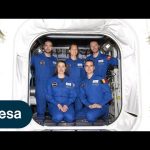
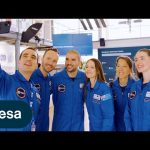
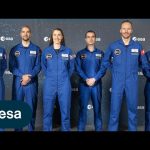
ESA’s most recent class of astronauts selected in 2022 includes Sophie Adenot, Pablo Álvarez Fernández, Rosemary Coogan, Raphaël Liégeois, and Marco Sieber. They recently completed one year of basic training and graduated as ESA astronauts on 22 April at ESA’s European Astronaut Centre in Germany, making them eligible for spaceflight. During their missions aboard the International Space Station, ESA astronauts will engage in a diverse range of activities, from conducting scientific experiments and medical research to Earth observation, outreach and operational tasks.
★ Subscribe: http://bit.ly/ESAsubscribe and click twice on the bell button to receive our notifications.
We are Europe’s gateway to space. Our mission is to shape the development of Europe’s space capability and ensure that investment in space continues to deliver benefits to the citizens of Europe and the world. Check out https://www.esa.int/ to get up to speed on everything space related.
🚀 Have you ever wondered how we transport rockets?
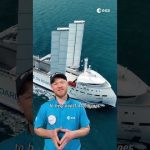
All the elements that make up Ariane 6 are manufactured in mainland Europe and then transported by this ship, named Canopée.
It is the first custom-built transporter to use sails, reducing emissions and saving on fuel by up to 30%, and on this trip, it travels for 10 days covering over 7000 km to reach Europe’s Spaceport in French Giuana.
The hybrid-propulsion vessel is 121 m long and has 37 m tall sails. Canopée rotates continuously between stop-offs to load each Ariane 6 stage and other parts and ship them across the Atlantic Ocean to Europe’s spaceport.
Aurora made a rare appearance across both the Northern and Southern Hemisphere skies after Earth was hit by one of the strongest geomagnetic storms for years. The storm over the weekend was classed as the highest G5.
Don’t worry if you missed them, we are entering a “solar maximum” where the Sun becomes very active meaning more storms and a greater chance of seeing Aurora in more places.
Let us know if and where you saw them in the comments👇
A group of 12 volunteers are sticking to a strict bed routine for 60 days, lying with their feet up and one shoulder always touching the mattress. This reclined lifestyle includes meals, showers and toilet breaks, as well as intensive cycling and centrifuge rides for some.
The BRACE study follows a two-month bedtime schedule to investigate how cycling and artificial gravity could counteract changes the human body experiences in space.
Astronauts face similar physiological problems as elderly and bedridden patients on Earth. During space missions, astronauts’ bodies go through a wide array of changes – everything from their eyes to their heart might be affected, and their muscles and bones start to deteriorate. To battle this degradation, crew members exercise two hours per day on the International Space Station.
The BRACE study involves male participants between the ages of 20 and 45 years with good physical and mental health. They are placed in beds tilted 6° below the horizontal position. As blood flows to the head and muscle wears out from lack of use, researchers chart how their bodies react.
Researchers split the volunteers in three groups. One group cycles in bed, a second one cycles while being spun on a centrifuge, and a third control group stays in bed for the full two months with no bike exercise or centrifuge rides. The centrifuge mimics artificial gravity, acting on all organs at once. Volunteers are spun to drive blood towards their feet, where the force of gravity doubles during the ride. Scientists hope artificial gravity could be used to keep astronauts fit and healthy in space.
Now halfway through its second edition, the experiment will finish on 4 May 2024, after 95 days of intense clinical testing and monitoring. This campaign takes place at MEDES, the Institute for Space Medicine and Physiology in Toulouse, France, and is supported by the French Space Agency CNES.
The study involves 14 European and international science teams that are working to release the results from the first BRACE campaign in 2023. Researchers are assessing a wide range of changes in the cardiovascular, metabolic, musculoskeletal, neuro-sensorial, haematological, and immunological systems.
The tests will provide a better understanding of the effects of prolonged bedrest to the benefit of those in space and on Earth. Results could help design countermeasures and improve health for patients suffering from accelerated ageing due to a sedentary lifestyle.
Europe’s new launcher, Ariane 6 uses liquid oxygen and hydrogen as fuel to lift it off the ground and into space. This fuel is chilled to -150°C which allows more propellant to be loaded into the rocket with more fuel from the engine.
But Ariane would not get far without the boosters that provide the most thrust by far.
In order to control the direction of Ariane 6 after launch, the nozzles on the boosters and main stage can swivel to keep it on course. This is no easy feat as Ariane 6 is 56 m tall and controlled at the bottom, so it is a careful balancing act.
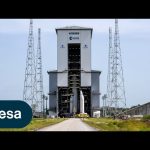
Last week, Ariane 6’s central core – the main body of the rocket – was stood tall at the launch zone and connected to its two solid-fuel boosters. This exciting moment means only one thing: it’s the start of the first launch campaign.
The main stage and upper stage make up the core stage, and they were autonomously driven at 3 km/h from the rocket assembly building to the launch pad, 800 m away. Then lifted by a crane, the Ariane 6 core was stood upright on the launch table.
The two boosters were transported to the launch pad on a specially designed truck and then configured with the rocket body, now holding it upright.
Ariane 6 is due to launch in summer 2024. The heavy-lift rocket will inaugurate a new era of autonomous European space transportation, powering Europe into space to realise its ambitions on the world stage. It will lift off from a modern launch complex at Europe’s Spaceport in French Guiana, carrying with it not just a variety of spacecraft, but also European goals for prosperity and autonomy.
Credits: ESA – European Space Agency
★ Subscribe: http://bit.ly/ESAsubscribe and click twice on the bell button to receive our notifications.
We are Europe’s gateway to space. Our mission is to shape the development of Europe’s space capability and ensure that investment in space continues to deliver benefits to the citizens of Europe and the world. Check out https://www.esa.int/ to get up to speed on everything space related.
Astronaut training consists of three main phases: basic training, pre-assignment training and increment training.
On the 22nd April, our astronaut candidates will have completed their basic training.
They will receive their certification at our European Astronaut Centre in Cologne, Germany, officially becoming fully fledged astronauts eligible for spaceflight.
After their graduation, the astronauts will proceed to the next phases of pre-assignment and mission-specific training, where they’ll learn specific skills for their future missions to the International Space Station and beyond!
📸 ESA – European Space Agency 📹 ESA – European Space Agency
As we approach the launch of ESA’s EarthCARE mission, we caught up with some of the scientists, engineers and experts behind the mission.
With the climate crisis increasingly tightening its grip, ESA’s Earth Cloud Aerosol and Radiation Explorer mission (EarthCARE) will shed new light on the complex interactions between clouds, aerosols and radiation in Earth’s atmosphere.
EarthCARE is the largest and most complex Earth Explorer mission. It comes at a critical time in the development of kilometre-scale resolution, global climate models and will provide an important contribution to an improved understanding of cloud convection and its role in Earth’s radiation budget.
EarthCARE is an ESA mission, but it has been developed as a cooperation between ESA and JAXA, the Japanese Space Agency.
This video features interviews with: Pavlos Kollias from Stony Brook University – McGill University, Thorsten Fehr, EarthCARE Mission Scientist at ESA, Robin Hogan, Senior Scientist at ECMWF, Dirk Bernaerts, EarthCARE Project Manager at ESA, Kotska Wallace, Mission and Optical Payload Manager at ESA, Tomomi Nio, EarthCARE Mission Manager at JAXA, Eiichi Tomita, EarthCARE/CPR Project Manager at JAXA, Ulla Wandinger, Senior Scientist at Leibniz Institute for Tropospheric Research and Bjoern Frommknecht, EarthCARE Mission Manager at ESA.
Follow the EarthCARE launch campaign blog for more updates.
Credits: ESA – European Space Agency
★ Subscribe: http://bit.ly/ESAsubscribe and click twice on the bell button to receive our notifications.
We are Europe’s gateway to space. Our mission is to shape the development of Europe’s space capability and ensure that investment in space continues to deliver benefits to the citizens of Europe and the world. Check out https://www.esa.int/ to get up to speed on everything space related.
ESA’s newly graduated astronauts reach the end of one year of rigorous basic astronaut training. Discover the journey of Sophie Adenot, Rosemary Coogan, Pablo Álvarez Fernández, Raphaël Liégeois, Marco Sieber, and Australian Space Agency astronaut candidate Katherine Bennell-Pegg. Selected in November 2022, the group began their training in April 2023.
Basic astronaut training provides the candidates with an overall familiarisation and training in various areas, such as spacecraft systems, spacewalks, flight engineering, robotics and life support systems as well as survival and medical training. They received astronaut certification at ESA’s European Astronaut Centre on 22 April 2024.
Following certification, the new astronauts will move on to the next phases of pre-assignment and mission-specific training – paving the way for future missions to the International Space Station and beyond.
Credits: Video: ESA – European Space Agency ISS and EVA footage: ESA/NASA
Music: Scorekeepers
★ Subscribe: http://bit.ly/ESAsubscribe and click twice on the bell button to receive our notifications.
We are Europe’s gateway to space. Our mission is to shape the development of Europe’s space capability and ensure that investment in space continues to deliver benefits to the citizens of Europe and the world. Check out https://www.esa.int/ to get up to speed on everything space related.
Europe has a new rocket, and it’s set to launch soon 🚀
Europe’s next launch vehicle is the powerful Ariane 6. The rocket will be bigger, better, and more versatile than its predecessor.
Our daily life is becoming increasingly reliant on space to keep people and things connected for communication, banking, transport, weather forecasting and more!
Ariane 6 is ensuring Europe has continued independent and autonomous access to space.
This video takes the viewer on a journey through space to reveal a new image from the NASA/ESA/CSA James Webb Space Telescope, the Horsehead Nebula.
This zoom video features three unique views of the Horsehead Nebula, including images from as ESA’s Euclid telescope, the NASA/ESA Hubble Space Telescope’s infrared view of the object, and finally revealing the new image from Webb’s NIRCam (Near-InfraRed Camera) instrument. It is the sharpest infrared image of the object to date, showing a part of the iconic nebula in a whole new light, and capturing its complexity with unprecedented spatial resolution. You can learn more about this new image here.
Credit: ESA/Webb, NASA, CSA, K. Misselt (University of Arizona) and A. Abergel (IAS/University Paris-Saclay, CNRS) Music: Stellardrone – The Night Sky in Motion
Olympus Mons has an average elevation of 22 kilometres and the caldera, or summit crater, has a depth of about 3 kilometres. The data was retrieved during orbit 143 of Mars Express on 24 February 2004. The view is looking north.
This video takes the viewer on a journey to the 34th anniversary image of the launch of the legendary NASA/ESA Hubble Space Telescope: the Little Dumbbell Nebula (also known as Messier 76, M76, or NGC 650/651). The object is located 3400 light-years away in the northern circumpolar constellation Perseus. The photogenic nebula is a favourite target of amateur astronomers.
Credit: NASA, ESA, STScI, A. Pagan (STScI) Acknowledgment: D. Crowson, A. Fujii, Digitized Sky Survey.
ESA’s newly graduated astronauts reach the end of one year of rigorous basic astronaut training. Watch the key moments during the journey of Sophie Adenot, Rosemary Coogan, Pablo Álvarez Fernández, Raphaël Liégeois, Marco Sieber, and Australian Space Agency astronaut candidate Katherine Bennell-Pegg. Selected in November 2022, the group began their training in April 2023.
Basic astronaut training provides the candidates with an overall familiarisation and training in various areas, such as spacecraft systems, spacewalks, flight engineering, robotics and life support systems as well as survival and medical training. They received astronaut certification at ESA’s European Astronaut Centre on 22 April 2024.
Following certification, the new astronauts will move on to the next phases of pre-assignment and mission-specific training – paving the way for future missions to the International Space Station and beyond.
Credits: ESA – European Space Agency ESA/NASA NASA ESA/Royal Netherlands Air Force
★ Subscribe: http://bit.ly/ESAsubscribe and click twice on the bell button to receive our notifications.
We are Europe’s gateway to space. Our mission is to shape the development of Europe’s space capability and ensure that investment in space continues to deliver benefits to the citizens of Europe and the world. Check out https://www.esa.int/ to get up to speed on everything space related.
Each year on 22 April, people across the planet join forces to raise awareness about the depleting quality of the environment, the unequivocal effects of climate change and the importance of protecting our planet for future generations. We celebrate Earth Day every day at ESA. This week, this spectacular image of Earth is brought to you by the Meteosat Second Generation series of missions.
Music: First Survivors 4 by Los Angeles-based British composer, Luke Richards. Sourced from Audio Network Limited.
Watch the replay as ESA astronaut candidates Sophie Adenot, Rosemary Coogan, Pablo Álvarez Fernández, Raphaël Liégeois, Marco Sieber and Australian Space Agency astronaut candidate Katherine Bennell-Pegg receive astronaut certification at ESA’s European Astronaut Centre. This officially marks their transition into fully-fledged astronauts, ready and eligible for spaceflight.
The group was selected in November 2022 and began their year-long basic astronaut training in April 2023.
Basic astronaut training provides the candidates with an overall familiarisation and training in various areas, such as spacecraft systems, spacewalking, flight engineering, robotics and life support systems, as well as survival and medical training.
Following certification, the new astronauts will move on to the next phases of pre-assignment and mission-specific training, paving the way for future missions to the International Space Station and beyond.
Chapters: 00:00 – 05:14 – Stay tuned 05:15 – 07:05 – Event 07:06 – 16:46 – Statement from Josef Aschbacher, ESA Director General 16:47 – 21:35 – Statement from Daniel Neuenschwander, Director of Human and Robotic Exploration 21:36 – 24:40 – Statement from Frank De Winne, Head of ESA’s European Astronaut Centre 24:41 – 31:35 – Event 31:36 – 36:35 – ESA astronaut class of 2022 graduation ceremony 36:36 – 40:10 – Statement from Enrico Palermo, Head of the Australian Space Agency 40:11 – 41:03 – Katherine Bennell-Pegg graduation ceremony 41:04 – 44:40 – Statement from Thomas Dermine, State Secretary for Economic Recovery and Strategic Investments 44:41 – 56:20 – Live Q&A 56:21 – 57:15 End of event
Credits: ESA – European Space Agency
★ Subscribe: http://bit.ly/ESAsubscribe and click twice on the bell button to receive our notifications.
We are Europe’s gateway to space. Our mission is to shape the development of Europe’s space capability and ensure that investment in space continues to deliver benefits to the citizens of Europe and the world. Check out https://www.esa.int/ to get up to speed on everything space related.
There’s a key milestone in the development of a satellite: integration. 🛰✅
🎓 Join ISTSat-1 and ³Cat-4 #student teams as they integrate their satellites with the deployer in preparation for launch this summer!
🚀 This exciting experience is part of our Fly Your Satellite! programme, which gives tertiary education students the chance to design, build, test and launch a #satellite.
Meet Hera, our very own asteroid detective. Together with two CubeSats – Milani the rock decoder and Juventas the radar visionary – Hera is off on an adventure to explore Didymos, a double asteroid system that is typical of the thousands that pose an impact risk to planet Earth.
In September 2022 NASA’s DART spacecraft tested if it was possible to divert an asteroid by giving it a shove – and found out that it was! Important knowledge, should we wish to avoid going the same way as the dinosaurs. Astronomers can observe from afar how the smaller asteroid’s orbit has shifted since DART’s impact, but there is still a missing piece of the puzzle if we want to fully understand how ‘kinetic impacting’ works in practice. Suitable for kids and adults alike, this episode of ‘The Incredible Adventures of Hera’ explains why ESA’s asteroid detective and its CubeSat assistants need to get up close and personal to shine light on this cosmic mystery.
Watch the other episodes of The Incredible Adventures of the Hera Mission:
We are Europe’s gateway to space. Our mission is to shape the development of Europe’s space capability and ensure that investment in space continues to deliver benefits to the citizens of Europe and the world. Check out https://www.esa.int/ to get up to speed on everything space related.
On the last day of his Huginn mission, ESA astronaut Andreas Mogensen takes us on a tour of the place he called home for 6 months: the International Space Station. From the beautiful views of Cupola to the kitchen in Node 1 filled with food and friends and all the way to the science of Columbus, the Space Station is the work and living place for astronauts as they help push science forward.
Credits: ESA – European Space Agency
★ Subscribe: http://bit.ly/ESAsubscribe and click twice on the bell button to receive our notifications.
We are Europe’s gateway to space. Our mission is to shape the development of Europe’s space capability and ensure that investment in space continues to deliver benefits to the citizens of Europe and the world. Check out https://www.esa.int/ to get up to speed on everything space related.
Scientists might have just found the first glory on a world outside our Solar System! “Glory” are colourful concentric rings of light that occur only under peculiar conditions. If confirmed, this finding could shed light on the mysterious atmosphere of the scorching hot gas giant WASP-76b.
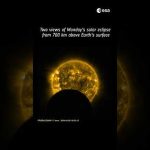
ESA’s Proba-2 captured two partial solar eclipses on 8 April 2024.
A solar eclipse occurs when the Moon passes between Earth and the Sun, totally or partially blocking the Sun from Earth’s point of view. On 8 April, lucky viewers across North America witnessed the Moon blocking out the Sun in its entirety for a few minutes, while those north and south of the ‘total eclipse path’ witnessed a partial eclipse.
Throughout the eclipse period, the Moon crossed Proba-2’s field of view twice, appearing as a partial solar eclipse. The satellite flies around 700 km above Earth’s surface in what is called a Sun-synchronous orbit, each orbit lasting around 100 minutes.
The video was produced from images taken by Proba-2’s SWAP telescope, which observes the Sun in extreme ultraviolet light. At these wavelengths, the turbulent nature of the Sun’s surface and corona – the Sun’s extended atmosphere – become visible. These measurements have to be made from space, because Earth’s atmosphere doesn’t allow such short wavelengths of light to pass through.
A total solar eclipse provides a unique opportunity to see the Sun’s corona from Earth’s surface, using visible light. As the Moon blocks most of the Sun’s bright light, the faint corona can be discerned. By comparing the SWAP ultraviolet images to what is seen by (visible light) telescopes on Earth, we can learn about the temperature and behaviour of different structures in the corona.
Other solar missions also made the most of the unique measurement opportunities provided by the eclipse. For example, ESA’s Solar Orbiter was positioned close to the Sun and at a 90-degree angle from Earth’s view throughout the eclipse. This allowed it to complement Earth-based observations by monitoring the Sun’s corona side-on, including any solar eruptions pointing in Earth’s direction.
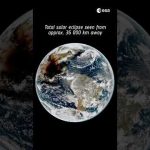
A total solar eclipse swept across North America yesterday, blocking out the Sun momentarily with parts of the continent plunged into darkness. Geostationary satellites orbiting 36 000 km away captured images of the rare celestial event.
These images, captured by the Geostationary Operational Environmental Satellite (GOES-16), captured the moon’s shadow moving across North America from approximately 16:00 to 23:00 CEST (15:00 to 22:00 BST.)
A total solar eclipse occurs when the Moon passes between the Sun and Earth and, for a short period, blocks the face of the Sun, save for a visible ring of light, known as the Sun’s corona.
The track of the moon’s shadow across Earth’s surface, called the path of totality, spanned across the North American continent – from Mexico to the very eastern tip of Canada.
The GOES series is a collaborative development and acquisition effort between National Oceanic and Atmospheric Administration (NOAA) and NASA. The GOES-16 (GOES-East) satellite, the first of the series, provides continuous imagery and atmospheric measurements of Earth’s western hemisphere and monitors space weather.
The Copernicus Sentinel-3 mission also captured images of the eclipse with its Sea and Land Surface Temperature Radiometer (SLSTR).
The eclipse also acts as a laboratory for researching what happens to weather when the Moon’s shadow passes over. The shadow makes air temperatures drop and can cause clouds to evolve in different ways. Data from GOES, Sentinel-3 and other satellites are now being used to explore these effects.