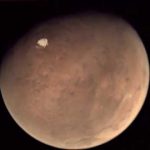
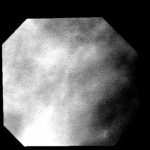
It can be seen as a dark blob passing through to the lower left.
Phobos sits very close to Mars by Solar System standards, orbiting just 6000 km from Mars’s surface. For context, our own moon lies about 385 000 km away from Earth’s surface.
Prior to flying the campaign orbits on 25/26 May, this will be the final interactive Q&A session with the Mars Express flight control team for participants in the VMC Schools Campaign. Priority for questions will go to school/club participants. Questions can be posted here in the ESA G+ channel or via Twitter using the #VMCSchools hashtag. Start 11:00 EDT / 15:00 GMT / 17:00 CEST http://goo.gl/Yw8P5p
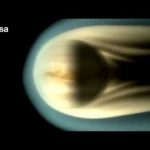
After eight years in orbit, ESA’s Venus Express has completed routine science observations and is preparing for a daring plunge into the planet’s hostile atmosphere.
Venus Express was launched on 9 November 2005, and arrived at Venus on 11 April 2006.
It has been orbiting Venus in an elliptical 24-hour loop that takes it from a distant 66 000 km over the south pole — affording incredible global views — to an altitude of around 250 km above the surface at the north pole, close to the top of the planet’s atmosphere.
With a suite of seven instruments, the spacecraft has provided a comprehensive study of the ionosphere, atmosphere and surface of Venus.
This video includes interviews in English with Håkan Svedhem, ESA mission scientist and Patrick Martin, ESA Venus Express mission manager
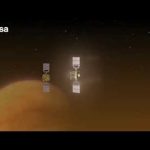
Visualisation of the Venus Express aerobraking manoeuvre, which will see the spacecraft orbiting Venus at an altitude of around 130 km from 18 June to 11 July. In the month before, the altitude will gradually be reduced from around 200 km to 130 km. If the spacecraft survives and fuel permits, the elevation of the orbit will be raised back up to approximately 450 km, allowing operations to continue for a further few months. Eventually, however, the spacecraft will plunge back into the atmosphere and the mission will end.
On 29 December 2013, ESA’s Mars Express will make the closest flyby yet of the Red Planet’s moon Phobos, skimming past only 45 km above its surface.
As the spacecraft passes close to Phobos, it will be pulled slightly off course by the moon’s gravity, by a few tens of centimetres. This small deviation will be measured using the spacecraft’s radio signals, and then translated into measurements of gravity, mass and density at different locations on the moon.
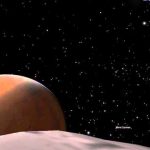
This animation shows the flyby (speeded up) as if you were standing on Phobos, with Mars in the background and Mars Express sweeping out an arc above. Toward the end of the sequence, Mars Express disappears behind Mars and out of sight of Phobos.
In celebration of the 10th anniversary of Mars Express: a new and enhanced Full Orbit Video generated by multiple images acquired by the VMC camera – the Mars Webcam – on board ESA’s Mars Express
This version is a special ‘MEX birthday preview’. We’ll post a somewhat extended version late next week, to coincide with the next expected VMC image set arriving from Mars (for news, follow the VMC blog http://blogs.esa.int/vmc)
Thanks to the Mars Express Science & operations teams for generating a fabulous, unique-in-our-Solar-System view of the Red planet. And happy Birthday, Mars Express!
Credit: ESA – European Space Agency, CC BY-SA 3.0 IGO
Copyright Notice:
This work is licenced under the Creative Commons Attribution-ShareAlike 3.0 IGO (CC BY-SA 3.0 IGO) licence. The user is allowed to reproduce, distribute, adapt, translate and publicly perform this publication, without explicit permission, provided that the content is accompanied by an acknowledgement that the source is credited as ‘ESA/DLR/FU Berlin’, a direct link to the licence text is provided and that it is clearly indicated if changes were made to the original content. Adaptation/translation/derivatives must be distributed under the same licence terms as this publication. To view a copy of this license, please visit http://creativecommons.org/licenses/by-sa/3.0/igo/
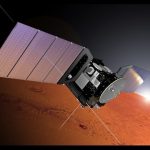
The journey of Mars Express, from drawing board through launch, to its key science highlights during ten years of operations. With its suite of seven instruments, Mars Express has studied the subsurface of the Red Planet to the upper atmosphere and beyond to the two tiny moons Phobos and Deimos, providing an in depth analysis of the planet’s history and returning stunning 3D images.
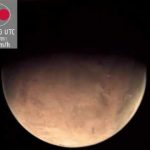
This movie was generated from 600 individual still images captured by the Visual Monitoring Camera (VMC) on board Mars Express during the 8194th orbit on 27 May 2010 between 02:00 and 09:00 UTC (04:00-11:00 CEST) and were transmitted to Earth a few hours later via ESA’s 35m New Norcia deep space station in Australia.
The portion of the movie where the planet beneath the spacecraft was dark has been largely removed since no detail was visible.
The images show the spacecraft’s slow descent from high above the planet, speeding up as closest approach is passed and then slowing down again as the distance increases. Towards the start of the video, the giant Martian volcanoes can be seen followed by the beginning of the ice coverage around the South Pole as the spacecraft crosses over to the night side of the planet. Shortly after emerging back onto the day side of the planet, the beautiful North Pole can be observed, followed by the long climb away from the planet over the equator. Finally, at the end of the movie, the disk of Phobos can be seen crossing from top to bottom of the image.
Credit: ESA – European Space Agency, CC BY-SA 3.0 IGO
Copyright Notice:
This work is licenced under the Creative Commons Attribution-ShareAlike 3.0 IGO (CC BY-SA 3.0 IGO) licence. The user is allowed to reproduce, distribute, adapt, translate and publicly perform this publication, without explicit permission, provided that the content is accompanied by an acknowledgement that the source is credited as ‘ESA/DLR/FU Berlin’, a direct link to the licence text is provided and that it is clearly indicated if changes were made to the original content. Adaptation/translation/derivatives must be distributed under the same licence terms as this publication. To view a copy of this license, please visit http://creativecommons.org/licenses/by-sa/3.0/igo/
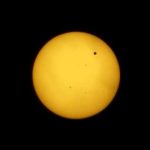
Time lapse movie of the transit of Venus, as seen from the land of the midnight sun in Svalbard. Interference from cloud gives an eerie feel to the scene.
This movie was compiled from images taken by the Venus Monitoring Camera on Venus Express as it approached the planet on its elliptical orbit on 1 June 2012. Initially, the spacecraft is looking at the south side of the planet from a distance of 63 000 km and clouds can be seen moving below. As the spacecraft draws closer, Venus starts filling the field of view and the equatorial regions can be seen. The sequence finishes with observations of cloud features at high latitudes.
Space missions are complicated pieces of orbital choreography. When planning a mission, spacecraft engineers must calculate how to point the solar panels towards the Sun, the main antenna towards Earth and the instruments towards the target. ESA Space Scientist Detlef Koschny build a LEGO model of Rosetta mission in order to visualise these precise orientations.
Built using LEGO Mindstorms, the Philae lander model can be controlled using a home computer. It can rotate and move the drill up and down to simulate the behaviour of the real lander. As part of ESA’s Rosetta space mission, Philae will land on comet Churyumov-Gerasimenko in November 2014 to study its composition.