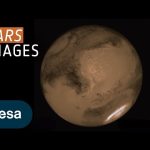
On 12 March 2025, ESA’s Hera spacecraft soared just 5000 km above Mars and passed within 300 km of its distant moon, Deimos. Captured by Hera’s 1020×1020 pixel Asteroid Framing Camera, this video sequence offers a rare view of the red planet and its enigmatic moon. The original greyscale images have been colour-enhanced based on known surface features.
We are Europe’s gateway to space. Our mission is to shape the development of Europe’s space capability and ensure that investment in space continues to deliver benefits to the citizens of Europe and the world. Check out https://www.esa.int/ to get up to speed on everything space related.
Join us live for a star-studded event this Thursday, as scientists working on ESA’s Hera mission for planetary defence release the mission’s first scientific observations beyond the Earth-Moon system, following its imminent flyby of Mars.
On 12 March 2025 ESA’s Hera mission comes to within 5000 km of the surface of the red planet and 300 km of Mars’s more distant and enigmatic moon Deimos. During this flyby Hera is performing observations of both Mars and the city-sized Deimos.
Hera then needs to swing its High Gain Antenna back to Earth to transmit its data home. The next day, on Thursday 13 March, these images will be premiered by Hera’s science team from ESA’s ESOC mission control centre in Darmstadt, Germany, explaining what they reveal, during our public webcast starting at 11:50 CET.
The team are being joined by ESA astronaut Alexander Gerst and renowned science fiction writer Andy Weir, author of The Martian and Project Hail Mary, as well as a surprise special guest!
Chapters: 00:00 Introduction 07:00 Image 1: AFC’s view of Mars and Deimos 18:20 Image 2: HyperScout’s view of colourful Mars 25:40 Audience questions 32:25 The Author and the Astronaut 50:55 Image 3: TIRI’s view of hot Mars, cold Mars 55:10 Ramses, Planetary Defence and asteroid deflection 1:00:25 The Hera AI companion – more than sci-fi! 1:05:30 What’s next for Hera?
★ Subscribe: http://bit.ly/ESAsubscribe and click twice on the bell button to receive our notifications.
We are Europe’s gateway to space. Our mission is to shape the development of Europe’s space capability and ensure that investment in space continues to deliver benefits to the citizens of Europe and the world. Check out https://www.esa.int/ to get up to speed on everything space related.
ESA’s Jupiter Icy Moons Explorer (Juice), is on an epic eight-year journey to Jupiter. This first episode of ‘The journey of Juice’ tells the story of Juice’s first months in space, from its launch on 14 April 2023 to its lunar-Earth gravity assist (LEGA for short) in August 2024. This flyby was not only the first double gravity assist manoeuvre of its kind, it was also a perfect opportunity to test out the spacecraft’s cameras and science instruments.
In this episode, Juice’s Mission Manager Nicolas Altobelli explains how the spacecraft will become the first ever human-made machine to orbit a moon of another planet, in this case Jupiter’s largest moon Ganymede.
You’ll also hear from Claire Vallat and Marc Costa at the European Space Astronomy Centre (ESAC) near Madrid, Spain. Juice will perform incredibly complex measurements once it reaches Jupiter, and the Science Operations team at ESAC is making sure we get the most out of every instrument.
Meanwhile, the Flight Control team at the European Space Operations Centre (ESOC) in Darmstadt, Germany, makes sure Juice is and stays on the right path. This episode shows what happened ‘behind the scenes’ before and during the lunar-Earth flyby, and stars Ignacio Tanco, Angela Dietz and members of the Juice Flight Control team as they do what they do best.
Finally, we highlight the ESA tracking station network (Estrack), another crucial component for Juice. Maintenance and Operations Engineer Belén Goméz gives a tour of the facility at Cebreros.
Following the very successful lunar-Earth flyby, Juice is now on its way to planet Venus for its next flyby. On 31 August 2025, this flyby will give Juice its second gravity boost. Tune back in next year for episode two of this series!
This series follows on from ‘The making of Juice’ series, which covered the planning, testing and launch of this once-in-a-generation mission.
Credit: ESA/Lightcurve Films, original music by William Zeitler
Acknowledgments: Direction, main camera, sound, editing, post-production: Maarten Roos. Camera at Cebreros during LEGA: Mikel Larequi. LEGA timelapse: Mark McCaughrean and Simeon Schmauß. Special thanks to Marc Costa (ESA – ESAC) and Jorge Fauste (ESA – Estrack)
★ Subscribe: http://bit.ly/ESAsubscribe and click twice on the bell button to receive our notifications.
We are Europe’s gateway to space. Our mission is to shape the development of Europe’s space capability and ensure that investment in space continues to deliver benefits to the citizens of Europe and the world. Check out https://www.esa.int/ to get up to speed on everything space related.
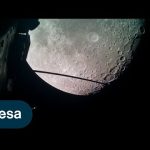
On 19–20 August 2024, Juice successfully completed a world-first lunar-Earth flyby, with flight controllers guiding the spacecraft first past the Moon, then past Earth. The gravity of the two changed Juice’s speed and direction, sending it on a shortcut to Jupiter via Venus.
The closest approach to the Moon was at 23:15 CEST on 19 August, deflecting Juice towards a closest approach to Earth just over 24 hours later at 23:56 CEST on 20 August. In the hours before and after both close approaches, Juice’s two monitoring cameras captured photos, giving us a unique ‘Juice eye view’ of our home planet.
Juice’s two monitoring cameras provide 1024 x 1024 pixel snapshots that can be processed in colour. Their main purpose is to monitor the spacecraft’s various booms and antennas, especially during the challenging period after launch. The photos they captured of the Moon and Earth during the lunar-Earth flyby are a bonus.
The piece of music that accompanies the images is called 11,2 km/s. It was composed by Gautier Acher back in 2015, and selected as the official theme music for ESA’s Estrack ground station network to mark its 40th anniversary (more information). The music is available under a CC BY-NC-SA licence.
Processing notes: The Juice monitoring cameras provide 1024 x 1024 pixel images. Upscaling software was used to convert the images into 2160 x 2160 pixel images, which match the 3480 x2160 pixel resolution of the 4K movie format.
Credits: ESA – European Space Agency Acknowledgements: Simeon Schmauß & Mark McCaughrean
★ Subscribe: http://bit.ly/ESAsubscribe and click twice on the bell button to receive our notifications.
We are Europe’s gateway to space. Our mission is to shape the development of Europe’s space capability and ensure that investment in space continues to deliver benefits to the citizens of Europe and the world. Check out https://www.esa.int/ to get up to speed on everything space related.
Join us for Juice’s flyby of the Moon. We’ll be sharing images as soon as we can after Juice sends them down to Earth. Be among the first people in the world to see these images, and ask your questions about the mission and its lunar-Earth flyby to our panel of Juice team members.
The images will be captured using Juice’s two ‘monitoring cameras’, designed to watch the unfolding of Juice’s solar panels, antennas and booms in space in the weeks after the spacecraft launched into space in April 2023. The cameras have successfully completed their task. But we thought… what will we see if we point them at the Moon?
We don’t know how the images will look. It’s the first time the cameras will point at a big bright object in space. And we’re sharing them publicly before we’ve had a chance to process them at all.
We are Europe’s gateway to space. Our mission is to shape the development of Europe’s space capability and ensure that investment in space continues to deliver benefits to the citizens of Europe and the world. Check out https://www.esa.int/ to get up to speed on everything space related.
ESA’s Jupiter Icy Moons Explorer (Juice) returns to Earth on 19–20 August 2024, to complete the world’s first Lunar-Earth gravity assist. Flight controllers will guide the spacecraft past the Moon and then Earth itself, ‘braking’ the spacecraft. This manoeuvre may seem counterintuitive but will allow Juice to take a shortcut via Venus on it’s way to Jupiter.
Juice has already travelled more than 1000 million km to the giant planet but it still has a long way to go even though Jupiter is on average ‘just’ 800 million km away from Earth. Join us as we explain why Juice’s journey to Jupiter is taking sooo long.
We are Europe’s gateway to space. Our mission is to shape the development of Europe’s space capability and ensure that investment in space continues to deliver benefits to the citizens of Europe and the world. Check out https://www.esa.int/ to get up to speed on everything space related.
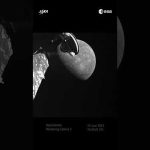
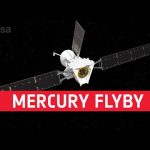
Watch Mercury appear from the shadows as the ESA/JAXA BepiColombo spacecraft sped by the planet’s night side during its 19 June 2023 close flyby, and enjoy a special flyover of geologically rich terrain.
Credits: Image: ESA/BepiColombo/MTM, CC BY-SA 3.0 IGO; Music composed by ILĀ. Shape from shading processing and animation (using Unity) by K. Wohlfarth and M. Tenthoff (TU Dortmund), based on techniques described by Tenthoff et al. (2020) and Domingue et al. (2015) with a global terrain model from Becker et al. (2016).
Music: Tim Garland – Moonlight Mystery
★ Subscribe: http://bit.ly/ESAsubscribe and click twice on the bell button to receive our notifications.
We are Europe’s gateway to space. Our mission is to shape the development of Europe’s space capability and ensure that investment in space continues to deliver benefits to the citizens of Europe and the world. Check out https://www.esa.int/ to get up to speed on everything space related.
Watch Mercury appear from the shadows as the ESA/JAXA BepiColombo spacecraft sped by the planet’s night side during its 19 June 2023 close flyby, and enjoy a special flyover of geologically rich terrain.
The first part of the movie is composed of 217 images captured by BepiColombo’s monitoring camera M-CAM3. The image sequence starts from 19:46:25 UTC on 19 June 2023, at an altitude of 1 789 km above the planet’s surface, and ends at 20:34:25 UTC on 20 June 2023, when BepiColombo was 331 755 km away. The image cadence was roughly once per minute around closest approach, but much slower in the later phases.
The second part of the movie cuts to a flyover of a special region of interest, rotating around features such as the 600 km-long Beagle Rupes curved escarpment and the elongated Sveinsdóttir impact crater that it cuts through. It also features the 218 km-wide Manley Crater and the straight Challenger Rupes scarp. At the end, the animated topography fades out and the projected image used for 3D reconstruction appears. Regions like these will be important for BepiColombo’s main science mission, to learn more about Mercury’s geological history.
Music was composed for the sequence by ILĀ, with the assistance of AI tools developed by the Machine Intelligence for Musical Audio (MIMA) group, University of Sheffield.
Credits: Image: ESA/BepiColombo/MTM, CC BY-SA 3.0 IGO; Music composed by ILĀ. Shape from shading processing and animation (using Unity) by K. Wohlfarth and M. Tenthoff (TU Dortmund), based on techniques described by Tenthoff et al. (2020) and Domingue et al. (2015) with a global terrain model from Becker et al. (2016).
★ Subscribe: http://bit.ly/ESAsubscribe and click twice on the bell button to receive our notifications.
We are Europe’s gateway to space. Our mission is to shape the development of Europe’s space capability and ensure that investment in space continues to deliver benefits to the citizens of Europe and the world. Check out https://www.esa.int/ to get up to speed on everything space related.
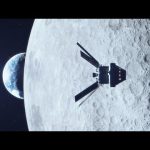
Watch live as NASA’s Orion spacecraft performs a close approach of the lunar surface on its way to a distant retrograde orbit, a highly stable orbit thousands of miles beyond the Moon. During the Artemis I flight test, launched on Nov. 16, Orion will travel 280,000 miles (450,000 km) from Earth and 40,000 miles (64,000 km) beyond the far side of the Moon, carrying science and technology payloads to expand our understanding of lunar science, technology developments, and deep space radiation.
Through Artemis missions, NASA will land the first woman and the first person of color on the Moon, paving the way for a long-term lunar presence and serving as a steppingstone to send astronauts to Mars. We are going.
The ESA/ @JAXA-HQ BepiColombo mission has made its second gravity assist of planet Mercury, capturing new close-up images as it steers closer towards Mercury orbit in 2025.
The closest approach took place at 09:44 UTC (11:44 CEST) on 23 June 2022, about 200 km above the planet’s surface. Images from the spacecraft’s three monitoring cameras (MCAM), along with scientific data from a number of instruments, were collected during the encounter.
We are Europe’s gateway to space. Our mission is to shape the development of Europe’s space capability and ensure that investment in space continues to deliver benefits to the citizens of Europe and the world. Check out https://www.esa.int/ to get up to speed on everything space related.
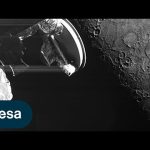
A beautiful sequence of 56 images taken by the monitoring cameras on board the ESA/JAXA BepiColombo mission as the spacecraft made its second close flyby of its destination planet Mercury on 23 June 2022.
The compilation includes images from two monitoring cameras (MCAM) onboard the Mercury Transfer Module, which provides black-and-white snapshots at 1024 x 1024 pixel resolution. The MCAMs also capture parts of the spacecraft: MCAM-2 sees the Mercury Planetary Orbiter’s medium-gain antenna and magnetometer boom, while the high-gain antenna is in the MCAM-3 field-of-view.
The image sequences lasted about 15 minutes starting soon after closest approach to Mercury, which was at an altitude of 200 km. The first sequence showcases images taken by MCAM-2, starting from a distance of around 920 km from the surface of the planet and finishing at about 6099 km. The second sequence shows images from MCAM-3 covering a similar distance range (approximately 984 km – 6194 km).
Since MCAM-2 and MCAM-3 are located on either side of the spacecraft, and the image acquisition alternated quickly between the two cameras with about 15-20 seconds between them, the final sequence shows a composite of the two views, giving an impression of the complete planet receding behind the spacecraft.
During the flyby it was possible to identify various geological features that BepiColombo will study in more detail once in orbit around the planet. While craters dominate the landscape, numerous volcanic plains can also be made out, as well as roughly linear ‘scarps’ – cliff-like features created by tectonic faulting. In this flyby, the planet’s largest impact basin Caloris was seen for the first time by BepiColombo, its highly-reflective lavas on its floor making it stand out against the darker background as it rotated into the MCAM-2 field of view.
The gravity assist manoeuvre was the second at Mercury and the fifth of nine flybys overall. During its seven-year cruise to the smallest and innermost planet of the Solar System, BepiColombo makes one flyby at Earth, two at Venus and six at Mercury to help steer it on course to arrive in Mercury orbit in 2025. The Mercury Transfer Module carries two science orbiters: ESA’s Mercury Planetary Orbiter and JAXA’s Mercury Magnetospheric Orbiter. They will operate from complementary orbits to study all aspects of mysterious Mercury from its core to surface processes, magnetic field and exosphere, to better understand the origin and evolution of a planet close to its parent star.
We are Europe’s gateway to space. Our mission is to shape the development of Europe’s space capability and ensure that investment in space continues to deliver benefits to the citizens of Europe and the world. Check out https://www.esa.int/ to get up to speed on everything space related.
A beautiful sequence of 53 images taken by the monitoring cameras on board the ESA/JAXA BepiColombo mission as the spacecraft made its first close flyby of its destination planet Mercury on 1 October 2021.
The compilation includes images from two of the three Monitoring Cameras (MCAM) onboard the Mercury Transfer Module, which provides black-and-white snapshots at 1024 x 1024 pixel resolution. It is not possible to image with the high-resolution camera suite during the cruise phase. The MCAMs also capture parts of the spacecraft: MCAM-2 sees the medium-gain antenna and magnetometer boom, while the high-gain antenna is in the MCAM-3 field-of-view.
The sequence opens with the closest images acquired by MCAM-2 and MCAM-3, taken at a distance of around 1000 km from the surface of the planet. Closest approach at 199 km took place about five minutes earlier, at 23:34:41 UTC.
During the half hour following the close approach, imaging alternated between the two cameras. In general, MCAM-2 pointed towards the northern hemisphere of Mercury, while MCAM-3 pointed towards the southern hemisphere. Thus the subsequent images show a set of complementary views from each camera in turn, ranging from a distance of about 2420 km to 6140 km from the surface of Mercury. In these relatively close images, it is possible to identify prominent impact craters, scarps, and other geological features that BepiColombo will study in more detail once in orbit around the planet at the end of 2025.
The final part of the compilation illustrates BepiColombo’s departure from Mercury as the spacecraft changed attitude along its trajectory, giving the impression Mercury’s apparent movement changes direction. The final image was taken at 03:03:49 UTC on 2 October from a distance of approximately 93 thousand kilometres. The final departure sequence has been speeded up by a factor of about 900.
Several different exposure times were used throughout the imaging sequence in order to try and capture the rapidly-varying brightness of Mercury, and in some cases the spacecraft and/or the planet are overexposed, particularly in the final departure sequence. Optical and electronic artefacts are also visible in some images.
The gravity assist manoeuvre was the first at Mercury and the fourth of nine flybys overall. During its seven-year cruise to the smallest and innermost planet of the Solar System, BepiColombo makes one flyby at Earth, two at Venus and six at Mercury to help steer it on course to arrive in Mercury orbit in 2025. The Mercury Transfer Module carries two science orbiters: ESA’s Mercury Planetary Orbiter and JAXA’s Mercury Magnetospheric Orbiter. They will operate from complementary orbits to study all aspects of mysterious Mercury from its core to surface processes, magnetic field and exosphere, to better understand the origin and evolution of a planet close to its parent star.
Credit: ESA/BepiColombo/MTM, CC BY-SA 3.0 IGO; Music composed and performed by Anil Sebastian and Ingmar Kamalagharan.
★ Subscribe: http://bit.ly/ESAsubscribe and click twice on the bell button to receive our notifications.
We are Europe’s gateway to space. Our mission is to shape the development of Europe’s space capability and ensure that investment in space continues to deliver benefits to the citizens of Europe and the world. Check out https://www.esa.int/ to get up to speed on everything space related.
Visualisation of BepiColombo flying by Mercury on 1 October 2021. The spacecraft makes nine gravity assist manoeuvres (one of Earth, two of Venus and six of Mercury) before entering orbit around the innermost planet of the Solar System.
The closest approach is at 23:34 UTC on 1 October (01:34 CEST 2 October) at a distance of about 200 km.
BepiColombo is an international collaboration between #ESA and #JAXA.
Credit: ESA/ATG medialab
★ Subscribe: http://bit.ly/ESAsubscribe and click twice on the bell button to receive our notifications.
We are Europe’s gateway to space. Our mission is to shape the development of Europe’s space capability and ensure that investment in space continues to deliver benefits to the citizens of Europe and the world. Check out https://www.esa.int/ to get up to speed on everything space related.
This remarkable footage shows the flyby of asteroid 2012 TC4 during the night of 11/12 October 2017. At the time this was recorded, the estimated 10-20 m-diameter asteroid was approaching Earth. It made its closest approach at 07:41 CEST on 12 October, just 43 782 km away – much closer than the Moon and inside the orbit of some satellites.
This was captured by astronomers Peter Schlatter and Dominik Bodenmann working at the ZIMLAT telescope at the Swiss Optical Ground Station and Geodynamics Observatory operated by the Astronomical Institute of the University of Bern (AIUB).
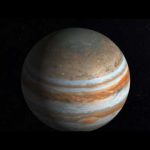
NASA’s Juno spacecraft made its latest close flyby of Jupiter Feb. 2 — passing about 2,700 miles above the planet’s clouds. This was the fourth close flyby since Juno began orbiting Jupiter last year on July 4. During these close passes instruments on the spacecraft probe beneath the cloud cover to collect scientific data about the planet’s structure, atmosphere and magnetosphere. This information could help us better understand the planetary systems being discovered around other stars. Also, Cassini Sees Saturn’s Rings in Greater Detail, The Most Extreme Blazars, NASA at Super Bowl Event, NASA at NBA Black Heritage Celebration, and
Day of Remembrance!
In NASA first of two televised briefings on Tuesday, April 14, plans and upcoming activities about the agency’s mission to Pluto that will make the first-ever close flyby of the dwarf planet on July 14 were discussed.
Briefers described the mission’s goals and context, scientific objectives and encounter plans – including what images can be expected and when.
New Horizons already has covered more than 3 billion miles since it launched on Jan. 19, 2006. The spacecraft will pass Pluto at a speed of 31,000 mph taking thousands of images and making a wide range of science observations. At a distance of nearly 4 billion miles from Earth at flyby, it will take approximately 4.5 hours for data to reach Earth.
Participants for 1-2 p.m. discussion were:
– John Grunsfeld, astronaut and Science Mission Directorate associate administrator, NASA Headquarters, Washington
– James Green, director of Planetary Science, NASA Headquarters
– Alan Stern, New Horizons Principal Investigator, Southwest Research Institute, Boulder, Colorado
– William McKinnon, New Horizons Co-Investigator, Washington University in St. Louis
– Cathy Olkin, New Horizons Deputy Project Scientist, Southwest Research Institute, Boulder, Colorado
During an October 9 press briefing at NASA headquarters, panelists discussed the Earth and space-based assets that will be in position to observe the October 19 flyby of Mars by comet C/2013 A1, also known as comet Siding Spring. These assets include NASA’s iconic Hubble Space Telescope and spacecraft orbiting and roving Mars.
During the once-in-a-lifetime flyby, Siding Spring will pass within about 88,000 miles (139,500 kilometers) of the Red Planet — less than half the distance between Earth and our moon and less than one-tenth the distance of any known comet flyby of Earth. This proximity will provide an unprecedented opportunity for researchers to gather data on both the comet and its effect on the Martian atmosphere.
On 29 December 2013, ESA’s Mars Express will make the closest flyby yet of the Red Planet’s moon Phobos, skimming past only 45 km above its surface.
As the spacecraft passes close to Phobos, it will be pulled slightly off course by the moon’s gravity, by a few tens of centimetres. This small deviation will be measured using the spacecraft’s radio signals, and then translated into measurements of gravity, mass and density at different locations on the moon.
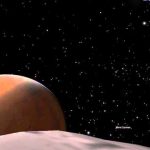
This animation shows the flyby (speeded up) as if you were standing on Phobos, with Mars in the background and Mars Express sweeping out an arc above. Toward the end of the sequence, Mars Express disappears behind Mars and out of sight of Phobos.
This animation tracks Rosetta’s journey through the Solar System, using gravity slingshots from Earth and Mars to reach its final destination: Comet 67P/Churyumov–Gerasimenko. Rosetta made three flybys of Earth, on 4 March 2005, 13 November 2007 and 13 November 2009, and one of Mars, on 25 February 2007. Rosetta has also visited two asteroids, taking extensive close-up images of 2867 Steins on 5 September 2008 and 21 Lutetia on 10 July 2010. Once the spacecraft is woken up from deep space hibernation on 20 January 2014, it will head for rendezvous with the comet in May. In November the Philae probe will be deployed to the comet surface. Rosetta will follow the comet to its closest distance to the Sun on 13 August 2015 and as it moves back towards the outer Solar System. The nominal mission end is December 2015.
Credits: ESA