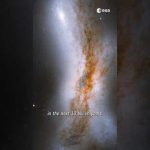
For years, astronomers believed the Milky Way and Andromeda were on a direct collision course in about 4.5 billion years. But new research using data from our Gaia mission and Hubble Space Telescope suggests the story isn’t so simple.
After running 100 000 simulations with the most precise data available, scientists now say there’s only a 50% chance the two galaxies will collide in the next 10 billion years.
The Large Magellanic Cloud, one of our satellite galaxies, could be tugging the Milky Way just enough to steer it away from Andromeda. Instead of crashing, the two galaxies might simply orbit each other in a slow cosmic dance.
So the fate of the Milky Way remains uncertain. And with the Sun expected to make Earth uninhabitable in about a billion years, a galaxy collision is low on our list of concerns.
📹 European Space Agency (ESA) 📸 NASA, ESA, STScI, Till Sawala (University of Helsinki), DSS, J. DePasquale (STScI)
For over a decade, ESA’s Gaia mission has mapped our galaxy with stunning precision—rewriting the story of the Milky Way. As its mission enters a new phase, we look back at its most groundbreaking discoveries.
Credit: ESA – European Space Agency
Chapters: 00:23 – Mapping the Milky Way and beyond 00:58 – Structure of the Milky Way 01:40 – Galactic family tree 02:27 – Mapping star-forming regions 03:00 – Ancient star streams 03:19 – Cosmic encounters 04:07 – Black holes and hidden giants
★ Subscribe: http://bit.ly/ESAsubscribe and click twice on the bell button to receive our notifications.
We are Europe’s gateway to space. Our mission is to shape the development of Europe’s space capability and ensure that investment in space continues to deliver benefits to the citizens of Europe and the world. Check out https://www.esa.int/ to get up to speed on everything space related.
From 25 July 2014 to 15 January 2025, the Gaia space observatory performed high-precision measurements of nearly two billion stars from its Lissajous orbit around the L2 Lagrange point, 1.5 million km from Earth.
After 10.5 years of groundbreaking observations, Gaia’s cold gas supply for attitude control has been depleted. On 27 March 2025, Gaia will leave its Lissajous orbit and transition into a stable heliocentric orbit. Soon after, the spacecraft will be passivated, with its instruments and transmitters switched off.
While Gaia will no longer collect new data, its scientific mission is far from over! The team continues working on Gaia Data Release 4 (expected 2026) and the final legacy catalogue (to be published not before the end of 2030), ensuring that Gaia’s discoveries will shape astronomy for decades to come.
This video visualises how Gaia leaves its Lissajous orbit and enters its final heliocentric orbit.
This video was made with Gaia Sky (https://gaiasky.space) by Tiago Nogueira, Toni Sagristà, and Stefan Jordan.
Text: Stefan Jordan, Tiago Nogueira, Tineke Roegiers
The creators would like to thank Alessandro Masat and Ander Martinez from ESA for providing Gaia’s orbit and attitude data.
Credit: ESA/Gaia/DPAC, CC BY-SA 3.0 IGO
★ Subscribe: http://bit.ly/ESAsubscribe and click twice on the bell button to receive our notifications.
We are Europe’s gateway to space. Our mission is to shape the development of Europe’s space capability and ensure that investment in space continues to deliver benefits to the citizens of Europe and the world. Check out https://www.esa.int/ to get up to speed on everything space related.
In 1975, 10 European countries came together with a vision to collaborate on key space activities: science and astronomy, launch capabilities and space applications: the European Space Agency, ESA, was born.
In 2025, we mark half a century of joint European achievement – filled with firsts and breakthroughs in science, exploration and technology, and the space infrastructure and economy that power Europe today.
During the past five decades ESA has grown, developing ever bolder and bigger projects and adding more Member States, with Slovenia joining as the latest full Member State in January.
We’ll also celebrate the 50th anniversary of ESA’s Estrack network, 30 years of satellite navigation in Europe and 20 years since ESA launched the first demonstration satellite Giove-A which laid the foundation for the EU’s own satnav constellation Galileo. Other notable celebrations are the 20th anniversary of ESA’s Business Incubation Centres, or BICs, and the 30th year in space for SOHO, the joint ESA and NASA Solar and Heliospheric Observatory.
Sadly though, 2025 will mean end of science operations for Integral and Gaia. Integral, ESA’s gamma-ray observatory has exotic objects in space since 2002 and Gaia concludes a decade of mapping the stars. But as some space telescopes retire, another one provides its first full data release. Launched in 2023, we expect Euclid’s data release early in the new year.
Launch-wise, we’re looking forward to Copernicus Sentinel-4 and -5 (Sentinel-4 will fly on an MTG-sounder satellite and Sentinel-5 on the MetOp-SG-A1 satellite), Copernicus Sentinel-1D, Sentinel-6B and Biomass. We’ll also launch the SMILE mission, or Solar wind Magnetosphere Ionosphere Link Explorer, a joint mission with the Chinese academy of science.
The most powerful version of Europe’s new heavy-lift rocket, Ariane 6, is set to fly operationally for the first time in 2025. With several European commercial launcher companies planning to conduct their first orbital launches in 2025 too, ESA is kicking off the European Launcher Challenge to support the further development of European space transportation industry.
In human spaceflight, Polish ESA project astronaut Sławosz Uznański will fly to the ISS on the commercial Axiom-4 mission. Artemis II will be launched with the second European Service Module, on the first crewed mission around the Moon since 1972.
The year that ESA looks back on a half century of European achievement will also be one of key decisions on our future. At the Ministerial Council towards the end of 2025, our Member States will convene to ensure that Europe’s crucial needs, ambitions and the dreams that unite us in space become reality.
So, in 2025, we’ll celebrate the legacy of those who came before but also help establish a foundation for the next 50 years. Join us as we look forward to a year that honours ESA’s legacy and promises new milestones in space.
Credits: ESA – European Space Agency
★ Subscribe: http://bit.ly/ESAsubscribe and click twice on the bell button to receive our notifications.
We are Europe’s gateway to space. Our mission is to shape the development of Europe’s space capability and ensure that investment in space continues to deliver benefits to the citizens of Europe and the world. Check out https://www.esa.int/ to get up to speed on everything space related.
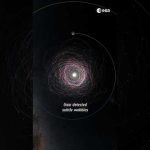
Thanks to the incredible precision of our Gaia mission, scientists have discovered potential moons orbiting over 350 asteroids! This nearly doubles the known number of ‘binary asteroids,’ revealing a whole new layer of complexity in our Solar System.
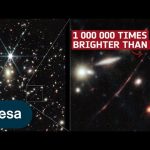
Embark on a cosmic journey with ESA as we explore the universe through the lens of ‘One Million’. From the scorching temperatures of the Sun’s corona to the cosmic gaze of the NASA/ESA/CSA James Webb Space Telescope — discover the astronomical wonders that surround us. 🚀
🎉 Join our space community in celebrating a momentous occasion — 1 MILLION subscribers on YouTube! 🌟 Thank you for your enthusiasm and support. ✨
★ Subscribe: http://bit.ly/ESAsubscribe and click twice on the bell button to receive our notifications.
We are Europe’s gateway to space. Our mission is to shape the development of Europe’s space capability and ensure that investment in space continues to deliver benefits to the citizens of Europe and the world. Check out https://www.esa.int/ to get up to speed on everything space related.
Ten years ago, on 19 December 2013, our billion star-mapping satellite Gaia launched.
Since then, Gaia has been scanning the sky and gathering an enormous amount of data on the positions and motions of 1.8 billion stars, enabling discoveries about the history of our galaxy.
Gaia is creating an extraordinarily precise three-dimensional map of more than a billion stars throughout our Milky Way galaxy and beyond, mapping their motions, luminosity, temperature and composition.
This huge stellar census will provide the data needed to tackle an enormous range of important questions related to the origin, structure and evolutionary history of our galaxy.
Gaia’s catalogue is ever-growing containing data on stars and other cosmic objects such as galaxies, exoplanets, and binary stars. Here’s to more discoveries!
Today, our Gaia mission releases a goldmine of knowledge about our galaxy and beyond. Among other findings, the star surveyor surpasses its planned potential to reveal half a million new and faint stars in a massive cluster, identify over 380 possible cosmic lenses, and pinpoint the positions of more than 150 000 asteroids within the Solar System.
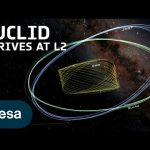
In the month after its launch on 1 July, Euclid has travelled 1.5 million kilometres from Earth towards the Sun-Earth Lagrange point L2, meaning it has ‘arrived’ at its destination orbit.
This animation showcases the orbits of Euclid (green), the James Webb Space Telescope (blue), and the Gaia mission (yellow) around this unique position in space. The positions of the spacecraft in this animation don’t correspond to their current positions in space.
Located about 1.5 million kilometres from Earth in the opposite direction from the Sun, L2 is about four times further away than our Moon. Several other space missions like Webb and Gaia also orbit L2 as it offers the perfect vantage point to study the Universe.
At L2, the spacecraft can keep the Sun, Earth and Moon behind them at all times, so they don’t interfere with observations, while at the same time getting a clear view of deep space and pointing an antenna back to Earth to remain in close communication.
Euclid and Webb’s halo orbit around L2 is big. In terms of distance, the ‘radius’ of Euclid’s orbit varies from about 400 000 kilometres at its closest to the centre, and up to 800 000 kilometres at its furthest. By the time Euclid has completed one full revolution around L2, the Moon will have circled the Earth six times. Gaia orbits L2 in a Lissajous orbit, with a maximum distance of around 350 000 km from its centre.
The region around L2 is big and even though the orbits of these spacecraft seem to cross in the animation, in reality there is plenty of space and a collision can be easily avoided. For example, Webb and Gaia are between 400 000 and 1 100 000 km apart, depending on where they are in their respective orbits.
Video credit: ESA/Gaia/DPAC; CC BY-SA 3.0 IGO
★ Subscribe: http://bit.ly/ESAsubscribe and click twice on the bell button to receive our notifications.
We are Europe’s gateway to space. Our mission is to shape the development of Europe’s space capability and ensure that investment in space continues to deliver benefits to the citizens of Europe and the world. Check out https://www.esa.int/ to get up to speed on everything space related.
Chariklo is an icy, small body, but the largest of the known Centaur population, located more than 3.2 billion kilometres away beyond the orbit of Saturn. Chariklo is only 250 kilometers or ~51 times smaller than Earth in diameter, and its rings orbit at a distance of about 400 kilometers from the center of the body.
On 18 October 2022, a team used the James Webb Space Telescipe to closely monitor the star Gaia DR3 6873519665992128512, and watch for the tell-tale dips in brightness indicating an occultation had taken place. The shadows produced by Chariklo’s rings were clearly detected, demonstrating a new way of using Webb to explore solar system objects. The star shadow due to Chariklo itself tracked just out of Webb’s view. This appulse (the technical name for a close pass with no occultation) was exactly as had been predicted after the last Webb course trajectory maneuver.
Credit: @NASA, ESA, CSA, Leah Hustak (STScI), Pablo Santos-Sanz (IAA-CSIC), Nicolás Morales (IAA-CSIC), Bruno Morgado (UFRJ, ON/MCTI, LIneA)
★ Subscribe: http://bit.ly/ESAsubscribe and click twice on the bell button to receive our notifications.
We are Europe’s gateway to space. Our mission is to shape the development of Europe’s space capability and ensure that investment in space continues to deliver benefits to the citizens of Europe and the world. Check out https://www.esa.int/ to get up to speed on everything space related.
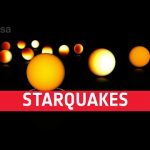
One of the surprising discoveries coming out of Gaia data release 3, is that Gaia is able to detect starquakes – tiny motions on the surface of a star – that change the shapes of stars, something the observatory was not originally built for.
Previously, Gaia already found radial oscillations that cause stars to swell and shrink periodically, while keeping their spherical shape. But Gaia has now also spotted other vibrations that are more like large-scale tsunamis. These nonradial oscillations change the global shape of a star and are therefore harder to detect.
Nonradial oscillation modes cause a star’s surface to move while it rotates, as shown in the animation. Dark patches are slightly cooler than bright patches, giving rise to periodic changes in the brightness of the star. The frequency of the rotating and pulsating stars was increased 8.6 million times to shift them into the audible range of humans.
Credit: ESA/Gaia/DPAC, CC BY-SA 3.0 IGO. Acknowledgement: Animation and sonification were created by: Dr. Joey Mombarg, KU Leuven, Belgium. Based on information from Gaia Data Release 3: Pulsations in main-sequence OBAF stars as observed by Gaia by the Gaia Collaboration, De Ridder et al., 2022, submitted to A&A. Van Reeth et al. 2015, ApJS 218, id.2, 32 pp. Mombarg et al. 2021, A&A 650, id.A58, 23 pp.
★ Subscribe: http://bit.ly/ESAsubscribe and click twice on the bell button to receive our notifications.
We are Europe’s gateway to space. Our mission is to shape the development of Europe’s space capability and ensure that investment in space continues to deliver benefits to the citizens of Europe and the world. Check out https://www.esa.int/ to get up to speed on everything space related.
Since its launch in 2013 ESA’s Gaia observatory has been mapping our galaxy from Lagrange point 2, creating the most accurate and complete multi-dimensional map of the Milky Way. By now two full sets of data have been released, the first set in 2016 and a second one in 2018. These data releases contained stellar positions, distances, motions across the sky, and colour information, among others. Now on 13 June 2022 a third and new full data set will be released. This data release will contain even more and improved information about almost 2 billion stars, Solar System objects and extragalactic sources. It also includes radial velocities for 33 million stars, a five-time increase compared to data release 2. Another novelty in this data set is the largest catalogue yet of binary stars in the Milky Way, which is crucial to understand stellar evolution.
We are Europe’s gateway to space. Our mission is to shape the development of Europe’s space capability and ensure that investment in space continues to deliver benefits to the citizens of Europe and the world. Check out https://www.esa.int/ to get up to speed on everything space related.
As always, a new year brings new and exciting missions and launches for ESA. In science the world looks forward to the first image releases of the recently launched James Webb Space Telescope and the third data release for Gaia, both teaching us more about our galaxy and Universe. ESA’s new Mars rover will be launched with the ExoMars mission, and we will also see the maiden flights of Vega-C, Ariane 6 and the Artemis I flight. Astronaut Samantha Cristoforetti will return to the ISS for her second mission and a new class of astronauts will be presented to the world. After the groundwork has been laid in 2021 a new Ministerial Council Meeting will gather to look at the future of ESA, and the need for ESA and Europe to accelerate space and integrated space technology into the fabric of our lives.
★ Subscribe: http://bit.ly/ESAsubscribe and click twice on the bell button to receive our notifications.
We are Europe’s gateway to space. Our mission is to shape the development of Europe’s space capability and ensure that investment in space continues to deliver benefits to the citizens of Europe and the world. Check out https://www.esa.int/ to get up to speed on everything space related.
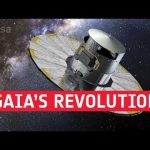
Launched in December 2013, the Gaia mission is revolutionising our understanding of the Milky Way. The space telescope is mapping our galaxy in unprecedented detail – measuring the position, movement and distance of stars.
At a meeting in Groningen in the Netherlands, scientists have been discussing the challenge of processing and visualising Gaia data.
We are Europe’s gateway to space. Our mission is to shape the development of Europe’s space capability and ensure that investment in space continues to deliver benefits to the citizens of Europe and the world. Check out http://www.esa.int/ESA to get up to speed on everything space related.
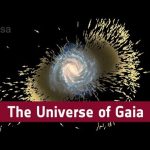
Launched in December 2013, ESA’s Gaia satellite has been scanning the sky to perform the most precise stellar census of our Milky Way galaxy, observing more than one billion stars and measuring their positions, distances and motions to unprecedented accuracy.
The second Gaia data release, published in April, has provided scientists with extraordinary data to investigate the formation and evolution of stars in the Galaxy and beyond, giving rise to hundreds of scientific studies that are revolutionising our view of the cosmos.
Credits: ESA / CNES / Arianespace; ESA / Gaia / DPAC; Gaia Sky / S. Jordan / T. Sagristà; Koppelman, Villalobos and Helmi; Marchetti et al. 2018; NASA / ESA / Hubble; ESO, M. Kornmesser, L. Calçada
★ Subscribe: http://bit.ly/ESAsubscribe and click twice on the bell button to receive our notifications.
ESA is Europe’s gateway to space. Our mission is to shape the development of Europe’s space capability and ensure that investment in space continues to deliver benefits to the citizens of Europe and the world. Check out http://www.esa.int/ESA to get up to speed on everything space related.
Astronomy is undergoing a revolution with the release of precision data on 1.7 billion stars in our galaxy from the Gaia space telescope. We head to the historic Observatory of Paris and ESA’s ESTEC base in the Netherlands to find out more.
It’s fair to say that science has been waiting for centuries, or even millennia for such a detailed survey of the Milky Way, and right now star-gazers are swamped with fresh, high-quality data that they can use to answer every question about the galaxy they ever wanted to ask.
Nesta edição de “Space”, a partir do Observatório de Paris, vamos encontrar-nos com astrónomos que trabalham numa missão especial do telescópio Gaia, que tem vigiado mais de mil milhões de estrelas da nossa galáxia, tentando dar resposta a alguns dos mistérios da Via Láctea.
Astronomen haben mit Daten vom Weltraumteleskop Gaia eine Himmelskarte mit mehr als einer Milliarde Sternen erstellt – mehr als genug Material für Jahrzehnte der Forschung.
The second data release of ESA’s Gaia mission has produced an extraordinary catalogue of over one and a half billion stars in our galaxy. Based on observations between July 2014 to May 2016, it includes the most accurate information yet on the positions, brightness, distance, motion, colour and temperature of stars in the Milky Way as well as information on asteroids and quasars.
Animated view of 14 099 asteroids in our Solar System, as viewed by ESA’s Gaia satellite using information from the mission’s second data release. The orbits of the 200 brightest asteroids are also shown, as determined using Gaia data.
In future data releases, Gaia will also provide asteroid spectra and enable a complete characterisation of the asteroid belt. The combination of dynamical and physical information that is being collected by Gaia provides an unprecedented opportunity to improve our understanding of the origin and the evolution of the Solar System.
Credit: ESA/Gaia/DPAC, CC BY SA 3.0 IGO
Acknowledgement: Gaia Data Processing and Analysis Consortium (DPAC); Orbits: Gaia Coordinating Unit 4; P. Tanga, Observatoire de la Côte d’Azur, France; F. Spoto, IMCCE, Observatoire de Paris, France; Animation: Gaia Sky; S. Jordan / T. Sagristà, Astronomisches Rechen-Institut, Zentrum für Astronomie der Universität Heidelberg, Germany
A 360° animated view of the entire sky on 25 April 2018.
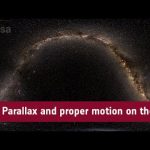
After a few seconds, the stars start moving in the sky according to parallax, an apparent shift caused by Earth’s yearly motion around the Sun. Then, constellation outlines appear as visual aids. Finally, stars start moving according to their true motion through space, which is visible on the sky as proper motion. Parallaxes have been exaggerated by 100 000 and proper motions have been speeded up by one trillion (10^12) to make them visible in this animation. This animation is based on data from the second data release of ESA’s Gaia satellite, which has measured the positions, parallaxes and motions of more than one billion stars across the sky to unprecedented accuracy.
ESA/Gaia/DPAC, CC BY SA 3.0 IGO
Acknowledgement: Gaia Data Processing and Analysis Consortium (DPAC); Gaia Sky; S. Jordan / T. Sagristà, Astronomisches Rechen-Institut, Zentrum für Astronomie der Universität Heidelberg, Germany
On 25 April 2018, ESA’s Gaia mission will publish its much awaited second data release, including high-precision measurements of nearly 1.7 billion stars in our Galaxy.
Scientists who have been working on creating and validating the data contained in the catalogue tell us why they are waiting for this extraordinary release.
Featured in the video: Antonella Vallenari (INAF, Astronomical Observatory of Padua), Anthony Brown (Leiden University), Timo Prusti (European Space Agency), Annie Robin (Institut UTINAM, OSU THETA Franche-Comté-Bourgogne), Laurent Eyer (University of Geneva) and Federica Spoto (IMCCE, Observatory of Paris).
A media briefing on the second Gaia data release will be held at the ILA Berlin Air and Space Show in Germany on 25 April 11:00-12:15 CEST. Watch the webstream at www.esa.int/live
Teresa Antoja holds a PhD in Physics and works as Research Fellow on the Gaia Mission. She gets everything ready so that the data coming down from the spacecraft can be used quickly and efficiently, contributing to its scientific exploitation by scientists all over the world that will revolutionise our view of our galaxy.