Tag: Gaia telescope

  • Gaia leaves for retirement orbit

    Gaia leaves for retirement orbit

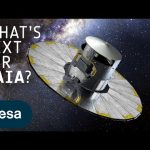
    From 25 July 2014 to 15 January 2025, the Gaia space observatory performed high-precision measurements of nearly two billion stars from its Lissajous orbit around the L2 Lagrange point, 1.5 million km from Earth.

    After 10.5 years of groundbreaking observations, Gaia’s cold gas supply for attitude control has been depleted. On 27 March 2025, Gaia will leave its Lissajous orbit and transition into a stable heliocentric orbit. Soon after, the spacecraft will be passivated, with its instruments and transmitters switched off.

    While Gaia will no longer collect new data, its scientific mission is far from over! The team continues working on Gaia Data Release 4 (expected 2026) and the final legacy catalogue (to be published not before the end of 2030), ensuring that Gaia’s discoveries will shape astronomy for decades to come.

    This video visualises how Gaia leaves its Lissajous orbit and enters its final heliocentric orbit.

    This video was made with Gaia Sky (https://gaiasky.space) by Tiago Nogueira, Toni Sagristà, and Stefan Jordan.

    Text: Stefan Jordan, Tiago Nogueira, Tineke Roegiers

    The creators would like to thank Alessandro Masat and Ander Martinez from ESA for providing Gaia’s orbit and attitude data.

    Credit: ESA/Gaia/DPAC, CC BY-SA 3.0 IGO

    ★ Subscribe: http://bit.ly/ESAsubscribe and click twice on the bell button to receive our notifications.

    Check out our full video catalog: http://bit.ly/SpaceInVideos
    Follow us on Twitter: http://bit.ly/ESAonTwitter
    On Facebook: http://bit.ly/ESAonFacebook
    On Instagram: http://bit.ly/ESAonInstagram
    On LinkedIn: https://bit.ly/ESAonLinkedIn
    On Pinterest: https://bit.ly/ESAonPinterest
    On Flickr: http://bit.ly/ESAonFlickr

    We are Europe’s gateway to space. Our mission is to shape the development of Europe’s space capability and ensure that investment in space continues to deliver benefits to the citizens of Europe and the world. Check out https://www.esa.int/ to get up to speed on everything space related.

    Copyright information about our videos is available here: https://www.esa.int/ESA_Multimedia/Terms_and_Conditions

  • This is where we are in the Milky Way… 🌌

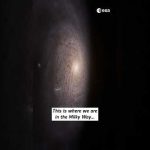
    This is where we are in the Milky Way… 🌌

    This stunning artist’s animation of the Milky Way is based on data from ESA’s Gaia space telescope. Gaia has completely reshaped our understanding of our home galaxy—revealing unexpected details about its spiral arms, central bar, and overall structure.

    We can’t take a selfie of the Milky Way, but thanks to Gaia, we’re seeing it clearer than ever! And with more data releases on the way, our view will only get sharper.

    Credit: ESA/Gaia/DPAC, Stefan Payne-Wardenaar

    #ESA #MilkyWay #Gaia

  • The best Milky Way animation, by Gaia

    The best Milky Way animation, by Gaia

    This is a new artist’s animation of our galaxy, the Milky Way, based on data from ESA’s Gaia space telescope.

    Gaia has changed our impression of the Milky Way. Even seemingly simple ideas about the nature of our galaxy’s central bar and the spiral arms have been overturned. Gaia has shown us that it has more than two spiral arms and that they are less prominent than we previously thought. In addition, Gaia has shown that its central bar is more inclined with respect to the Sun.
    No spacecraft can travel beyond our galaxy, so we can’t take a selfie, but Gaia is giving us the best insight yet of what our home galaxy looks like. Once all of Gaia’s observations collected over the past decade are made available in two upcoming data releases, we can expect an even sharper view of the Milky Way.

    Click here to download the still image of the Milky Way: https://www.esa.int/Science_Exploration/Space_Science/Gaia/New_Gaia_release_reveals_rare_lenses_cluster_cores_and_unforeseen_science

    Credit: ESA/Gaia/DPAC, Stefan Payne-Wardenaar

    ★ Subscribe: http://bit.ly/ESAsubscribe and click twice on the bell button to receive our notifications.

    Check out our full video catalog: http://bit.ly/SpaceInVideos
    Follow us on Twitter: http://bit.ly/ESAonTwitter
    On Facebook: http://bit.ly/ESAonFacebook
    On Instagram: http://bit.ly/ESAonInstagram
    On LinkedIn: https://bit.ly/ESAonLinkedIn
    On Pinterest: https://bit.ly/ESAonPinterest
    On Flickr: http://bit.ly/ESAonFlickr

    We are Europe’s gateway to space. Our mission is to shape the development of Europe’s space capability and ensure that investment in space continues to deliver benefits to the citizens of Europe and the world. Check out https://www.esa.int/ to get up to speed on everything space related.

    Copyright information about our videos is available here: https://www.esa.int/ESA_Multimedia/Terms_and_Conditions

    #ESA #Gaia #MilkyWay