Tag: GaiaDR2

  • The Universe of Gaia

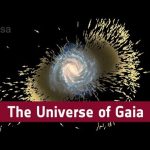
    The Universe of Gaia

    Launched in December 2013, ESA’s Gaia satellite has been scanning the sky to perform the most precise stellar census of our Milky Way galaxy, observing more than one billion stars and measuring their positions, distances and motions to unprecedented accuracy.

    The second Gaia data release, published in April, has provided scientists with extraordinary data to investigate the formation and evolution of stars in the Galaxy and beyond, giving rise to hundreds of scientific studies that are revolutionising our view of the cosmos.

    More info: http://bit.ly/GaiaScience

    Credits: ESA / CNES / Arianespace; ESA / Gaia / DPAC; Gaia Sky / S. Jordan / T. Sagristà; Koppelman, Villalobos and Helmi;
    Marchetti et al. 2018; NASA / ESA / Hubble; ESO, M. Kornmesser, L. Calçada

    ★ Subscribe: http://bit.ly/ESAsubscribe and click twice on the bell button to receive our notifications.

    Check out our full video catalog: http://bit.ly/SpaceInVideos
    Follow ESA on Twitter: http://bit.ly/ESAonTwitter
    On Facebook: http://bit.ly/ESAonFacebook
    On Instagram: http://bit.ly/ESAonInstagram
    On Flickr: http://bit.ly/ESAonFlickr

    ESA is Europe’s gateway to space. Our mission is to shape the development of Europe’s space capability and ensure that investment in space continues to deliver benefits to the citizens of Europe and the world. Check out http://www.esa.int/ESA to get up to speed on everything space related.

    Copyright information about our videos is available here: http://www.esa.int/spaceinvideos/Terms_and_Conditions

  • Gaia second data release

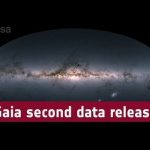
    Gaia second data release

    The second data release of ESA’s Gaia mission has produced an extraordinary catalogue of over one and a half billion stars in our galaxy. Based on observations between July 2014 to May 2016, it includes the most accurate information yet on the positions, brightness, distance, motion, colour and temperature of stars in the Milky Way as well as information on asteroids and quasars.

    ★ Subscribe: http://bit.ly/ESAsubscribe

    Learn more: http://bit.ly/GaiaRickestStarMap

  • The Hyades cluster

    The Hyades cluster

    Animated 3D view of the sky as observed by ESA’s Gaia satellite using information from the mission’s second data release.

    The bright band in the left half of the image is the Milky Way, where most of the stars in our Galaxy reside. The animation starts with the Orion constellation at the centre; we then move towards the neighbouring Taurus constellation and to the Hyades star cluster, which is part of this constellation. Hyades is the closest open cluster to the Solar System, some 150 light-years away.

    The animation first shows the 3D structure of the cluster, based on accurate position and distance information from Gaia. Then an animated view of the future motions of stars is shown – both in Hyades and beyond. This is based on Gaia’s measurements of the velocity of stars across the sky, also known as proper motion.

    Credit: ESA/Gaia/DPAC, CC BY SA 3.0 IGO

    Acknowledgement: Gaia Data Processing and Analysis Consortium (DPAC); Gaia Sky; S. Jordan / T. Sagristà, Astronomisches Rechen-Institut, Zentrum für Astronomie der Universität Heidelberg, Germany

    ★ Subscribe: http://bit.ly/ESAsubscribe

    Learn more: bit.ly/GaiaRickestStarMap

  • Gaia’s first asteroid survey

    Gaia’s first asteroid survey

    Animated view of 14 099 asteroids in our Solar System, as viewed by ESA’s Gaia satellite using information from the mission’s second data release. The orbits of the 200 brightest asteroids are also shown, as determined using Gaia data.

    In future data releases, Gaia will also provide asteroid spectra and enable a complete characterisation of the asteroid belt. The combination of dynamical and physical information that is being collected by Gaia provides an unprecedented opportunity to improve our understanding of the origin and the evolution of the Solar System.

    Credit: ESA/Gaia/DPAC, CC BY SA 3.0 IGO

    Acknowledgement: Gaia Data Processing and Analysis Consortium (DPAC); Orbits: Gaia Coordinating Unit 4; P. Tanga, Observatoire de la Côte d’Azur, France; F. Spoto, IMCCE, Observatoire de Paris, France; Animation: Gaia Sky; S. Jordan / T. Sagristà, Astronomisches Rechen-Institut, Zentrum für Astronomie der Universität Heidelberg, Germany

    ★ Subscribe: http://bit.ly/ESAsubscribe

    Learn more: bit.ly/GaiaRickestStarMap

  • 360º Parallax and proper motion on the sky

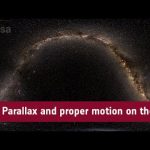
    360º Parallax and proper motion on the sky

    A 360° animated view of the entire sky on 25 April 2018.

    After a few seconds, the stars start moving in the sky according to parallax, an apparent shift caused by Earth’s yearly motion around the Sun. Then, constellation outlines appear as visual aids. Finally, stars start moving according to their true motion through space, which is visible on the sky as proper motion. Parallaxes have been exaggerated by 100 000 and proper motions have been speeded up by one trillion (10^12) to make them visible in this animation. This animation is based on data from the second data release of ESA’s Gaia satellite, which has measured the positions, parallaxes and motions of more than one billion stars across the sky to unprecedented accuracy.

    ESA/Gaia/DPAC, CC BY SA 3.0 IGO

    Acknowledgement: Gaia Data Processing and Analysis Consortium (DPAC); Gaia Sky; S. Jordan / T. Sagristà, Astronomisches Rechen-Institut, Zentrum für Astronomie der Universität Heidelberg, Germany

    ★ Subscribe: http://bit.ly/ESAsubscribe

    Learn more: http://bit.ly/GaiaRickestStarMap