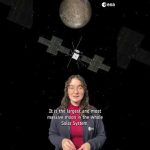
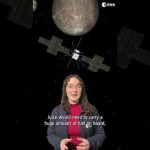
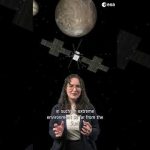
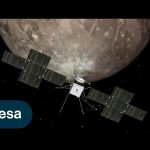
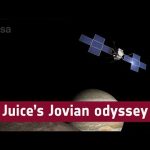
Ganymede is the primary scientific target of the Jupiter Icy Moons Explorer, Juice, mission. With a diameter of about 5260 km, larger than that of Pluto and Mercury, Ganymede tops the Solar-System moons’ size chart. It is the seventh moon from the gas giant (and the third among the Galilean satellites) and orbits Jupiter at a distance of more than 1 million kilometres. Researchers believe there is tidal heating on Ganymede, although to a much smaller degree than on Io and Europa. This heat could drive some tectonic activity and provide one of the necessary conditions for life to emerge: a source of energy.
This high-resolution mapping of the surface can help constrain the moon’s composition and mineralogy, and assess how habitable Ganymede could be by searching for biosignatures. Observations at various wavelengths will allow astronomers to study non-water-ice material to determine the distribution of biologically essential elements—such as carbon or oxygen—and other important elements—such as magnesium and iron—on the planetary body. The mission will also shed light on the origin and evolution of the materials on the surface by exploring which substances form at Ganymede and which are brought in from the plasma environment around the moon.
To study Ganymede in detail, Juice will enter orbit around it, becoming the first spacecraft to orbit a moon in the outer Solar System. The dedicated orbital tour is expected to last about eight months and will be the final stage of the mission.
📹 @EuropeanSpaceAgency
★ Subscribe: http://bit.ly/ESAsubscribe and click twice on the bell button to receive our notifications.
We are Europe’s gateway to space. Our mission is to shape the development of Europe’s space capability and ensure that investment in space continues to deliver benefits to the citizens of Europe and the world. Check out https://www.esa.int/ to get up to speed on everything space related.
When a spacecraft launches on a mission to another planet it must first break free of the Earth’s gravitational field. Once it has done that, it enters interplanetary space, where the dominant force is the gravitational field of the Sun.
The spacecraft begins to follow a curving orbit, around the Sun, which is similar to the orbit of a comet. When this orbit brings it close to its target destination the spacecraft must fire a retrorocket to slow down and allow itself to be captured by the gravitational field of its target. The smaller the target, the more the spacecraft must slow down.
Sometimes passing a planet can result in the spacecraft being accelerated, even without the spacecraft firing any of its thrusters. This is known as the ‘slingshot’ effect. Such ‘gravity assist’ manoeuvres are now a standard part of spaceflight and are used by almost all our interplanetary missions. They take advantage of the fact that the gravitational attraction of the planets can be used to change the trajectory and speed of a spacecraft.
The amount by which the spacecraft speeds up or slows down is determined by whether it is passing behind or in front of the planet as the planet follows its orbit. When the spacecraft leaves the influence of the planet, it follows an orbit on a different course than before.
📹 @EuropeanSpaceAgency
★ Subscribe: http://bit.ly/ESAsubscribe and click twice on the bell button to receive our notifications.
We are Europe’s gateway to space. Our mission is to shape the development of Europe’s space capability and ensure that investment in space continues to deliver benefits to the citizens of Europe and the world. Check out https://www.esa.int/ to get up to speed on everything space related.
Our Jupiter Icy Moons Explorer, Juice, will make detailed observations of the giant gas planet and its three large ocean-bearing moons – Ganymede, Callisto and Europa – with a suite of remote sensing, geophysical and in situ instruments. The mission will characterise these moons as both planetary objects and possible habitats, explore Jupiter’s complex environment in depth, and study the wider Jupiter system as an archetype for gas giants across the Universe.
Juliet will be taking us to Jupiter and its moons in the coming weeks. So stay tuned for more!
📹 @europeanspaceagency
★ Subscribe: http://bit.ly/ESAsubscribe and click twice on the bell button to receive our notifications.
We are Europe’s gateway to space. Our mission is to shape the development of Europe’s space capability and ensure that investment in space continues to deliver benefits to the citizens of Europe and the world. Check out https://www.esa.int/ to get up to speed on everything space related.
ESA’s Juice mission has entered its final phase of development, with the spacecraft moving to an @Airbus Defence and Space facility in Toulouse, France, for the next round of testing. The spacecraft has been fully integrated, and these tests will be done in full flight configuration, as Juice is scheduled for launch from Europe’s Spaceport in Kourou, French Guiana, in April 2023.
The Juice mission is a perfect example of collaboration between several national space agencies and European industry. Its objective is to explore the gas giant Jupiter, its environment, and three of its moons: Europa, Callisto and Ganymede. By studying this planetary system, ESA hopes to learn more about the icy worlds around Jupiter and the origins and possibility of life in our Universe
We are Europe’s gateway to space. Our mission is to shape the development of Europe’s space capability and ensure that investment in space continues to deliver benefits to the citizens of Europe and the world. Check out https://www.esa.int/ to get up to speed on everything space related.
ESA’s Jupiter Icy Moons Explorer, Juice, is set to embark on an eight-year cruise to Jupiter starting April 2023. The mission will investigate the emergence of habitable worlds around gas giants and the Jupiter system as an archetype for the numerous giant planets now known to orbit other stars.
This animation depicts Juice’s journey to Jupiter and highlights from its foreseen tour of the giant planet and its large ocean-bearing moons. It depicts Juice’s journey from leaving Earth’s surface in a launch window 5–25 April 2023 and performing multiple gravity assist flybys in the inner Solar System, to arrival at Jupiter (July 2031), flybys of the Jovian moons Europa, Callisto and Ganymede, orbital insertion at Ganymede (December 2034), and eventual impact on this moon’s surface (late 2035).
An Ariane 5 will lift Juice into space from Europe’s Spaceport in Kourou. A series of gravity assist flybys of Earth, the Earth-Moon system and Venus will set the spacecraft on course for its July 2031 arrival at Jupiter. These flybys are shown here in order – Earth-Moon (August 2024), Venus (August 2025), Earth (September 2026, January 2029) – interspersed by Juice’s continuing orbits around the Sun. Juice’s flyby of the Earth-Moon system, known as a Lunar-Earth gravity assist (LEGA), is a world first: by performing this manoeuvre – a gravity assist flyby of the Moon followed just 1.5 days later by one of Earth – Juice will save a significant amount of propellant on its journey.
Juice will start its science mission about six months prior to entering orbit around Jupiter, making observations as it approaches its destination. Once in the Jovian system, a gravity assist flyby of Jupiter’s largest moon Ganymede – also the largest moon in the Solar System – will help Juice enter orbit around Jupiter, where the spacecraft will spend four years observing the gas giant and three of its moons: Ganymede, Callisto and Europa.
Juice will make two flybys of Europa (July 2032), which has strong evidence for an ocean of liquid water under its icy shell. Juice will look at the moon’s active zones, its surface composition and geology, search for pockets of liquid water under the surface, and study the plasma environment around Europa, also exploring the moon’s tiny atmosphere and hunting for plumes of water vapour (as have been previously detected erupting to space).
A sequence of Callisto flybys will be used to study this ancient, cratered world that may too harbour a subsurface ocean, also changing the angle of Juice’s orbit with respect to Jupiter’s equator, making it possible to explore Jupiter’s higher latitudes (2032–2034).
A sequence of Ganymede and Callisto flybys will adjust Juice’s orbit – properly orienting it while minimising the amount of propellant expended – so that it can enter orbit around Ganymede in December 2034, making it the first spacecraft to orbit another planet’s moon. Juice’s initial elliptical orbit will be followed by a 5000 km-altitude circular orbit, and later a 500 km-altitude circular orbit.
Ganymede is the only moon in the Solar System to have a magnetosphere. Juice will investigate this phenomenon and the moon’s internal magnetic field, and explore how its plasma environment interacts with that of Jupiter. Juice will also study Ganymede’s atmosphere, surface, subsurface, interior and internal ocean, investigating the moon as not only a planetary object but also a possible habitat.
Over time, Juice’s orbit around Ganymede will naturally decay due to lack of propellant, and it will make a grazing impact onto the surface (late 2035).
The Juice launch itself will be a historical milestone for more reasons than one. It will be the final launch for Ariane 5, ending the launcher’s nearly three-decade run as one of the world’s most successful heavy-lift rockets. Its duties are being taken over by Ariane 6.
We are Europe’s gateway to space. Our mission is to shape the development of Europe’s space capability and ensure that investment in space continues to deliver benefits to the citizens of Europe and the world. Check out https://www.esa.int/ to get up to speed on everything space related.
Listen to the full episode of this podcast and subscribe at: https://www.nasa.gov/gravityassist
For decades, moons of the outer solar system have proven fascinating subjects for scientists interested in the search for life. Forty years ago this year, NASA’s Voyager 1 spacecraft flew by Saturn’s moon Titan and took the first close images, revealing a thick orange-colored atmosphere that is the most Earth-like in the solar system. NASA’s Cassini probe then dropped off a lander at Titan called Huygens in 2004, and studied Titan in detail during its 13 years at Saturn. Now, NASA is preparing to launch the rotorcraft mission Dragonfly to Titan in the 2020s. But Titan is just one interesting moon. The European Space Agency’s upcoming JUpiter ICy moons Explorer (JUICE) mission will study Ganymede, Europa, and another moon of Jupiter called Callisto. Meanwhile, NASA’s Europa Clipper mission will provide complementary observations of Europa.
Juice, ESA’s Jupiter Icy Moons Explorer, is set to embark on a seven-year cruise to Jupiter starting May 2022. The mission will investigate the emergence of habitable worlds around gas giants and the Jupiter system as an archetype for the numerous giant planets now known to orbit other stars.
This animation depicts the journey to Jupiter and the highlights from its foreseen tour of the giant planet and its large ocean-bearing moons.
An Ariane 5 will lift Juice into space from Europe’s Spaceport in Kourou. A series of gravity-assist flybys at Earth (3), Venus (1) and Mars (1) will set the spacecraft on course for its October 2029 rendezvous in the Jovian system.
It is expected that a number of instruments will be activated during the gravity assists (indicated by the different coloured beams scanning across the planets) and measurements will be taken for calibration and to check the health of the instruments. The visualisations of the Earth flybys show the closest approaches over the planet according to current planning – over the South Pacific Ocean, Argentina and Peru, respectively. Throughout the animation, the instrument beam colours correspond to example observations by JANUS (green), MAJIS (red), UVS (purple), Gala (Blue) and RIME (grey), which are cameras, spectrometers, laser altimeter and radar.
During the Venus flyby, limited observations can be made because the spacecraft will be oriented to protect it from the heat of the Sun experienced in the inner Solar System. The Mars flyby will see Juice fly over the planet’s south pole to make scientific observations.
Juice will start its science mission about six months prior to arriving in orbit around the gas giant, making observations as it approaches its destination. Once in the Jovian system, a gravity-assist flyby of Jupiter’s largest moon Ganymede – the largest moon in the Solar System – helps Juice enter orbit around the gas giant 7.5 hours later.
While in Jupiter orbit, the spacecraft will study the Jovian system as an archetype for gas giants, making observations of its atmosphere, the magnetosphere, its rings and satellites.
During the tour, Juice will make two flybys of Europa, which has strong evidence for an ocean of liquid water under its icy shell. Juice will look at the moon’s active zones, its surface composition and geology, search for pockets of liquid water under the surface and study the plasma environment around Europa.
A sequence of Callisto flybys will not only be used to study this ancient, cratered world that may too harbor a subsurface ocean, but it will change the angle of Juice’s orbit with respect to Jupiter’s equator, making it possible to investigate the polar regions and environment at higher latitudes.
During the tour there will also be unique periods to observe events such as moon transits. The example in this animation shows Europa and Io passing in front of Jupiter on 27 January 2032. This type of event is rare, with less than 10 expected to occur during Juice’s tour of the Jovian system.
A sequence of Ganymede and Callisto flybys will adjust the orbit of Juice to enable it to enter orbit around Ganymede, marking it the first spacecraft to orbit another planet’s moon (aside from our own). The elliptical orbit will be followed by a 5000 km altitude cicular orbit, and later a 500 km circular orbit.
Ganymede is unique in the Solar System in that it is the only moon to have a magnetosphere. Juice will investigate this phenomenon and the moon’s internal magnetic field, and the interaction of its plasma environment with that of Jupiter. Juice will also study the moon’s atmosphere, surface, subsurface, interior and its internal ocean, investigating the moon as a planetary object and possible habitat.
Over time the 500 km orbit will naturally decay – eventually there will not be enough propellant to maintain it – and it will make a grazing impact on the surface. The animation concludes with an example of what the approach to impact could look like.
★ Subscribe: http://bit.ly/ESAsubscribe and click twice on the bell button to receive our notifications.
ESA is Europe’s gateway to space. Our mission is to shape the development of Europe’s space capability and ensure that investment in space continues to deliver benefits to the citizens of Europe and the world. Check out http://www.esa.int/ESA to get up to speed on everything space related.