Steve Spangler is a bestselling author, STEM educator and Emmy award-winning television personality with more than 2,100 television appearances to his credit. Steve appeared as a regular guest on the Ellen DeGeneres Show from 2007-2022 (27 appearances).
Steve Spangler is a bestselling author, STEM educator and Emmy award-winning television personality with more than 2,100 television appearances to his credit. Steve appeared as a regular guest on the Ellen DeGeneres Show from 2007-2022 (27 appearances).
Getting ready to image faraway planets, discussing artificial intelligence at NASA, and a milestone for our supersonic X-plane … a few of the stories to tell you about – This Week at NASA!
Link to download this video: https://images.nasa.gov/details/Getting%20Ready%20to%20Image%20Faraway%20Planets%20on%20This%20Week%20@NASA%20%E2%80%93%20May%2024,%202024
Video Producer: Andre Valentine Video Editor: Andre Valentine Narrator: Emanuel Cooper Music: Universal Production Music Credit: NASA
In its latest test of readiness for space, ESA’s Hera spacecraft for planetary defence is being operated for around three weeks in hard vacuum, while being subjected to the same temperature profiles it will experience during its journey to the Didymos binary asteroid system.
The 1.6 × 1.6 × 1.7 m spacecraft was slid inside the 4.5-m diameter, 11.8-m long Phenix thermal vacuum chamber at ESA’s ESTEC Test Centre in the Netherlands.
“You’re always a bit nervous when your baby gets moved about,” remarks Ian Carnelli, overseeing Hera for ESA. “Right now it’s being shut into a dark airless box for weeks on end, but we have confidence it will perform well.”
Hera can be seen receded into the rectangular ‘thermal tent’ within Phenix. The six copper walls of this internal box can be heated up to 100°C or cooled via piped liquid nitrogen down to –190°C, all independently from each other.
Then, after the main door of the stainless steel Phenix chamber was slid shut, the air within the chamber was pumped out during a lengthy 20 hours process down to approximately one billionth of outside atmospheric pressure. This will allow the Hera team from ESA, European Test Services operating the Test Centre and Hera manufacturer OHB to test the spacecraft’s thermal behaviour as the temperature changes around it.
Space is a place where it is possible to be hot and cold at the same time if one part of your spacecraft is in sunlight and another is in shade. And because there is no air, there is no conduction or convection to lose heat from your spacecraft. Instead thermal experts employ insulation and radiators to keep the body of a spacecraft within carefully chosen temperature limits. In general spacecraft electronics – just like their human makers – work best at room temperature.
“We already have detailed models of the spacecraft’s thermal behaviour, and this spacecraft-level thermal vacuum test lets us correlate these models with reality,” explains Hera’s Product Assurance and Safety manager, Heli Greus.
“More than 400 thermal sensors have been placed in and around Hera to give us precise knowledge of what is going on, and the test is being supervised on a 24/7 basis in case anything anomalous occurs. The spacecraft is now being put through a series of ‘cold plateaus’ and ‘hot plateaus’ representative of its mission, which will allow us to test the thermal limits of each specific unit aboard.”
Hera is Europe’s contribution to an international planetary defence experiment. Following the DART mission’s impact with the Dimorphos asteroid in 2022 – modifying its orbit and sending a plume of debris thousands of kilometres out into space – Hera will return to Dimorphos to perform a close-up survey of the crater left by DART. The mission will also measure Dimorphos’ mass and make-up, along with that of the larger Didymos asteroid that Dimorphos orbits around. Hera is due for launch in October 2024.
The ESTEC Test Centre in the Netherlands is the largest facility of its kind in Europe, providing a complete suite of equipment for all aspects of satellite testing under a single roof.
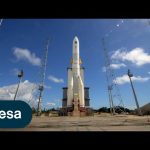
Teams across Europe and at Europe’s Spaceport in French Guiana, have been tirelessly conducting a test campaign that will, in 2024, end with the first launch of Europe’s newest heavy-lift rocket, Ariane 6.
In the summer, the mobile gantry was rolled back at the launchpad, revealing the huge rocket to the elements. Then, the main stage’s Vulcain 2.1 engine roared into life in a series of ‘hot fire’ tests for the rocket and entire ground system, including tank filling rehearsals, countdowns, vibration-damping water systems and more.
Tests continued on the upper-stage reignitable Vinci engine and Auxiliary Power Unit at the German Aerospace Center (DLR) test site in Lampoldshausen.
Very soon, tests will be complete, and Europe’s heavy-lift rocket will take flight.
★ Subscribe: http://bit.ly/ESAsubscribe and click twice on the bell button to receive our notifications.
We are Europe’s gateway to space. Our mission is to shape the development of Europe’s space capability and ensure that investment in space continues to deliver benefits to the citizens of Europe and the world. Check out https://www.esa.int/ to get up to speed on everything space related.
Changes in our climate, along with other factors, have led to wildfires increasing in intensity, severity, size and duration. NASA climate and wildfire expert Liz Hoy explains how and why NASA studies these events from the ground, air, and space to better understand the impacts they have on both a local and global scale. https://www.nasa.gov/fires
Producers: Jessica Wilde, Scott Bednar Editor: Daniel Salazar
Are hurricanes getting stronger? Although we’ll never see a Category 6 hurricane, data does show that more hurricanes are becoming more severe. Hurricane and climate expert Mara Cordero-Fuentes of NASA’s Goddard Space Flight Center tells us more about the connection between climate change and tropical cyclones.
The Artemis I mission is almost ready for launch: it will send an uncrewed spacecraft beyond the Moon and back. Join this virtual Q&A to learn more about Europe’s contribution to the mission: ESA is overseeing the development of the European Service Module, that provides air, electricity and propulsion to the spacecraft. Participants to this media briefing include Josef Aschbacher, ESA Director General ; David Parker, ESA Director for Human and Robotic Exploration ; Jean-Marc Nasr, @Airbus EVP Space Systems and Marc Steckling, Airbus Head of Space Exploration.
We are Europe’s gateway to space. Our mission is to shape the development of Europe’s space capability and ensure that investment in space continues to deliver benefits to the citizens of Europe and the world. Check out https://www.esa.int/ to get up to speed on everything space related.
Getting back to the business of NASA, an update on our Commercial Crew Program, and, our mission to the Sun is in full swing … a few of the stories to tell you about – This Week at NASA!
This video is available for download from NASA’s Image and Video Library: https://images.nasa.gov/details-NHQ_2019_0201_Getting%20Back%20to%20Business%20on%20This%20Week%20@NASA%20%E2%80%93%20February%201,%202019.html
Fake videos and audio keep getting better, faster and easier to make, increasing the mind-blowing technology’s potential for harm if put in the wrong hands. Bloomberg QuickTake explains how good deep fakes have gotten in the last few months, and what’s being done to counter them.
This animation of NAVCAM images follows the spacecraft’s approach to the comet from a distance of about 800 km on 1 August to a distance of about 62 km on 22 August 2014.
The movie is a showcase of over one thousand NAVCAM images released today in ESA’s Archive Image Browser: http://imagearchives.esac.esa.int/
In NASA’a second televised briefings on Tuesday, April 14, plans and upcoming activities about the agency’s mission to Pluto that will make the first-ever close flyby of the dwarf planet on July 14 were briefed.
Briefers described the mission’s goals and context, scientific objectives and encounter plans – including what images can be expected and when.
New Horizons already has covered more than 3 billion miles since it launched on Jan. 19, 2006. The spacecraft will pass Pluto at a speed of 31,000 mph taking thousands of images and making a wide range of science observations. At a distance of nearly 4 billion miles from Earth at flyby, it will take approximately 4.5 hours for data to reach Earth.
Participants for the 2:20-3:30 p.m. discussion were:
– James Green, director of Planetary Science, NASA Headquarters
– Glen Fountain, New Horizons Project Manager, Johns Hopkins University Applied Physics Laboratory, Laurel, Maryland
– Hal Weaver, New Horizons Project Scientist, Johns Hopkins University Applied Physics Laboratory, Laurel, Maryland
– Alan Stern, New Horizons Principal Investigator, Southwest Research Institute, Boulder, Colorado