Few conflicts have rivaled the scale and destruction of the Punic wars fought between Rome and Carthage. In this first episode I set the stage for a conflict that will reshape history!
Sources:
“The Fall of Carthage” by Adrian Goldsworthy
“In the Name of Rome” by Adrian Goldsworthy
“The Rise of Rome” by Anthony Everitt
The gameplay comes from Total War: Rome 2
“Please note this is an unofficial video and is not endorsed by SEGA or the Creative Assembly in any way. For more information on Total War, please visit www.totalwar.com.”
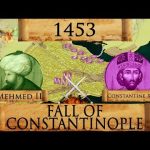
The Eastern Roman Empire was under constant Ottoman pressure ever since the new conquerors appeared in the Anatolia. Although the Ottomans tried to take Constantinople on a number of occasions, they had to lift the siege of the city due to the Crusades of Varna and Nicopolis, the Timurid Invasion and the battle of Ankara, and the Interregnum period that happened after their Sultan Bayezid was taken hostage by Timur. However, after the victories at the battles of Varna (1444) and 2nd Kosovo (1448) against the crusaders of Wladyslaw III and John Hunyadi, the road to Constantinople was open and the new sultan Mehmed II set his sight on the city of the Roman emperors…
We are grateful to our patrons, who made this video possible: Matthew Levy, Rene Malmgren, Ibrahim Rahman, Koopinator, Daisho, Łukasz Maliszewski, William Fluit, Juan Camilo Rodriguez, Murray Dubs, Félix Gagné-Dion, Fahri Dashwali, Kyle Hooton, Dan Mullen, Mohamed Thair, Pablo Aparicio Martínez, Iulian Margeloiu, Chet, Nick Nasad, Jeyares, Amir Eppel, Thomas Bloch, Uri Sternfeld, Georgi Kirilov, Mohammad Mian, Daniel Yifrach, Brian Crane, Muramasa, Gerald Tnay, Hassan Ali, Richie Thierry, David O’Hare, Christopher Commins, Chris Glantzis, William Pugh, Stefan Dt, indy, Bashir Hammour, Mario Nickel, R.G. Ferrick, Moritz Pohlmann, Russell Breckenridge, Jared R. Parker, Kassem Omar Kassem, AmericanPatriot, Robert Arnaud, Christopher Issariotis, John Wang, Joakim Airas, Nathanial Eriksen, Joakim Airas, Chuan Kit Kee, John Padalis, Raphaël Dordeins, Donovan Moore, Howie Truong, Chuan Kit Kee, Håvard Siegel Haukeberg, ccplz, Tepes Obrejac, Jon, Emil Johansson, Patrick Riordan, Marc Kuiper, Qamil Lita, Jack Roelofs, Fernando Henrique, iMattyz, Rbj, Frat, The Noob Game Developer, Jacob Filmer, Travis Tiffany, Andreas Ekström, Zachary Marhal, Tomás Cortés Benjumea, Mensur Hamzic, Maxwell Gaughran, Kristofer Eriksson, Dave Ormsby, Aaron Snakenberg, Razen Alsuwaihel, Scott Buster, Erik W Thurnher, Tim Taylor, Aldo Schepis and Umar Farooq.
The Machinimas for this video are created by one more friend – Malay Archer. Check out his channel, he has some of the best Total War machinimas ever created: https://www.youtube.com/user/MathemedicUpdates/videos
Signup for your FREE trial to The Great Courses Plus here: http://ow.ly/sLYW30f0W34
The Great Courses Plus is currently available to watch through a web browser to almost anyone in the world and optimized for the US market. The Great Courses Plus is currently working to both optimize the product globally and accept credit card payments globally.
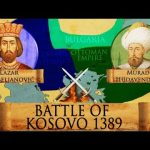
The Ottoman invasion of Europe was truly challenged for the first time during the Battle of Kosovo of 1389. The Serbs and other Balkan peoples alongside their allies from Western and Eastern Europe fought valiantly against overwhelming odds and although they lost, the foundation of the future resistance, that continued until the dissolution of the Ottoman Empire, was set. This battle was also remarkable due to the fact that leaders of both armies were killed during it. Prince Lazar Hrebeljanović died in the battle and Sultan Murad I was assassinated by the Serbian knight Miloš Obilić, who was killed shortly after. All three are considered martyrs by their people and the spirit of this battle is still part of the bitter animosity…
Sources used:
John V. A. Fine; John Van Antwerp Fine (1994). The Late Medieval Balkans: A Critical Survey from the Late Twelfth Century to the Ottoman Conquest. University of Michigan Press.
Ломоносов Матвей. Русские исторические источники Косовской битвы 1389 г.. — Пермь: Пермский госуниверситет, 2005
Inspired by: BazBattles, Invicta (THFE), Epic History TV and Historia Civilis
Songs used:
Ottoman Song – Uskudara Giderken
Dark Times – Kevin MacLeod
Magnus Ringblom – Ancient Sculptures in Church
Johannes Bornlof – Barbarians
Rannard Sillard – Deathmatch
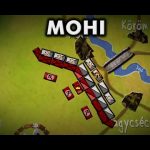
Mongol invasion of Europe was swift even by todays standards. In roughly 6 years, Subotai and Batu Khan conquered most of the Russian principalities and then proceeded to invade Central Europe…
Main Sources:
David Nicolle – Hungary and the Fall of Eastern Europe
James Chambers – The Devil’s Horsemen
Stephen Turnbull – Genghis Khan & The Mongol Conquests
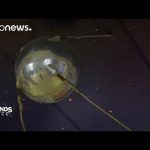
Sixty years ago, Sputnik became the first satellite in space and changed the world forever.
Launched by the Soviet Union on 4 October 1957, this shiny orb kick-started the space race, and opened up the heavens for mankind to explore.
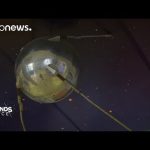
To mark the occasion ESA Euronews arranged access to the private museum of RSC Energia, the Russian state company that actually built the world’s first satellite, officially called Sputnik-1. Hanging in this Moscow treasure trove of pioneering space probes is one of the original Sputnik flight spares, built in 1957. Compact, at just over 80 kilogrammes, its polished surfaces and distinctive antennae are now unmistakable – look at this satellite, and the first word in your mind is ‘Sputnik’.
Il y a soixante ans, le premier satellite artificiel Spoutnik était mis en orbite devançant la chienne Laïka, Youri Gagarine et Alexeï Leonov dans la longue liste des légendes soviétiques de l’espace. Aujourd’hui, ce minuscule engin est encore dans toutes les mémoires comme notre reporter Jeremy Wilks a pu le constater à Moscou auprès de vétérans de l’époque comme Alexeï Leonov et de représentants du secteur spatial russe.
Nous avons eu l’autorisation exceptionnelle de visiter un lieu unique : le musée privé de RSC Energia, la société d’Etat russe à l’origine du premier satellite artificiel. Son nom officiel Spoutnik-1. L’un de ses exemplaires originaux construit en 1957 trône parmi les trésors de l’espace exposés sur place.
Hatvan évvel ezelőtt állt Föld körüli pályára a Szputnyik, az első ember készítette űrjármű. Szovjet űrlegendák sora követte: Lajka kutya, Jurij Gagarin, Alekszej Leonov – akiknek az öröksége ma is él.
Minisorozatunkban, az űrkutatás legendáiban rendszeresen megemlékeztünk erről, és most a Space teljes adását ennek az apró szerkezetnek szenteltük, ami megváltoztatta a világot.
Az RSC Energija múzeumában vagyunk, ez az állami vállalat építette a világ első műholdját, a Szputnyik1-et. Ebben az űrkutatási relikviákkal teli kincsesraktárban van egy 1957-ben készült tartalék Szputnyik is.