After 20 days in space, ESA project astronaut Sławosz Uznański-Wiśniewski and his Axiom Mission 4 crewmates returned safely to Earth on 15 July 2025.
#Ignis mission highlights:
🌍 230 orbits around Earth 📏 + 13 million km travelled 🧪+ 20 science experiments (13 led by Poland) 💯 All mission objectives fulfilled ⏰ 105 hours of orbital work 📈 + 25% extra activities completed
📹 European Space Agency (ESA) 📸 Axiom Space/SpaceX
Listen up! From long form interviews with astronauts and engineers to narrative shows that take you on a tour of the galaxy, NASA podcasts let you experience the thrill of space exploration without ever leaving Earth. Find your new favorite podcast at https://www.nasa.gov/podcasts.
Producer/Editor: Lacey Young Music: Universal Music Production Credit: NASA
At NASA, there is space for everybody! Subscribe to NASA’s official YouTube channel to explore the universe and discover our home planet. Visit https://www.nasa.gov for more!
Producer/Editor: Lacey Young Music: Universal Production Music
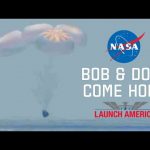
NASA Astronauts Robert Behnken and Douglas Hurley splashed down in the Dragon Endeavour capsule at 2:48 p.m. EDT on Sunday, Aug. 2, off the coast of Pensacola, Florida.
Demo-2 is SpaceX’s final test flight and is providing data on the performance of the Falcon 9 rocket, Crew Dragon spacecraft and ground systems, as well as in-orbit, docking, splashdown, and recovery operations. The data will inform NASA’s certification of the SpaceX crew transportation system for regular flights carrying astronauts to and from the space station. SpaceX is readying the hardware for the first rotational mission that will occur following NASA certification, which is expected to take about six weeks.
Today we made history as NASA Astronauts Robert Behnken and Douglas Hurley safely and successfully splashed down into the Gulf of Mexico after two months on board the International Space Station. This completes the flight demonstration of the SpaceX Dragon Endeavour spacecraft, which will now be used to ferry astronauts to and from the space station from American soil. Now that our #LaunchAmerica crew has returned to Earth, join us in welcoming them as they fly into Ellington Field, home of our astronaut corps:
NASA Astronauts Robert Behnken and Douglas Hurley splashed down in the Dragon Endeavour capsule at 2:48 p.m. EDT on Sunday, Aug. 2, off the coast of Pensacola, Florida.
The Crew Dragon hatch was opened at 3:59 p.m., and Behnken and Hurley exited the spacecraft onto the Go Navigator for initial medical checks before returning to shore by helicopter. Once returned to shore, both crew members will immediately board a waiting NASA plane to fly back to Ellington field in Houston.
Hurley and Behnken arrived to the International Space Station May 31 and spent 62 days supporting science and research aboard the orbiting laboratory as part of Expedition 63.
Demo-2 is SpaceX’s final test flight and is providing data on the performance of the Falcon 9 rocket, Crew Dragon spacecraft and ground systems, as well as in-orbit, docking, splashdown, and recovery operations. The data will inform NASA’s certification of the SpaceX crew transportation system for regular flights carrying astronauts to and from the space station. SpaceX is readying the hardware for the first rotational mission that will occur following NASA certification, which is expected to take about six weeks.
“Houston, we’ve had a problem.” Apollo 13 has become known as “a successful failure” that saw a safe return of the crew in spite of a catastrophic explosion in the middle of their lunar journey. This 30-minute documentary features interviews with Apollo 13 Astronauts Jim Lovell and Fred Haise, as well as Flight Directors Gene Kranz and Glynn Lunney, with engineer Hank Rotter. Parts of their interviews take place in the restored Apollo mission control room. This documentary also features original NASA footage and newly synchronized audio from Mission Control.
Thanks to Stephen Slater and Ben Feist/Apollo in Real-Time (apolloinrealtime.org/13) for providing additional footage and audio.
Like many people around the world, ESA astronaut Matthias Maurer is adjusting to a new normal. Find out how he is spending his time at home during the COVID-19 outbreak, along with a few tips on how to gain inspiration from isolation.
We are Europe’s gateway to space. Our mission is to shape the development of Europe’s space capability and ensure that investment in space continues to deliver benefits to the citizens of Europe and the world. Check out http://www.esa.int/ESA to get up to speed on everything space related.
Earth is a complex, dynamic system. For 60 years, we have studied our changing planet, and our understanding continues to expand with the use of new technologies. With data from satellites, instruments on the International Space Station, airborne missions, balloons, and observations from ships and on land, we track changes to land, water, ice, and the atmosphere. Application of our Earth observations help improve life now and for future generations.
Congress passed the National Aeronautics and Space Act, on July 16 and President Eisenhower signed it into law on July 29, 1958. NASA opened for business on Oct. 1, 1958. Our history tells a story of exploration, innovation and discoveries. The next 60 years, that story continues. Learn more: https://www.nasa.gov/60
Video highlight showing receipt of signal from ESA’s Rosetta comet chaser after 31 months of deep-space hibernation. Teams at ESA’s operations centre in Darmstadt, Germany, leapt for joy as the signal was confirmed via NASA’s 70m tracking stations in California and Australia.