Tag: Hubble images

  • Relax and drift through the Andromeda Galaxy 💫

    Relax and drift through the Andromeda Galaxy 💫

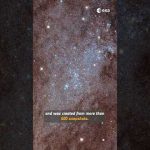
    Witness the breathtaking beauty of our cosmic neighbor—the Andromeda galaxy—located 2.5 million light-years away. This spiral disk galaxy appears elliptical from Earth due to its tilted orientation. In this panoramic view, young blue stars shimmer along the galaxy’s outer rim, while older yellowish stars cluster toward the bright central hub, resembling the yolk of a cosmic fried egg. 🍳💫

    This vibrant portrait is the result of over 10 years of observations and more than 600 snapshots captured by the Hubble Space Telescope. Altogether, it reveals the mesmerizing glow of 200 million stars scattered across the galaxy’s immense 200,000-light-year-wide disk. As the camera zooms into the central region, a dense sea of ancient stars comes into view. Panning across the galaxy’s expanse, we see intricate patterns of dark dust clouds weaving through space, while vibrant blue star clusters stand out along the edges, signaling regions of ongoing star formation. 🌌✨

    Prepare to be amazed as we explore one of the largest and most detailed galactic images ever captured—offering a glimpse into the heart of a distant galaxy, yet eerily similar to our own Milky Way.

    📸 NASA, ESA, B. Williams (University of Washington), G. Bacon (STScI)
    🎶 Rain Clouds – Beautiful Visions

    #ESA #AndromedaGalaxy #Hubble
  • Did someone say glow up? ✨

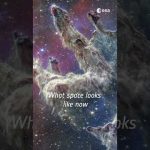
    Did someone say glow up? ✨

    📹 ESA – European Space Agency

    📸 ESA/Webb, NASA & CSA, J. Lee and the PHANGS-JWST and PHANGS-HST Teams, A. Scholz, K. Muzic, A. Langeveld, R. Jayawardhana, A. Adamo (Stockholm University) and the FEAST JWST team, STScI, A. Riess (JHU/STScI), Euclid/Euclid Consortium

    #ESA #Space #Webb

  • Zoom into the Dumbbell Nebula 🔎 #shorts

    Zoom into the Dumbbell Nebula 🔎 #shorts

    This video takes the viewer on a journey to the 34th anniversary image of the launch of the legendary NASA/ESA Hubble Space Telescope: the Little Dumbbell Nebula (also known as Messier 76, M76, or NGC 650/651). The object is located 3400 light-years away in the northern circumpolar constellation Perseus. The photogenic nebula is a favourite target of amateur astronomers.

    Credit: NASA, ESA, STScI, A. Pagan (STScI)
    Acknowledgment: D. Crowson, A. Fujii, Digitized Sky Survey.

    #ESA #Hubble #DumbbellNebula

  • Hubble and Webb’s views of the Crab Nebula 🤩 #shorts

    Hubble and Webb’s views of the Crab Nebula 🤩 #shorts

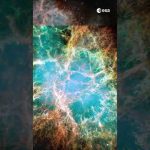
    The first image shown in this video is the 2005 Hubble optical wavelength image of the Crab Nebula. This is followed by a new image of the object from the James Webb Space Telescope’s NIRCam (Near-Infrared Camera) and MIRI (Mid-Infrared Instrument) instruments that has revealed new details in infrared light.

    In Webb’s infrared observation, a crisp, cage-like structure of fluffy red-orange filaments and knots of dust surround the object’s central area. However, some aspects of the inner workings of the Crab Nebula become more prominent and increase in detail in infrared light. In particular, Webb highlights what is known as synchrotron emission, seen here with a milky smoke-like appearance throughout the majority of the Crab Nebula’s interior.

    Credit: NASA, ESA, CSA, STScI, T. Temim (Princeton University), N. Bartmann (ESA/Webb), A. Loll/J. Hester (Arizona State University)
    Music: Stellardrone – The Night Sky in Motion

    #ESA
    #Webb
    #Space