NASA’s Juno spacecraft has been in orbit around Jupiter for almost eight years, offering it the unique opportunity to make close flybys of two of the planet’s intriguing moons, volcanic Io and icy Europa.
Join NASA experts Thursday, March 7, as we delve into these enigmatic worlds to learn how scientists are unraveling their secrets. From Io’s tumultuous volcanic activity to Europa’s ice-covered ocean depths, discover the latest findings from the Juno spacecraft.
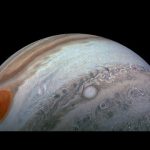
On May 16, 2023, NASA’s Juno spacecraft flew past Jupiter’s volcanic moon Io, and then the gas giant soon after. Io is the most volcanically active body in the solar system. Slightly larger than Earth’s moon, Io is a world in constant torment. Not only is the biggest planet in the solar system forever pulling at it gravitationally, but so are its Galilean siblings – Europa and the biggest moon in the solar system, Ganymede. The result is that Io is continuously stretched and squeezed, actions linked to the creation of the lava seen erupting from its many volcanoes.
This rendering provides a “starship captain” point of view of the flyby, using images from JunoCam. For both targets, Io and Jupiter, raw JunoCam images were reprojected into views similar to the perspective of a consumer camera. The Io flyby and the Jupiter approach movie were rendered separately and composed into a synchronous split-screen video.
Launched on Aug. 5, 2011, Juno embarked on a 5-year journey to Jupiter. Its mission: to probe beneath the planet’s dense clouds and answer questions about the origin and evolution of Jupiter, our solar system, and giant planets in general across the cosmos. Juno arrived at the gas giant on July 4, 2016, after a 1.7-billion-mile journey, and settled into a 53-day polar orbit stretching from just above Jupiter’s cloud tops to the outer reaches of the Jovian magnetosphere. Now in its extended mission, NASA’s most distant planetary orbiter continues doing flybys of Jupiter and its moons.
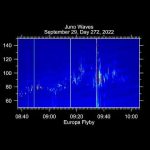
In this video, measurements collected by the Waves instrument aboard NASA’s Juno spacecraft during its close flyby of Jupiter’s moon Europa on Sept. 29, 2022 have been converted to an audible frequency. As the white line moves across the spectrogram, which is a visual way of representing signal strength over time, the variation of frequency of the plasma waves observed near Europa can be heard as the plasma density varies. The video shows data collected over approximately 1.5 hours during the Europa flyby.
The science team for our Juno spacecraft at Jupiter will reveal new findings that provide the first 3D look at how the planet’s roiling atmosphere operates underneath the top layers of clouds, and how these revelations offer insight into the atmospheres of giant planets elsewhere in the universe.
The event will take place at NASA’s Jet Propulsion Laboratory in Southern California, which manages the Juno mission.
Briefing participants include:
– Lucas Paganini, Juno program scientist, NASA Headquarters, Washington – Scott Bolton, Juno principal investigator, Southwest Research Institute, San Antonio – Marzia Parisi, Juno scientist, JPL – Keren Duer, Juno scientist, Weizmann Institute of Science, Rehovot, Israel – Leigh Fletcher, Juno participating scientist, University of Leicester, England – Alessandro Mura, Juno co-investigator, Institute for Space Astrophysics and Planetology, Rome
For more about the Juno mission, visit nasa.gov/juno and missionjuno.swri.edu
Credit: NASA/JPL-Caltech/SWRI Video thumbnail JunoCam image processing by David Marriott
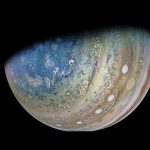
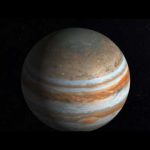
On June 7, 2021, NASA’s Juno spacecraft flew closer to Jupiter’s ice-encrusted moon Ganymede than any spacecraft in more than two decades. Less than a day later, Juno made its 34th flyby of Jupiter. This animation provides a “starship captain” point of view of each flyby. For both worlds, JunoCam images were orthographically projected onto a digital sphere and used to create the flyby animation. Synthetic frames were added to provide views of approach and departure for both Ganymede and Jupiter.
In this animation the viewer is taken low over Jupiter’s north pole to illustrate the 3-D aspects of the region’s central cyclone and the eight cyclones that encircle it.
Read more: https://www.nasa.gov/feature/jpl/nasa-s-juno-mission-provides-infrared-tour-of-jupiter-s-north-pole
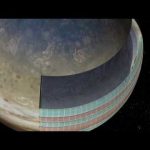
The movie utilizes imagery derived from data collected by the Jovian Infrared Auroral Mapper (JIRAM) instrument aboard NASA’s Juno mission during its fourth pass over the massive planet. Infrared cameras are used to sense the temperature of Jupiter’s atmosphere and provide insight into how the powerful cyclones at Jupiter’s poles work. In the animation, the yellow areas are warmer (or deeper into Jupiter’s atmosphere) and the dark areas are colder (or higher up in Jupiter’s atmosphere). In this picture the highest “brightness temperature” is around 260K (about -13°C) and the lowest around 190K (about -83°C). The “brightness temperature” is a measurement of the radiance, at 5 µm, traveling upward from the top of the atmosphere towards Juno, expressed in units of temperature.
Credit: NASA/JPL-Caltech/SwRI/ASI/INAF/JIRAM
The bands were thought to be an expression of Jovian weather, related to winds blowing eastward and westward at different speeds.
This animation illustrates a recent discovery by Juno that demonstrates these east-west flows, also known as jet-streams penetrate deep into the planet’s atmosphere, to a depth of about 1,900 miles (3,000 kilometers). Due to Jupiter’s rapid rotation (Jupiter’s day is about 10 hours), these flows extend into the interior parallel to Jupiter’s axis of rotation, in the form of nested cylinders. Below this layer the flows decay, possibly slowed by Jupiter’s strong magnetic field.
The depth of these flows surprised scientists who estimate the total mass involved in these jet streams to be about 1% of Jupiter’s mass (Jupiter’s mass is over 300 times that of Earth). This discovery was revealed by the unprecedented accuracy of Juno’s measurements of the gravity field.
This animation takes the viewer on a simulated flight into, and then out of, Jupiter’s upper atmosphere at the location of the Great Red Spot. It was created by combining an image from the JunoCam imager on NASA’s Juno spacecraft with a computer-generated animation.
The perspective begins about 2,000 miles (3,000 kilometers) above the cloud tops of the planet’s southern hemisphere. The bar at far left indicates altitude during the quick descent; a second gauge next to that depicts the dramatic increase in temperature that occurs as the perspective dives deeper down. The clouds turn crimson as the perspective passes through the Great Red Spot. Finally, the view ascends out of the spot.
NASA’s Juno spacecraft made its latest close flyby of Jupiter Feb. 2 — passing about 2,700 miles above the planet’s clouds. This was the fourth close flyby since Juno began orbiting Jupiter last year on July 4. During these close passes instruments on the spacecraft probe beneath the cloud cover to collect scientific data about the planet’s structure, atmosphere and magnetosphere. This information could help us better understand the planetary systems being discovered around other stars. Also, Cassini Sees Saturn’s Rings in Greater Detail, The Most Extreme Blazars, NASA at Super Bowl Event, NASA at NBA Black Heritage Celebration, and
Day of Remembrance!
On June 28, the booster for NASA’s Space Launch System (SLS) rocket was fired up for a major two-minute full-duration qualification ground test at Orbital ATK Propulsion Systems’ test facilities in Promontory, Utah. Engineers will evaluate test data on the motor’s performance using cold propellant, the steering operation of its redesigned nozzle, and other operational data to help qualify the booster for flight. This is the last time the booster will be fired in a test environment before it’s used for the first uncrewed test flight of SLS with NASA’s Orion spacecraft, known as Exploration Mission-1, in late 2018. Also, SLS Test Hardware Arrives at Marshall, Juno Arrives at Jupiter July 4th, Test Lab Launched to Streamline Air Travel, Russian Docking System Tested on ISS, and NASA 2016 Agency Honor Award Distinguished Honorees.
The successful liftoff of the Juno spacecraft from the Kennedy Space Center begins a five-year cruise to the planet Jupiter to investigate the planet’s structure, atmosphere and magnetosphere. It will also provide detailed images of Jupiter’s surface and capture the first high-resolution views of its poles. Also, possible Martian water flows; Vesta’s new look; oxygen in space; and, Columbia debris. Plus, HQ crew visit; Russians spacewalk; SOFIA ambassadors; new Apollo 15 book; and dunk tank for food.
NASA’s Juno spacecraft is on its way to Jupiter after being launched aboard an Atlas V rocket from the Cape Canaveral Air Force Station, Florida on August 5 at 11:25 a.m. Eastern. The solar-powered spacecraft will arrive at Jupiter in July 2016 and orbit its poles 33 times to find out more about the gas giant’s interior, atmosphere and aurora. Scientists believe Jupiter holds the key to better understanding the origins of our solar system.