Tag: Jupiter’s moons

  • I want to break free… 🎶 #shorts

    I want to break free… 🎶 #shorts

    When a spacecraft launches on a mission to another planet it must first break free of the Earth’s gravitational field. Once it has done that, it enters interplanetary space, where the dominant force is the gravitational field of the Sun.

    The spacecraft begins to follow a curving orbit, around the Sun, which is similar to the orbit of a comet. When this orbit brings it close to its target destination the spacecraft must fire a retrorocket to slow down and allow itself to be captured by the gravitational field of its target. The smaller the target, the more the spacecraft must slow down.

    Sometimes passing a planet can result in the spacecraft being accelerated, even without the spacecraft firing any of its thrusters. This is known as the ‘slingshot’ effect. Such ‘gravity assist’ manoeuvres are now a standard part of spaceflight and are used by almost all our interplanetary missions. They take advantage of the fact that the gravitational attraction of the planets can be used to change the trajectory and speed of a spacecraft.

    The amount by which the spacecraft speeds up or slows down is determined by whether it is passing behind or in front of the planet as the planet follows its orbit. When the spacecraft leaves the influence of the planet, it follows an orbit on a different course than before.

    📹 @EuropeanSpaceAgency

    ★ Subscribe: http://bit.ly/ESAsubscribe and click twice on the bell button to receive our notifications.

    Check out our full video catalog: http://bit.ly/SpaceInVideos
    Follow us on Twitter: http://bit.ly/ESAonTwitter
    On Facebook: http://bit.ly/ESAonFacebook
    On Instagram: http://bit.ly/ESAonInstagram
    On LinkedIn: https://bit.ly/ESAonLinkedIn
    On Pinterest: https://bit.ly/ESAonPinterest
    On Flickr: http://bit.ly/ESAonFlickr

    We are Europe’s gateway to space. Our mission is to shape the development of Europe’s space capability and ensure that investment in space continues to deliver benefits to the citizens of Europe and the world. Check out https://www.esa.int/ to get up to speed on everything space related.

    Copyright information about our videos is available here: https://www.esa.int/ESA_Multimedia/Terms_and_Conditions

    #ESA
    #Jupiter
    #JuiceMission
  • Time to explore Jupiter with some JUICE!🧃 #shorts

    Time to explore Jupiter with some JUICE!🧃 #shorts

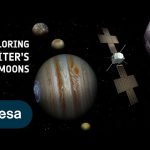
    Our Jupiter Icy Moons Explorer, Juice, will make detailed observations of the giant gas planet and its three large ocean-bearing moons – Ganymede, Callisto and Europa – with a suite of remote sensing, geophysical and in situ instruments. The mission will characterise these moons as both planetary objects and possible habitats, explore Jupiter’s complex environment in depth, and study the wider Jupiter system as an archetype for gas giants across the Universe.

    Juliet will be taking us to Jupiter and its moons in the coming weeks. So stay tuned for more!

    📹 @europeanspaceagency

    ★ Subscribe: http://bit.ly/ESAsubscribe and click twice on the bell button to receive our notifications.

    Check out our full video catalog: http://bit.ly/SpaceInVideos
    Follow us on Twitter: http://bit.ly/ESAonTwitter
    On Facebook: http://bit.ly/ESAonFacebook
    On Instagram: http://bit.ly/ESAonInstagram
    On LinkedIn: https://bit.ly/ESAonLinkedIn
    On Pinterest: https://bit.ly/ESAonPinterest
    On Flickr: http://bit.ly/ESAonFlickr

    We are Europe’s gateway to space. Our mission is to shape the development of Europe’s space capability and ensure that investment in space continues to deliver benefits to the citizens of Europe and the world. Check out https://www.esa.int/ to get up to speed on everything space related.

    Copyright information about our videos is available here: https://www.esa.int/ESA_Multimedia/Terms_and_Conditions

    #ESA
    #Juice
    #Jupiter

  • Juice one step closer to launch

    Juice one step closer to launch

    After many years of study, development, building and testing, ESA’s Jupiter Icy Moons Explorer, Juice, has finally arrived at Europe’s Spaceport in Kourou, French Guiana. At the end of 2022 the spacecraft underwent its final thermal vacuum test at an Airbus Defence and Space facility in Toulouse, as well as its final software verification tests, whereby it was controlled from the ESOC mission control centre in Darmstadt, Germany.

    Soon, an Ariane 5 will lift Juice into orbit and send it on its journey to explore the largest planet in our Solar System and its three icy moons, Europa, Callisto and in particular Ganymede. By exploring and studying the Jovian system, the mission neatly fullfills its role in ESA’s Cosmic Vision programme, teaching us about our Universe and the origins of life.

    Stay tuned: www.esa.int/juice

    ★ Subscribe: http://bit.ly/ESAsubscribe and click twice on the bell button to receive our notifications.

    Check out our full video catalog: http://bit.ly/SpaceInVideos
    Follow us on Twitter: http://bit.ly/ESAonTwitter
    On Facebook: http://bit.ly/ESAonFacebook
    On Instagram: http://bit.ly/ESAonInstagram
    On LinkedIn: https://bit.ly/ESAonLinkedIn
    On Pinterest: https://bit.ly/ESAonPinterest
    On Flickr: http://bit.ly/ESAonFlickr

    We are Europe’s gateway to space. Our mission is to shape the development of Europe’s space capability and ensure that investment in space continues to deliver benefits to the citizens of Europe and the world. Check out https://www.esa.int/ to get up to speed on everything space related.

    Copyright information about our videos is available here: https://www.esa.int/ESA_Multimedia/Terms_and_Conditions

    #ESA
    #Juice
    #Jupiter

  • Juice’s odyssey of exploration

    Juice’s odyssey of exploration

    A grand odyssey of exploration is about to begin. Humankind’s next bold mission to the outer Solar System, ESA’s Jupiter Icy Moons Explorer, Juice, is poised to explore giant planet Jupiter and its largest moons. These intriguing worlds have piqued our curiosity ever since Galileo first raised his telescope to the planet and discovered its four largest moons: Io, Europa, Ganymede and Callisto, three of which are thought to harbour underground oceans.

    Early space probes visiting the Jovian system have raised more questions than answers. But thanks to Juice, many of those answers are now within reach. ESA is launching the spacecraft in April 2023 on an eight-year journey to the distant planet.

    To uncover the hidden secrets of these mysterious worlds, Juice is equipped with the most powerful science instruments ever sent to the outer Solar System. The spacecraft will face many dangers along the way: radiation, extreme temperatures, and the vast gravitational pull of Jupiter, all while operating hundreds of millions of kilometres from Earth. But in the safe hands of ESA’s operators to guide it safely through these challenges, the dangers will be worth it for the science that Juice is destined to uncover.

    The countdown to this new era of Jupiter system exploration has begun. Stay tuned: www.esa.int/juice

    Credit: Produced by ESA/ATG medialab

    ★ Subscribe: http://bit.ly/ESAsubscribe and click twice on the bell button to receive our notifications.

    Check out our full video catalog: http://bit.ly/SpaceInVideos
    Follow us on Twitter: http://bit.ly/ESAonTwitter
    On Facebook: http://bit.ly/ESAonFacebook
    On Instagram: http://bit.ly/ESAonInstagram
    On LinkedIn: https://bit.ly/ESAonLinkedIn
    On Pinterest: https://bit.ly/ESAonPinterest
    On Flickr: http://bit.ly/ESAonFlickr

    We are Europe’s gateway to space. Our mission is to shape the development of Europe’s space capability and ensure that investment in space continues to deliver benefits to the citizens of Europe and the world. Check out https://www.esa.int/ to get up to speed on everything space related.

    Copyright information about our videos is available here: https://www.esa.int/ESA_Multimedia/Terms_and_Conditions

    #ESA
    #Juice
    #Jupiter