How do we know the Earth isn’t flat? For thousands of years people have known the Earth is round. Ancient civilizations used the stars and shadows to figure it out. Mariners confirmed it by sailing around the globe. And when the space age began, we saw it with our own eyes — the Earth is round!
A NASA scientist explains how we’ve known for centuries that our planet is a sphere.
Have you ever wanted to design something that could fly around the Moon? This is your opportunity. The Artemis II astronauts will use a zero gravity indicator during their mission to demonstrate when their Orion spacecraft has reached microgravity. This plushie needs to be soft, small, and importantly, remind us of home.
The Moon Mascot contest challenges people of all ages from all over the world to submit a design to be made by NASA’s Thermal Blanket Lab and flown aboard Artemis II.
Thanks to the incredible precision of our Gaia mission, scientists have discovered potential moons orbiting over 350 asteroids! This nearly doubles the known number of ‘binary asteroids,’ revealing a whole new layer of complexity in our Solar System.
1️⃣ Space near Mercury is HOT. Sending a spacecraft there is a bit like asking a laptop to work inside a hot pizza oven! Some spacecraft have gotten close to Mercury but none have remained in this scorching heat continuously. This means we still don’t have high-resolution data covering Mercury’s entire surface.
2️⃣ It’s difficult to observe from Earth: Because Mercury is very close to the Sun, when we try to look at it from Earth, it’s often lost in the Sun’s glare.
3️⃣ It’s hard to reach: Mercury is not that far, but according to some estimates, it would take less energy to get to Pluto than to get to Mercury. The Sun’s strong gravitational pull means that spacecraft need to use a lot of energy to slow down enough to orbit Mercury.
But our BepiColombo mission, will help us learn a lot more about Mercury when it enters into orbit in 2026! It’s the most advanced spacecraft ever sent to Mercury. It will help us answer many questions, such as: Why is there ice in the polar craters of the scorched planet? And what are the mysterious ‘hollows’ on its surface?
In 2016, scientists spotted Kamo’oalewa ,a 40 to 100 metre object, during a planetary defence survey to discover space rocks that could possibly hit our planet.
At first, the object appeared to orbit Earth in a similar way to our Moon. But astronomers found it was actually orbiting the Sun on a very similar path to Earth. So, Kamo’oalewa was demoted from a potential new moon to a near-Earth asteroid and a quasi-satellite to Earth.
However, the asteroid’s connection to the Moon could run deeper. The object’s Earth-like orbit and Moon-like composition may indicate that it was created when a chunk of the Moon was thrown into space by an asteroid impact.
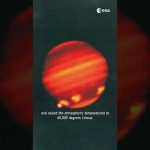
30 years ago, the comet, Shoemaker-Levy 9, pounded into the southern hemisphere of Jupiter, leaving dark scars in the planet’s atmosphere that persisted for several weeks.
The remarkable event was the first direct observation of an extraterrestrial collision in the Solar System.
Huge plumes up to 3 thousand kilometres high were created by the impact and raised the atmospheric temperatures to 40,000 degrees Celsius.
Almost 10 years after the collision, our Herschel telescope found conclusive evidence that Shoemaker-Levy 9 was the origin of water found in Jupiter’s upper atmosphere. Our Juice mission launched last year will map the distribution of Jupiter’s atmospheric ingredients in even greater detail.
This kind of collision was more frequent in the early solar system but today, something as large as Shomaker-Levy impacts Earth only once in a million years.
However, it is important we can protect ourselves from such space hazards which is why we are carrying out several projects dedicated to improving our ability to detect, track and mitigate potentially hazardous asteroids and comets, such as our Hera mission currently planned to launch later this year and our new mission, Ramses, which will to rendezvous with the asteroid Apophis.
📹 ESA – European Space Agency 📸 HA. Weaver, T. ESmith (Space Telescope Science Institute), and NASA/ESA 📸 ESA/Hubble (M. Kornmesser & L. L. Christensen) 📸 H. Hammel, MIT and NASA/ESA 📸 Calar Alto Observatory/Max Planck Institute for Astronomy, Heidelberg, Germany
How do we know what Earth’s climate was like long ago? If you look closely, there are clues just about everywhere across our globe. Some are easy to see and others are more subtle. NASA climate scientist Dr. Gavin Schmidt explains.
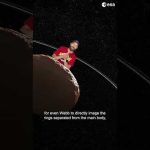
Chariklo is an icy, small body, but the largest of the known Centaur population, located more than 3.2 billion kilometres away beyond the orbit of Saturn. Chariklo is only 250 kilometers or ~51 times smaller than Earth in diameter, and its rings orbit at a distance of about 400 kilometers from the center of the body.
On 18 October 2022, a team used the James Webb Space Telescipe to closely monitor the star Gaia DR3 6873519665992128512, and watch for the tell-tale dips in brightness indicating an occultation had taken place. The shadows produced by Chariklo’s rings were clearly detected, demonstrating a new way of using Webb to explore solar system objects. The star shadow due to Chariklo itself tracked just out of Webb’s view. This appulse (the technical name for a close pass with no occultation) was exactly as had been predicted after the last Webb course trajectory maneuver.
Credit: @NASA, ESA, CSA, Leah Hustak (STScI), Pablo Santos-Sanz (IAA-CSIC), Nicolás Morales (IAA-CSIC), Bruno Morgado (UFRJ, ON/MCTI, LIneA)
★ Subscribe: http://bit.ly/ESAsubscribe and click twice on the bell button to receive our notifications.
We are Europe’s gateway to space. Our mission is to shape the development of Europe’s space capability and ensure that investment in space continues to deliver benefits to the citizens of Europe and the world. Check out https://www.esa.int/ to get up to speed on everything space related.
In Rovaniemi, the Arctic Circle runs through Santa Claus Village, located eight kilometres north of the city centre. The Arctic Circle marks the southernmost latitude where the sun can stay continuously below or above the horizon for 24 hours – these phenomena are known as the Midnight Sun in the summer and the Polar Night in the winter.
We are Europe’s gateway to space. Our mission is to shape the development of Europe’s space capability and ensure that investment in space continues to deliver benefits to the citizens of Europe and the world. Check out https://www.esa.int/ to get up to speed on everything space related.
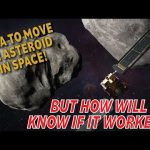
NASA’s Double Asteroid Redirection Test, also known as DART, is humanity’s first attempt to change the motion of a non-hazardous asteroid in space by intentionally crashing a spacecraft into it. After impact, ground-based observatories across the globe will turn their eyes to the skies to determine if this planetary defense test was successful. In this video, NASA visits Lowell Observatory to learn more about how astronomers have been tracking this double asteroid over the course of many years, and how they will document the orbital change post-impact.
DART is a spacecraft designed to impact an asteroid as a test of technology. DART’s target asteroid is NOT a threat to Earth. This asteroid system is a perfect testing ground to see if intentionally crashing a spacecraft into an asteroid is an effective way to change its course, should a hazardous asteroid be discovered in the future.
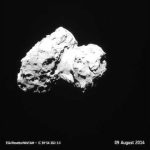
This animation of NAVCAM images follows the spacecraft’s approach to the comet from a distance of about 800 km on 1 August to a distance of about 62 km on 22 August 2014.
The movie is a showcase of over one thousand NAVCAM images released today in ESA’s Archive Image Browser: http://imagearchives.esac.esa.int/
Special Thanks to Anne Ketola for all the awesome NASA gear, and David Zimmerman for video equipment!
Lyrics:
When I EDL, time for seven minutes of flamin’ hell
Rover’s touchin’ down
everybody passin’ peanuts around, yeah
We’re at mission control, getting full use outta ev-er-y Sol (wa!)
Just 25 feet left to go
It’s Curiosity, look out below (yo)
Crane lower that rover (ah)
Crane lower that rover (ah)
Crane lower that rover (ah)
N-N-N-Now bug out!
Crane lower that rover
Crane lower that rove
Crane lower that rover
Now bug out!
Kickin’ it at my con(sole), this is what I see (okay)
Data streaming back from curiosity
I got stars on my ‘hawk
and I ain’t afraid to show it (show it, show it, show it)
We’re NASA and we know it
We’re NASA and we know it
(Yo)
When I look for ice, gotta calibrate, gotta be precise
And when I raise the mast, panoramic views are unsurpassed (wha?)
This is how I rove, baking red rocks in my nuclear stove
We headed to the peak, with my laser eye
No one to bury me when it’s time to die (ow!)
Crane lower that rover
Crane lower that rover
Crane lower that rover
Now bug out!
Crane lower that rover
Crane lower that rover
Crane lower that rover
Now bug out!
Shoutout to Carl the Sage (and) Neil Degrasse T (B.A.!)
Shoutout to JPL and the Rocker-Bogie
We’re better than SpaceX
And we ain’t afraid to show it (show it, show it, show it)
We’re NASA and we know it
We’re NASA and we know it