Tag: korea

  • China to Korea at night timelapse

    China to Korea at night timelapse

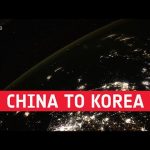
    Timelapse video made during ESA astronaut Thomas Pesquet’s second mission to the International Space Station, “Alpha”. The camera is setup to take pictures at intervals of two a second, and the pictures are then edited into this video that plays at 25 pictures a second. The video is around 12 times faster than real speed.

    Thomas shared this video on social media with the caption:
    “A night #timelapse over South-East Asia. Green lights of squid fishing, bright city lights of Hong Kong and Shanghai followed by Seoul until the border of the Korean peninsula closes on a pitch black DPRK.”

    Over 200 experiments are planned during Thomas’ time in space, with 40 European ones and 12 new experiments led by the French space agency #CNES.

    Latest updates on the Alpha mission can be found via @esaspaceflight on Twitter, with more details on ESA’s exploration blog via thomaspesquet.esa.int.

    Background information on the Alpha mission is available at www.esa.int/MissionAlpha with a brochure at www.esa.int/AlphaBrochure.

    ★ Subscribe: http://bit.ly/ESAsubscribe and click twice on the bell button to receive our notifications.

    Check out our full video catalog: http://bit.ly/SpaceInVideos
    Follow us on Twitter: http://bit.ly/ESAonTwitter
    On Facebook: http://bit.ly/ESAonFacebook
    On Instagram: http://bit.ly/ESAonInstagram
    On Pinterest: https://bit.ly/ESAonPinterest
    On Flickr: http://bit.ly/ESAonFlickr

    We are Europe’s gateway to space. Our mission is to shape the development of Europe’s space capability and ensure that investment in space continues to deliver benefits to the citizens of Europe and the world. Check out https://www.esa.int/ to get up to speed on everything space related.

    Copyright information about our videos is available here: https://www.esa.int/ESA_Multimedia/Terms_and_Conditions

    #ESA
    #MissionAlpha
    #Timelapse
  • Nitrogen dioxide emissions over China

    Nitrogen dioxide emissions over China

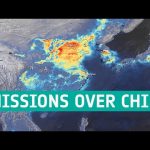
    This animation, using data from the Copernicus Sentinel-5P satellite, shows the nitrogen dioxide emissions from 20 December 2019 until 16 March 2020 – using a 10-day moving average. The drop in emissions in late-January is visible, coinciding with the nationwide quarantine, and from the beginning of March, the nitrogen dioxide levels have begun to increase.

    Learn more: http://bit.ly/COVID19NitrogenDioxideOverChina

    Credits: contains modified Copernicus Sentinel data (2019-20), processed by ESA, CC BY-SA 3.0 IGO

    ★ Subscribe: http://bit.ly/ESAsubscribe and click twice on the bell button to receive our notifications.

    Check out our full video catalog: http://bit.ly/SpaceInVideos
    Follow us on Twitter: http://bit.ly/ESAonTwitter
    On Facebook: http://bit.ly/ESAonFacebook
    On Instagram: http://bit.ly/ESAonInstagram
    On Flickr: http://bit.ly/ESAonFlickr

    We are Europe’s gateway to space. Our mission is to shape the development of Europe’s space capability and ensure that investment in space continues to deliver benefits to the citizens of Europe and the world. Check out http://www.esa.int/ESA to get up to speed on everything space related.

    Copyright information about our videos is available here: http://www.esa.int/spaceinvideos/Terms_and_Conditions

    #ESA
    #

  • Moon stresses greater gov’t role in fostering AI technology

    Moon stresses greater gov’t role in fostering AI technology

    문 대통령, 새해 첫 부처 업무보고서 과학기술 통한 성장 강조

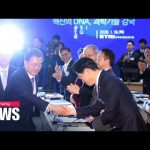
    President Moon Jae-in has called for the government to play a greater role in growing the country’s artificial intelligence sector… to boost the competitiveness of Korea’s IT sector globally.
    Shin Se-min reports.
    President Moon Jae-in has pressed for more governmental support to boost Korea’s information technology prowess, including its AI industry.
    During an annual policy review on Thursday, held at the state-funded Electronics and Telecommunications Research Institute in Daejeon,… the president said the country has the potential to become an AI powerhouse.
    “We must secure future jobs with information technology and become an innovative and inclusive nation. Korea has enough potential to become a science-technology power and the world leader in the AI field. Turning that potential into reality is the task the government should do.”
    Calling it the “infrastructure of Korea’s innovative growth,” the president said the country should complete the establishment of a nationwide 5G network by 2022.
    He also promised to lead the way in fostering AI-related unicorn firms through support with education and training.
    Backing that plan,… the Ministry of Science and ICT announced it will invest a trillion won, around 860 million U.S. dollars, to create more AI and software professionals.
    The first policy briefing focusing on scientific technology clearly reflects the administration’s resolve in boosting the nation’s competitiveness in advanced technology this year,… one of the core policy goals for 2020.
    The president, also stressing the importance of the role of broadcasting, said comprehensive policy measures are critical in trying to contain the spread of fake news,… something that has been rapidly growing in the new forms of media.
    Shin Se-min, Arirang News.

    #AI #technology #government

    Arirang News Facebook: http://www.facebook.com/arirangtvnews