Tag: Landing sequence

  • Schiaparelli’s descent to Mars in real time

    Schiaparelli’s descent to Mars in real time

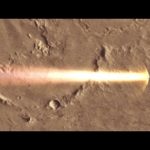
    Visualisation of the ExoMars Schiaparelli module entering and descending through the atmosphere to land on Mars. The animation follows a simulated timeline of the module, starting when it enters the atmosphere at an altitude of 121 km at 14:42 GMT. In six minutes it will use a heatshield, parachute and thrusters to brake from 21 000 km/h to a near standstill 2 m above the surface, where a crushable structure on its underside will absorb the final shock.

    The key operational milestones are highlighted in the animation at the predicted times at which they have been calculated to occur. However, the actual times may vary depending on the atmospheric conditions on the day, the final path through the atmosphere and the speed at which the module descends.

    The times indicated in the animation are onboard spacecraft times at Mars. The one-way signal travel time on 19 October is just under 10 minutes, meaning that signals relayed by spacecraft at Mars are received on Earth about 10 minutes after the event itself has happened on the Red Planet.

    Both Schiaparelli and the Mars scenery in this animation are computer-generated.

  • Rosetta end of mission

    Rosetta end of mission

    Inside the main control room at ESA’s operation centre as the Rosetta spacecraft sends its last signal from Comet 67P/Churyumov–Gerasimenko, confirming the end of the spacecraft’s 12.5 year journey in space.

  • Visualising Rosetta’s descent

    Visualising Rosetta’s descent

    Animation visualising Rosetta’s descent to Comet 67P/Churyumov–Gerasimenko on 30 September 2016. The sequence is speeded up to show the relative motion of Rosetta and the rotating comet below.

    Rosetta will target a smooth region close to several large pits measuring more than 100 m across and 60 m deep, on the small lobe of the comet.

    The impact time is predicted as 11:20 GMT +/- 20 minutes on 30 September.

    More information about Rosetta’s descent towards region of active pits, see
    http://www.esa.int/Our_Activities/Space_Science/Rosetta/Rosetta_s_descent_towards_region_of_active_pits

    For the latest updates, see http://rosetta.esa.int

    Credit: ESA/ATG medialab, Music: Pawel Blaszczak