During the 2017 Administrator’s Agency Honor Awards Ceremony on June 15 at Langley Research Center, NASA’s Acting Administrator, Robert Lightfoot, presented Distinguished Service and Distinguished Public Service Medals to individuals who have made extraordinary and indelible contributions to the agency’s mission success. These awards are NASA’s most prestigious and distinguished honors.
Tag: Langley Research Center
-

Langley Centennial Celebration Highlights Hidden Figures on This Week @NASA – December 2, 2016
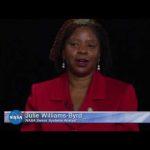
On Dec. 1, NASA Administrator Charlie Bolden helped kick off a yearlong centennial celebration for the agency’s Langley Research Center in Hampton, Virginia with several events highlighting the work of the African American women of Langley’s West Computing Unit. These mathematicians performed critical calculations for several historic NASA space missions in the early days of America’s space program, and their story is told in the book, “Hidden Figures,” by author Margot Lee Shetterly and the upcoming 20th Century Fox movie of the same name. It was also discussed during a NASA education event at Langley featuring Bolden, the film’s director Ted Melfi, NASA’s Chief Historian Bill Barry, and Langley electro-optics engineer Julie Williams-Byrd – a modern-day NASA figure using science, technology, engineering and mathematics, or STEM — skills to make an impact. Later that evening, a VIP social and screenings of the film took place at nearby Virginia Air & Space Center. The women featured in Hidden Figures – Katherine Johnson, Mary Jackson and Dorothy Vaughan – known as “human computers,” helped put John Glenn in orbit, and helped Neil Armstrong and other astronauts land on the moon. Also, Cassini’s Ring-Grazing Orbit around Saturn, Next Space Station Crew Previews Mission, and Russian Cargo Ship Experiences Anomaly after Launch!
-
Real People Behind NASA’s Hidden Figures
NASA kicked off a yearlong centennial celebration for its Langley Research Center in Hampton, Virginia, with events Dec. 1 highlighting the critical work done by the African American women of Langley’s West Computing Unit, a story told in the book and upcoming movie “Hidden Figures”. During a NASA education event that was streamed to schools across the country, NASA Administrator Charles Bolden, Film director Ted Melfi, NASA Chief Historian Bill Barry, who consulted on the film, and NASA Modern Figure Julie Williams-Byrd, an electro-optics engineer for the Space Mission Analysis Branch at Langley, discussed the work of past and present NASA figures benefits humanity and enable future long-duration human and robotic exploration into deep space, including the agency’s Journey to Mars.
-
NASA Dedicates Facility to Mathematician, Presidential Medal Winner
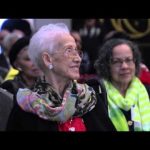
NASA commemorated the many contributions of retired mathematician Katherine Johnson to America’s space program during a building dedication ceremony on May 5, at the agency’s Langley Research Center in Hampton, Virginia. Langley’s new Katherine G. Johnson Computational Research Facility was formally dedicated to the venerated mathematician and Presidential Medal of Freedom recipient.
Johnson worked at Langley from 1953 until her retirement in 1986, beginning as a research mathematician — part of a pool of women hired to perform mathematical equations and calculations by hand for engineers. She quickly distinguished herself and was permanently assigned to the branch that would later calculate the launch windows for NASA’s first Project Mercury flights.
Notable accomplishments include her computation, by hand, of the launch window and trajectory for Alan Shepard’s maiden space voyage aboard Freedom 7 in 1961, and verification, also by hand, of calculations made by the first computers for John Glenn’s history-making orbit around the Earth in 1962. She also calculated the trajectory for the historic Apollo 11 first moon landing flight in 1969.
-

Our NASA is strong on This Week @NASA – February 12, 2016
During his Feb. 9 State of NASA speech at Langley Research Center in Hampton, Va, Administrator Charles Bolden characterized President Obama’s $19 billion Fiscal Year 2017 budget proposal for NASA as a vote of confidence and an indication of the agency’s strength. Bolden noted that the investments in the FY2017 budget proposal will empower NASA to continue to work with partners both in and out of government to develop the technologies that drive exploration – to build an even stronger future in which NASA continues reaching for new heights for the benefit of all humankind. Also, Space station one-year crew update, Increased land water slows sea level rise, Gravitational waves detected, and more!
-

Administrator Bolden Discusses the ‘State of NASA’
On Tuesday, Feb. 9, as part of the rollout of President Barack Obama’s Fiscal Year 2017 budget proposal for NASA, Administrator Charles Bolden delivered a “State of NASA” speech at the agency’s Langley Research Center, in Hampton, Va. During the speech, Bolden highlighted key work and advancements by the agency during the last few years and discussed some of the future goals the agency continues to work toward, including exploration of Mars and elsewhere in our solar system and beyond, aeronautics research, development of technology to enable humans to explore deep space, and research aboard the International Space Station for the benefit of life on Earth and for astronauts on long duration space missions.