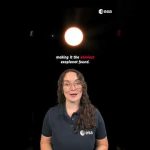
The fraction of light that an object reflects is called its ‘albedo’. Most planets have a low albedo, either because they have an atmosphere that absorbs a lot of light, or because their surface is dark or rough. Earth, for example, only reflects around 30% of incoming sunlight. Exceptions tend to be frozen ice-worlds, or planets like Venus which have a cloud layer (reflecting 75% of the Sun’s light in Venus’ case).
LTT9779 b’s 80% of albedo came as a surprise because the planet’s side facing its star is estimated to be around 2000 °C. Any temperature above 100 °C is too hot for clouds of water to form, but the temperature of this planet’s atmosphere should even be too hot for clouds made of metal or glass.
LTT9779 b can form metallic clouds despite being so hot because the atmosphere is oversaturated with silicate and metal vapours.
📹 ESA – European Space Agency
🖥️ Ricardo Ramírez Reyes/Universidad de Chile
★ Subscribe: http://bit.ly/ESAsubscribe and click twice on the bell button to receive our notifications.
Check out our full video catalog: http://bit.ly/SpaceInVideos
Follow us on Twitter: http://bit.ly/ESAonTwitter
On Facebook: http://bit.ly/ESAonFacebook
On Instagram: http://bit.ly/ESAonInstagram
On LinkedIn: https://bit.ly/ESAonLinkedIn
On Pinterest: https://bit.ly/ESAonPinterest
On Flickr: http://bit.ly/ESAonFlickr
We are Europe’s gateway to space. Our mission is to shape the development of Europe’s space capability and ensure that investment in space continues to deliver benefits to the citizens of Europe and the world. Check out https://www.esa.int/ to get up to speed on everything space related.
Copyright information about our videos is available here: https://www.esa.int/ESA_Multimedia/Terms_and_Conditions
#ESA
#Cheops
#Exoplanets