
The ascent of space shuttle Discovery from NASA’s Kennedy Space Center on Feb. 24 is shown from a number of unique angles recorded by multiple engineering cameras situated at and around Launch Pad 39A.
Tag: launch
-
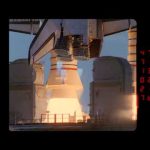
“Best of the Best” Provides New Views, Commentary of Shuttle Launches
This video from the Glenn Research Center highlights in stunning, behind-the-scenes imagery the launches of three space shuttle missions: STS-114, STS-117, and STS-124. NASA engineers provide commentary as footage from the ground and from the orbiters themselves document in detail the first phase of a mission.
-

New Shuttle Launch Date Tops This Week @NASA
A new target launch date has been selected for STS-133, allowing ample time for repairs to space shuttle Discovery. Also, NASA’s chief technologist and planetary science director were among more than 20 speakers featured at the second TEDxNASA conference in Newport News, Virginia. Hosted by the Langley Research Center, TEDx focused on education, innovation, family, technology, art and space travel. Plus, X-15 astronaut Joe Wagner joins Aerospace Hall of Fame; HQ Honor Awards; and Herrington helps celebrate American Indian & Alaska Native Heritage Month.
-

“Ice Team” Inspects NASA’s Shuttle Atlantis During STS-132 Launch Countdown
At NASA’s Kennedy Space Center in Florida, members of the Final Inspection Team, also known as the “Ice Team,” performs a walkdown of Kennedy’s Launch Pad 39A during space shuttle Atlantis’ STS-132 launch countdown on May 14. The six-member team walks on every level of the pad’s fixed service structure, inspecting the shuttle, external fuel tank, solid rocket boosters, pad structure and ground equipment for signs of ice buildup, debris or anything else that might be amiss prior to launch. As part of the inspection, photos are taken and transmitted to the launch team for review.
A videographer for NASA was included as a member of the team to capture the first-ever up close, high-definition video of this important and hazardous inspection process. -
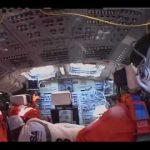
Launch Tops STS-132 Crews First Day in Space
The liftoff and eight-and-a-half minute ascent of shuttle Atlantis into space is among the highlights of STS-132’s first flight day of its 12-day mission. The six-member crew of Commander Ken Ham, Pilot Tony Antonelli and Mission Specialists Garrett Reisman, Steve Bowen, Mike Good and Piers Sellers is delivering to the ISS a cargo carrier filled with spare parts and Rassvet, the Russian Mini Research Module-1.
-
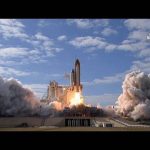
STS-129 HD Launch
Space shuttle Atlantis and its six-member crew began an 11-day delivery flight to the International Space Station on Monday with a 2:28 p.m. EST launch from NASA’s Kennedy Space Center in Florida. The shuttle will transport spare hardware to the outpost and return a station crew member who spent more than two months in space.
Atlantis is carrying about 30,000 pounds of replacement parts for systems that provide power to the station, keep it from overheating, and maintain a proper orientation in space. The large equipment can best be transported using the shuttle’s unique capabilities.
-
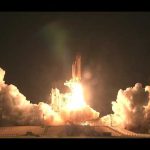
STS-128 HD Launch
With seven astronauts and a host of experiments and equipment on board, space shuttle Discovery completed a flawless ascent into orbit Friday night to begin a two-day chase of the International Space Station. With Commander Rick “C.J. ” Sturckow at the controls, the shuttle lifted off on-time at 11:59 p.m. EDT from NASA’s Kennedy Space Center in Florida. The crew will rendezvous and dock with the station Sunday and the crew will begin transferring equipment to the outpost during the 13-day mission.
After flying up on Discovery, Nicole Stott will trade places with station resident Tim Kopra, who went into space last month aboard Endeavour. Equipment and science racks for the orbiting laboratory are riding inside the Leonardo cargo module, which is secured tightly inside Discovery’s payload bay. The module will be lifted out of Discovery and locked onto the station so the crew can transfer the gear efficiently. The treadmill named for comedian Stephen Colbert also is aboard Discovery and destined for the station.
-
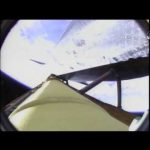
STS-127 Launch HD
NASA’S SHUTTLE ENDEAVOUR LAUNCHES TO COMPLETE JAPANESE MODULE
CAPE CANAVERAL, Fla. — Space shuttle Endeavour and its seven-member crew launched at 6:03 p.m. EDT Wednesday from NASA’s Kennedy Space Center in Florida. The mission will deliver the final segment to the Japan Aerospace Exploration Agency’s Kibo laboratory and a new crew member to the International Space Station.
Endeavour’s 16-day mission includes five spacewalks and the installation of two platforms outside the Japanese module. One platform is permanent and will allow experiments to be directly exposed to space. The other is an experiment storage pallet that will be detached and returned with the shuttle. During the mission, Kibo’s robotic arm will transfer three experiments from the pallet to the exposed platform. Future experiments also can be moved to the platform from the inside of the station using the laboratory’s airlock.
Shortly before liftoff, Commander Mark Polansky thanked the teams that helped make the launch possible.
“Endeavour has patiently waited for this,” said Polansky. “We’re ready to go, and we’re going to take all of you with us on a great mission.”
-
NASA Mission Update: New Horizon
Three billion miles away from Earth, near the farthest reaches of our solar system, is the heavenly body with an extreme orbit known for 76 years as Pluto. Discovered by astronomers in 1930, Pluto was considered the ninth planet in our solar system until 2006 — when, after much debate, it was reclassified by the International Astronomical Union as a “dwarf planet,” officially dropping its name — for a number.
Denis Bogan, New Horizons Program Scientist: “Well, it certainly doesnt affect Pluto. Pluto is the same thing it was before it was discovered, before it was given a name, and before the name was changed.”
Nor does Pluto’s reclassification change the importance of NASA’s first mission to study it.
Launch Announcer: “We have ignition and lift off of NASAs New Horizon spacecraft on a decade-long”
Launched in January 2006, the thousand-pound New Horizons spacecraft will travel through space for 9-1/2 years before meeting up with Pluto in the summer of 2015.
Denis Bogan: “The last time Pluto was in this position in its orbit was during the French and Indian War. It takes 248 Earth years to travel around its orbit and come back to the same place again. At the speed of light, sending a radio signal back from the spacecraft, from Pluto to Earth, will take 4-1/2 hours.”
Operating on less power than a pair of common 100-watt light bulbs, New Horizons will map the highest-interest areas of Pluto to a resolution of 50 meters, less than the length of a football field — three billion miles away. Itll then move on to survey Pluto’s neighborhood: the atmosphere, ancient materials and small bodies of the Kuiper Belt, a chaotic region astrophysicists believe can tell us how Earth, the planets, even our sun were made.
Denis Bogan: “We have primitive material chunks of rock and ice, millions of objects of objects out there in the Kuiper Belt and we know very little about it. We didnt discover it until 1992.”
Traveling 3 billion miles to frozen, rocky Pluto and its environs, New Horizon is, in a way, going back in time to the chemical building blocks of the solar system, and life.
To learn more about the New Horizons mission visit www.nasa.gov
-
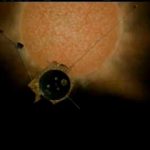
NASA Mission Update: ULYSSES
The sun is the source of life-sustaining energy here on Earth. Much of how it works – and affects us — remains a source of scientific mystery. Sunspots were first recorded by humans in the 16-hundreds. Astrophysicists have since linked heightened sunspot activity with the solar wind. It’s a million-mile-an-hour force of magnetically-charged particles emanating from the sun’s upper atmosphere. Ebbing and flowing in minimum and maximum intensities over eleven year cycles, this so-called space weather can seriously affect how things work here on Earth, such as disrupting satellite communications, telephone service and personal electronics.
Arik Posner, Program Scientist: “It would help our technology, to safeguard the technology by knowing when and in what intensity space weather occurs and where these effects might show up”
Launch Announcer : “2 -1 ignition and liftoff of Discovery and the Ulysses spacecraft bound for the polar regions of the sun.”
Until the launch of Ulysses from space shuttle Discovery in 1990, data for understanding and predicting space weather had come from a limited sampling area: the plane extending from the suns equator. Ulysses has since made three orbits above and below the poles of the sun, vastly expanding the territory from where raw space weather data are gathered.
Arik Posner: “So Ulysses was really the first spacecraft that leaped out of this confinement, and it gives us a view of the global heliosphere.”
Ulysses has found that the solar minimum were in right now is producing the lowest levels of solar wind seen since accurate readings became available a half-century ago. But for heliophysicists, these data raise as many questions as they answer.
Arik Posner: “The Space Age is only 50 years now, and the Sun just operates on longer time scales than these 50 years. So we might have just glimpsed just the surface of what is really going on.”
By expanding its reach, both in time and space, Ulysses is helping the discipline of space weather prediction grow beyond its infancy for the betterment of life here on Earth.
For more about Ulysses, the heliosphere, and space weather, log onto: www.nasa.gov/missions and click on ‘Ulysses.’
-

NASA Mission Update: CALIPSO
NASA Mission Update: CALIPSO
Clouds have forever held the imagination of skygazers who are captivated by their endless beauty and seeming randomness. But clouds, and whats in them, also hold fascination for scientists who seek to understand the many effects they have on life here on Earth.
Hal Maring, Program Scientist, CALIPSO: “Low clouds, which are white, can reflect sunlight and cause cooling of the Earth, and high clouds tend to warm the Earth by absorbing and re-radiating warmth back into the atmosphere.”
Launch Announcer: “2-1 We have ignition and we have lift-off of NASAs Calipso/Cloudsat spacecraft.”
Since its launch in April 2006, the Cloud-Aerosol Lidar and Infrared Pathfinder Satellite Observation mission, CALIPSO, has provided new insight into the role that clouds play in regulating our climate. As CALIPSO orbits the Earth, its light detection and ranging, or lidar system, emits short pulses of green and infrared light, producing a 300-feet wide snapshot of what’s in the atmosphere from top to bottom — clouds and airborne particles. Snapshots collected along the same orbit are then streamed together to paint a picture of what a vertical slice of our atmosphere looks like.
Hal Maring: “Its basically a large laser range finder, and it shoots light down into the atmosphere. And, its able to detect and measure, clouds in the vertical .Not like a photograph, which tends to be two-dimensional, but gives us vertical curtains of measurements of clouds, i.e., their altitude.”
These critical cloud data from CALIPSO are used with information gathered by other satellites in NASAs A-train constellation of Earth-observing spacecraft to quantify just how much sunlight reaches the planet — and how much gets radiated back into space. This so-called energy budget is a key to documenting and understanding climate change.
Hal Maring: “We have found, it appears as though, the Earth is warming and its warming because of an imbalance or a change in the Earths energy budget.”
To see and learn more about CALIPSOs cloud images, or how CALIPSOs also helping scientists understand how climate may be changed by naturally-occurring and manmade particulates in the atmosphere called aerosols, go to www.nasa.gov/missions and click on “CALIPSO.”