Tag: liftoff

  • Proxima liftoff

    Proxima liftoff

    ESA astronaut Thomas Pesquet, NASA astronaut Peggy Whitson and Roscosmos commander Oleg Novitsky were launched to the International Space Station on 17 November from Baikonur cosmodrome in Kazakhstan on their Soyuz MS-03 spacecraft.

    Thomas, Peggy and Oleg will spend six months in space working and living on the International Space Station.

    The Proxima mission is the ninth long-duration mission for an ESA astronaut. It is named after the closest star to the Sun, continuing a tradition of naming missions with French astronauts after stars and constellations.

    During Proxima, Thomas will perform around 50 scientific experiments for ESA and France’s space agency CNES as well as take part in many research activities for the other Station partners. The mission is part of ESA’s vision to use Earth-orbiting spacecraft as a place to live and work for the benefit of European society while using the experience to prepare for future voyages of exploration further into the Solar System.

    Follow Thomas and his mission via http://thomaspesquet.esa.int and go to the mission blog for updates: http://blogs.esa.int/thomas-pesquet
  • Galileo 15-18 – liftoff replay

    Galileo 15-18 – liftoff replay

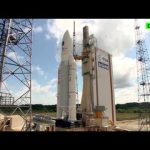
    Europe’s 15th, 16th, 17th and 18th Galileo satellites lifted off from Europe’s Spaceport in French Guiana atop an Ariane 5 launcher.

    Credit: ESA/CNES/Arianespace

  • Sentinel-3A prepares for liftoff (4K timelapse)

    Sentinel-3A prepares for liftoff (4K timelapse)

    This timelapse video shows Sentinel-3A, from final preparations to liftoff on a Rockot launcher from the Plesetsk Cosmodrome in northern Russia, at 17:57 GMT (18:57 CET) on 16 February 2016.

    Sentinel-3A is the third satellite to be launched for Europe’s Copernicus environment monitoring programme.

    Designed as a two-satellite constellation – Sentinel-3A and -3B – the Sentinel-3 mission carries a series of cutting-edge instruments for systematic measurements of Earth’s oceans, land, ice and atmosphere. Over oceans, Sentinel-3 measures the temperature, colour and height of the sea surface as well as the thickness of sea ice. These measurements will be used, for example, to monitor changes in sea level, marine pollution and biological productivity. Over land, this innovative mission will monitor wildfires, map the way land is used, provide indices of vegetation state and measure the height of rivers and lakes.

    More about Sentinel-3A: http://esa.int/sentinel-3

    Credits: Directed by Stephane Corvaja, ESA; Edited by Manuel Pedoussaut, Zetapress ; Music by Hubrid-Rockot

  • Principia liftoff

    Principia liftoff

    ESA astronaut Tim Peake, NASA astronaut Tim Kopra and commander Yuri Malenchenko were launched into space 15 Decemeber 11:03 GMT from Baikonur cosmodrome, Kazakhstan.The launch marks the start of Tim Peake’s six-month Principia mission on the International Space Station running over 30 scientific experiments for ESA.Follow Tim Peake viatimpeake.esa.int and follow the whole mission on ESA’sPrincipia blog.

    Full launch replay here:
    http://www.esa.int/spaceinvideos/Videos/2015/12/Principia_launch

  • iriss Soyuz TMA-18M timelapse (4K)

    iriss Soyuz TMA-18M timelapse (4K)

    This timelapse video shows the Soyuz TMA-18M spacecraft moving from its integration facility to it launch pad in Baikonur Cosmodrome and the launch on 2 September 2015 with commander Sergei Volkov, ESA astronaut Andreas Mogensen and Aidyn Aimbetov to the International Space Station.

    Andreas became Denmark’s first astronaut when he left our planet on his 10-day ‘iriss’ mission. ESA used the mission to test new technologies and conduct a series of scientific experiments.

    Andreas returned to Earth with Soyuz spacecraft commander Gennady Padalka and Kazakh cosmonaut Aidyn Aimbetov on 12 September.

    Follow Andreas via http://andreasmogensen.esa.int

    Credit: Directed by Stephane Corvaja – ESA and edited by Manuel Pedoussaut – Zetapress ; Music by Hubrid TMA-18

  • Ariane 5 liftoff on flight VA226

    Ariane 5 liftoff on flight VA226

    On 30 September 2015, Ariane 5 flight VA226 lifted off from Europe’s Spaceport in French Guiana and delivered two telecom satellites, Sky Muster and Arsat-2, into their planned orbits.

  • iriss mission liftoff

    iriss mission liftoff

    ESA astronaut Andreas Mogensen, commander Sergei Volkov and Aidyn Aimbetov were launched into space this morning 2 September at 04:37:43 GMT (06:37:43 CEST) from Baikonur cosmodrome, Kazakhstan.

    The launch marks the start of ESA’s 10-day ‘iriss’ mission that will focus on testing new technologies and ways of running complex space missions.

    The astronaut’s Soyuz TMA-18M spacecraft was pushed into Earth orbit as planned accelerating 50 km/h on every second for the first nine minutes of their launch.

    The spacecraft separated from the Soyuz launcher at 04:46 GMT (06:46 CEST)

  • Ariane 5 flight VA225 liftoff

    Ariane 5 flight VA225 liftoff

    On 20 August 2015, Ariane 5 flight VA225 lifted off from Europe’s Spaceport in French Guiana and delivered two telecom satellites, Eutelsat-8 West B and Intelsat-34, into their planned orbits.

    Credit: Arianespace

  • Replay of Vega liftoff VV04 with IXV

    Replay of Vega liftoff VV04 with IXV

    Replay of the liftoff of Vega VV04 with ESA’s Intermediate eXperimental Vehicle, IXV, launched from Kourou, French Guiana on 11 February 2015.

    IXV was launched 340 km into space atop a Vega rocket, VV04, from Kourou in French Guiana on 11 February 2015. After separation from Vega, IXV coasted to 412 km before beginning a punishing glide back through the atmosphere. During its autonomous flight, IXV tested the latest technologies and critical systems to extend Europe’s capability for space exploration.

    More about IXV: http://www.esa.int/Our_Activities/Launchers/IXV
    Connect with IXV on Twitter: twitter.com/esa_ixv

    Credits: ESA/Arianespace

  • Onboard camera view: launch and separation of Sentinel-1A

    Onboard camera view: launch and separation of Sentinel-1A

    Cameras mounted on the Soyuz Fregat upper stage that sent Sentinel-1A into space on 3 April 2014 captured this superb footage. It shows liftoff, the various stages in the rocket’s ascent and the Sentinel-1A satellite being released from the Fregat upper stage to start its life in orbit around Earth.

    The 2.3 tonne satellite lifted off on a Soyuz rocket from Europe’s Spaceport in Kourou, French Guiana at 21:02 GMT (23:02 CEST). The first stage separated 118 sec later, followed by the fairing (209 sec), stage 2 (287 sec) and the upper assembly (526 sec). After a 617 sec burn, the Fregat upper stage delivered Sentinel into a Sun-synchronous orbit at 693 km altitude. The satellite separated from the upper stage 23 min 24 sec after liftoff.

    Sentinel-1 is the first in the family of satellites for Europe’s Copernicus programme. It carries an advanced radar to scan Earth’s surface in all weather conditions and regardless of whether it is day or night. This new mission will be used to care for many aspects of our environment, from detecting and tracking oil spills and mapping sea ice to monitoring movement in land surfaces and mapping changes in the way land is used.

  • Ariane 5 flight VA217 liftoff replay

    Ariane 5 flight VA217 liftoff replay

    The first Ariane 5 launch of 2014 lifted off from Europe’s Spaceport in French Guiana on its mission to place two telecommunications satellites, ABS-2 & Athena–Fidus, into their planned transfer orbits.

    Credit: ESA / CNES / Arianespace

  • First Soyuz transfer and liftoff from French Guiana

    First Soyuz transfer and liftoff from French Guiana

    The Russian Soyuz vehicle lifted off for the first time from its new launch complex at Europe’s Spaceport in French Guiana on 21 October 2011. Flight VS01 carried the first two operational satellites of Europe’s Galileo navigation system into orbit.
    This time-lapse movie shows the three-stage Soyuz transfer from the assembly and testing building to the launch pad where it is then raised to the vertical. Once in the Mobile gantry, the Upper Composite containing the satellites and Fregat-MT upper stage is hoisted into position on top of the vehicle. The gantry is then rolled back, clearing the way for Soyuz to lift off.