When astronauts return to the lunar surface they are probably going to be doing more driving than walking – but to keep billowing moondust at bay they are going to need roads. An ESA project reported in today’s Nature Scientific Reports tested the creation of roadworthy surfaces by melting simulated moondust with a powerful laser.
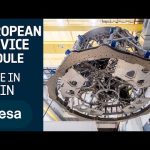
Artemis in Europe: the structure and radiators for the European Service Modules that fly NASA’s Orion spacecraft to the Moon are built in Turin, Italy.
Thales Alenia Space produces the structure that acts like a chassis on a car providing the solid foundations for all other elements to be attached to and also absorbs the forces that the Artemis spacecraft will endure during launch into Earth orbit and onto the Moon.
Technicians assemble the primary structure that is made from a core of Composite Fibre Reinforced Polymer sandwich panels and aluminium alloy elements for the secondary structures. This technology keeps the European Service Module light enough to fly farther and longer but strong enough to keep its shape.
Thales Alenia Space also supplies the radiators for the European Service Modules that consist of six elements forming two independent systems. Like a car’s radiator system the European Service Module radiators are designed to expel excess heat and keep the computers and other components inside from overheating.
The structures are trucked from Turin to Bremen, Germany, where the rest of the hardware that makes a spacecraft can be installed. The first step in their voyage to the Moon.
Credits: ESA – European Space Agency
★ Subscribe: http://bit.ly/ESAsubscribe and click twice on the bell button to receive our notifications.
We are Europe’s gateway to space. Our mission is to shape the development of Europe’s space capability and ensure that investment in space continues to deliver benefits to the citizens of Europe and the world. Check out https://www.esa.int/ to get up to speed on everything space related.
During Artemis I the European Service Module (ESM) surpassed expectations. Now, as we set our sights on Artemis II, the European Service Module is ready to once again serve as Orion’s primary power and propulsion component and keep the spacecraft at the right temperature and on course. And this time, with real astronauts on board.
ESM-2 stands as a testament to ESA’s contributions to NASA’s Orion spacecraft and the Artemis programme, ensuring the crew will have the essentials – from electricity to temperature control – in the vastness of space.
Next up, ESM-2 will be connected with the crew module to create the Artemis II vehicle. It will then be thoroughly tested before launch scheduled for next year.
ESA is committed to send astronauts beyond low-Earth orbit and ultimately to the surface of the Moon and beyond. ESM is a key contribution to this joint international endeavour.
This video features interviews with: – Philippe Berthe, ESA’s European Service Module Project Coordination manager – Kai Bergemann, Airbus deputy programme manager for Orion and the European Service Module – Jeremy Hansen, Canadian Space Agency Artemis II astronaut – Debbie Korth, NASA deputy programme manager for Orion
Credits: ESA – European Space Agency 📸 NASA/Kim Shiflett
★ Subscribe: http://bit.ly/ESAsubscribe and click twice on the bell button to receive our notifications.
We are Europe’s gateway to space. Our mission is to shape the development of Europe’s space capability and ensure that investment in space continues to deliver benefits to the citizens of Europe and the world. Check out https://www.esa.int/ to get up to speed on everything space related.
The ‘Enabling Lunar In-Situ Agriculture by Producing Fertilizer from Beneficiated Regolith’ project, involves studying a combination of mechanical, chemical and biological processes to extract mineral nutrients from the lunar soil. Valuable elements might need concentrating before use, while undesirable ones would be removed.
The current study represents a proof of principle using available lunar regolith simulants, opening the way to more detailed research in future.
★ Subscribe: http://bit.ly/ESAsubscribe and click twice on the bell button to receive our notifications.
We are Europe’s gateway to space. Our mission is to shape the development of Europe’s space capability and ensure that investment in space continues to deliver benefits to the citizens of Europe and the world. Check out https://www.esa.int/ to get up to speed on everything space related.
On Saturday, Nov. 26, at 8:42 a.m EST (13:42 UTC) the Orion spacecraft will break the record for farthest distance traveled by a spacecraft designed to carry humans to deep space and safely return them to Earth. This distance is currently held by the Apollo 13 spacecraft. In this video, Apollo astronauts and flight directors give their insights into the Apollo program, the nation’s reaction then, and how the Artemis program will benefit the nation today. As we go back to the Moon, Artemis will prepare us to travel even deeper into space.