Tag: Mars Express (Orbit)

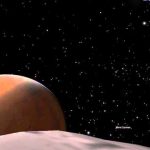
  • Mars Express flyby as seen from Phobos (Animation)

    Mars Express flyby as seen from Phobos (Animation)

    On 29 December 2013, ESA’s Mars Express will make the closest flyby yet of the Red Planet’s moon Phobos, skimming past only 45 km above its surface.

    As the spacecraft passes close to Phobos, it will be pulled slightly off course by the moon’s gravity, by a few tens of centimetres. This small deviation will be measured using the spacecraft’s radio signals, and then translated into measurements of gravity, mass and density at different locations on the moon.

    This animation shows the flyby (speeded up) as if you were standing on Phobos, with Mars in the background and Mars Express sweeping out an arc above. Toward the end of the sequence, Mars Express disappears behind Mars and out of sight of Phobos.

    Credit: ESA
  • Phobos 360

    Phobos 360

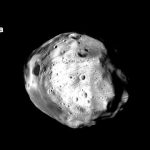
    The innermost moon of Mars, Phobos, is seen here in full 360 degree glory. The images were taken by the High Resolution Stereo Camera (HRSC) on ESA’s Mars Express at various times throughout the mission’s 10 years.

    The moon’s parallel sets of grooves are perhaps the most striking feature, along with the giant 9 km-wide Stickney impact crater that dominates one face of the 27 x 22 x 18 km moon.

    The origin of the moon’s grooves is a subject of much debate. One idea assumes that the crater chains are associated with impact events on the moon itself.

    Another idea suggests they result from Phobos moving through streams of debris thrown up from impacts 6000 km away on the surface of Mars, with each ‘family’ of grooves corresponding to a different impact event.

    Mars Express has imaged Phobos from a wide range of distances, but will make its closest flyby yet on 29 December 2013, at just 45 km above the moon.

    Although this is too close to take images, gravity experiments will give insight into the interior structure of Phobos.

    Credits: ESA/DLR/FU Berlin (G. Neukum)

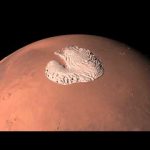
  • Mars 360: the north pole

    Mars 360: the north pole

    Enjoy views of the martian north pole from all angles in this new animation from ESA’s Mars Express.

    The ice cap has a diameter of about 1000 km and consists of many thin layers of ice mixed with dust that extend to a depth of around 2 km below the cap. The prominent gap in the ice cap is a 318 km-long, 2 km-deep chasm called Chasma Boreale.

    The layers result from variations in the orbit and rotation of Mars that affect the amount of sunlight received at the poles, and thus the amount of melting and deposition of materials over time. Meanwhile, strong prevailing winds are thought to be responsible for shaping the spiral troughs.

    The polar ice cap in this movie was constructed using data provided by the Mars Advanced Radar for Subsurface and Ionospheric Sounding instrument, MARSIS.

    Low-frequency radio waves beamed towards the surface are reflected back to Mars Express from the planet’s surface and from interfaces between layers of different materials underground.

    The strength and timing of the radar echoes are a gauge of the depths of different types of interfaces, such as between rock, water or ice. This information can then be translated into 3D views, as seen in this movie.

    Credit: ESA/ASI/NASA/JPL/La Sapienza University/INAF (A. Frigeri)

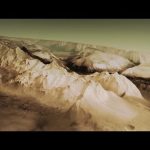
  • Mars showcase

    Mars showcase

    From the highest volcano to the deepest canyon, from impact craters to ancient river beds and lava flows, this showcase of images from ESA’s Mars Express takes you on an unforgettable journey across the Red Planet.

    Mars Express was launched on 2 June 2003 and arrived at Mars six-and-a-half months later. It has since orbited the planet nearly 12 500 times, providing scientists with unprecedented images and data collected by its suite of scientific instruments.

    The data have been used to create an almost global digital topographic model of the surface, providing a unique visualisation and enabling researchers to acquire new and surprising information about the evolution of the Red Planet.

    The images in this movie were taken by the High Resolution Stereo Camera and the video was released by the DLR German Aerospace Center as part of the ten years of Mars Express celebrations in June 2013. The music has been created by Stephan Elgner of DLR’s Mars Express planetary cartography team. DLR developed and is operating the stereo camera.

    Read the original post on DLR’s website here: http://www.dlr.de/dlr/en/desktopdefault.aspx/tabid-10212/332_read-7208/year-all/332_page-2/#gallery/10805

    Credit: ESA / DLR / FU Berlin (G. Neukum)