Oxia Planum contains one of the largest exposures of rocks on Mars that are around 3.9 billion years old and clay-rich, indicating that water once played a role here. The site sits in a wide catchment area of valley systems with the exposed rocks exhibiting different compositions, indicating a variety of deposition and wetting environments.
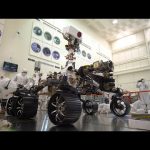
A European rover, Rosalind Franklin, is part of the ExoMars programme that will explore the surface of Mars. The rover will be the first mission to combine the capability to move across the surface and to study Mars at depth.
Missions to Mars have made many exciting discoveries that have transformed our understanding of the planet, but the next step is to bring samples to Earth for detailed analysis in sophisticated laboratories.
Detect, fetch and collect. A seemingly easy task is being tested to find the best strategy to collect samples on the martian surface, some 290 000 million km away from home.
Testing technologies for Mars exploration is part of the daily job of Laura Bielenberg, an ESA graduate trainee for the Mars Sample Return campaign.
The test takes place at the rock-strewn recreation of the Red Planet at ESA’s ESTEC technical centre in Noordwijk, the Netherlands. The nickname of this test site is the ‘Mars Yard’ and is part of the Planetary Robotics Laboratory.
The tube is a replica of the sample caches that NASA’s Perseverance rover is leaving on Mars hermetically sealed with precious martian samples inside. They are called RSTA, an acronym of Returnable Sample Tube Assembly, and to most people on Earth they look like lightsabers. Laura is investigating sample tube collection strategies, from autonomous detection to pose estimation of sample tubes on Mars, with a testbed called the RABBIT (RAS Bread Boarding In-house Testbed).
The Sample Transfer Arm will need to load the tubes from the martian surface for delivery towards Earth. ESA’s robotic arm will collect them from the Perseverance rover, and possibly others dropped by sample recovery helicopters as a backup.
Besides cameras and sensors, the team relies on neural networks to detect the tubes and estimate their pose. Inspired by the way the human brain works, neural networks mimic the way biological neurons signal to one another.
We are Europe’s gateway to space. Our mission is to shape the development of Europe’s space capability and ensure that investment in space continues to deliver benefits to the citizens of Europe and the world. Check out https://www.esa.int/ to get up to speed on everything space related.
NASA will host a briefing to provide highlights from the first year-and-a-half of the Perseverance rover’s exploration of Mars.
The rover landed in Mars’ Jezero Crater in February 2021 and is collecting samples of rock and other materials from the Martian surface. Perseverance is investigating the sediment-rich ancient river delta in the Red Planet’s Jezero Crater.
Speakers: • Lori Glaze, director of NASA’s Planetary Science Division, NASA Headquarters • Laurie Leshin, JPL director • Rick Welch, Perseverance deputy project manager, JPL • Ken Farley, Perseverance project scientist, Caltech • Sunanda Sharma, Scanning Habitable Environments with Raman and Luminescence for Organics and Chemicals (SHERLOC) scientist, JPL • David Shuster, Perseverance returned sample scientist, University of California, Berkeley
Our next Mars Rover gets closer to launch, a comet spotted from the space station and we’re ready to build a spacecraft to explore a metal-rich asteroid … a few of the stories to tell you about – This Week at NASA!
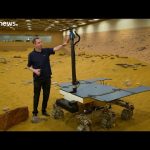
ExoMars is the first mission to head to the Red Planet to seek signs of life, now or in the past. It’s a massive scientific and technical challenge, and Euronews meets some of the team involved in this joint ESA-Roscosmos project in this month’s edition of Space.
ESA is Europe’s gateway to space. Our mission is to shape the development of Europe’s space capability and ensure that investment in space continues to deliver benefits to the citizens of Europe and the world. Check out http://www.esa.int/ESA to get up to speed on everything space related.
Watch as NASA tests a new parachute for landing the Mars 2020 rover on the Red Planet. On Sept. 7, NASA’s ASPIRE project broke a record when its rocket-launched parachute deployed in 4-10ths of a second—the fastest inflation of this size chute in history: https://go.nasa.gov/2Ro4eAL
Spacecraft in orbit and on Mars’s surface have made many exciting discoveries, transforming our understanding of the planet and unveiling clues to the formation of our Solar System, as well as helping us understand our home planet. The next step is to bring samples to Earth for detailed analysis in sophisticated laboratories where results can be verified independently and samples can be reanalysed as laboratory techniques continue to improve.
Bringing Mars to Earth is no simple undertaking—it would require at least three missions from Earth and one never-been-done-before rocket launch from Mars.
A first mission, NASA’s 2020 Mars Rover, is set to collect surface samples in pen-sized canisters as it explores the Red Planet. Up to 31 canisters will be filled and readied for a later pickup – geocaching gone interplanetary.
In the same period, ESA’s ExoMars rover, which is also set to land on Mars in 2021, will be drilling up to two meters below the surface to search for evidence of life.
A second mission with a small fetch rover would land nearby and retrieve the samples in a Martian search-and-rescue operation. This rover would bring the samples back to its lander and place them in a Mars Ascent Vehicle – a small rocket to launch the football-sized container into Mars orbit.
A third launch from Earth would provide a spacecraft sent to orbit Mars and rendezvous with the sample containers. Once the samples are safely collected and loaded into an Earth entry vehicle, the spacecraft would return to Earth, release the vehicle to land in the United States, where the samples will be retrieved and placed in quarantine for detailed analysis by a team of international scientists.
The dramatic conclusion to ESA’s latest StarTiger project: a ‘dropship’ quadcopter steers itself to lower a rover gently onto a safe patch of the rocky martian surface. StarTiger’s Dropter project was tasked with developing and demonstrating a European precision-landing capability for Mars and other targets.
Starting from scratch for the eight-month project, the Dropter team was challenged to produce vision-based navigation and hazard detection and avoidance for the dropship. It has to identify a safe landing site and height before winching down its passenger rover on a set of cables. Flight testing took place at Airbus Defence and Space’s Trauen test site in northern Germany.
Credit:
Deutsches Forschungszentrum für Künstliche Intelligenz, DFKI
Spin.Works
Poznañ University of Technology/Institute of Control and Information Engineering, IAII
Airbus Defence & Space