Steve Spangler is a bestselling author, STEM educator and Emmy award-winning television personality with more than 2,100 television appearances to his credit. Steve appeared as a regular guest on the Ellen DeGeneres Show from 2007-2022 (27 appearances).
Watch the Psyche spacecraft launch from NASA’s Kennedy Space Center in Florida on a SpaceX Falcon Heavy rocket. Targeted to launch on Oct. 12, 2023, at 10:16 a.m. EDT. The mission to Psyche will take us on a journey to a metal-rich asteroid.
During this mission we will be researching the largest metallic object in the solar system, how planets form and testing high-speed laser communications with Deep Space Optical Communications (DSOC) technology.
Did you know that in microgravity we are preparing one of the most promising fuels for the future?
Microgravity is helping to find answers and models to refine the processes needed to efficiently burn solid fuel like iron dust. Are we witnessing the rise of a new “Iron Age”? Could we use metal powders instead of petrol to fuel our cars?
Solid fuels are used for burning a match, lighting a sparkler on New Year’s Eve as well as the fuel inside the boosters of Ariane and of other rockets. But metals such as iron can also burn, in powder form, and are entirely smokeless and carbon free.
Metals could be produced using clean energy, such as from solar cells or wind turbines. That electricity is stored as chemical energy in the metal powder at energy densities that are competitive with fossil fuels. This has the potential to reduce greenhouse gasses emission globally, but a barrier to implementing this technology is the development of combustion systems that can efficiently burn the metal fuels, which requires a solid understanding of their combustion physics.
To understand the physics of metal fuel combustion, a cluster of iron powder needs to be suspended for about 30 seconds, the time needed to observe and study how a flame propagates. Researchers used sounding rockets and parabolic flights to run experiments in weightlessness and to validate existing models, yielding promising results.
The density of iron particles and the composition of gases in the combustion chamber are essential parameters, like in a petrol car engine. Microgravity allows for the study of the laws of flame propagation, to optimise parameters in industrial burner designs, and reduce impact on the environment.
These space experiments also help us understand similar phenomena, such as the spreading of contagious microbes and forest fires.
In a vote of confidence for the technique a student team at TU Eindhoven in The Netherlands worked with industrial partners to design a metal combustion facility now installed at Swinkels Family Brewers, subsidised by the Dutch province of Noord-Brabant, used to produce steam for the brewing process.
The step to space research is closer than you might think. Get involved with spaceflight research via https://www.esa.int/spaceflightAO. Find out about our commercial partnerships and opportunities in human and robotic exploration via https://www.esa.int/explorationpartners to run your research in microgravity as well.
★ Subscribe: http://bit.ly/ESAsubscribe and click twice on the bell button to receive our notifications.
We are Europe’s gateway to space. Our mission is to shape the development of Europe’s space capability and ensure that investment in space continues to deliver benefits to the citizens of Europe and the world. Check out https://www.esa.int/ to get up to speed on everything space related.
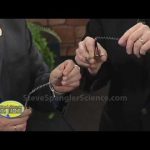
Check out this and other cool science experiments at http://www.stevespanglerscience.com/experiments/ Can a piece of metal have a “memory”? Yes, if the metal is a special alloy of nickel and titanium. It’s called Memory Metal, and the uses for this material go far beyond today’s amazing demonstration.
About Steve Spangler Science…
Steve Spangler is a celebrity teacher, science toy designer, speaker, author and an Emmy award-winning television personality. Spangler is probably best known for his Mentos and Diet Coke geyser experiment that went viral in 2005 and prompted more than 1,000 related YouTube videos. Spangler is the founder of www.SteveSpanglerScience.com, a Denver-based company specializing in the creation of science toys, classroom science demonstrations, teacher resources and home for Spangler’s popular science experiment archive and video collection. Spangler is a frequent guest on the Ellen DeGeneres Show where he takes classroom science experiments to the extreme. Check out his pool filled with 2,500 boxes of cornstarch!
On the education side, Spangler started his career as a science teacher in the Cherry Creek School district for 12 years. Today, Steve travels extensively training teachers in ways to make learning more engaging and fun. His hands-on science boot camps and summer institutes for teachers inspire and teach teachers how to prepare a new generation for an ever-changing work force. Over the last 15 years, he has also made more than 500 television appearances as an authority on hands-on science and inquiry-based learning.
On the business side, Spangler is the founder and CEO of Steve Spangler Science, a Denver-based company specializing in the creation of educational toys and kits and hands-on science training services for teachers. The companys unique business strategies and viral creations have been featured in the Wall Street Journal, Inc. Magazine, Wired and TIME Magazine where online readers voted Steve Spangler #18 in the Top 100 Most Influential People of the Year for 2006 (what were they thinking?). You’ll find more than 140 Spangler created products available online at SteveSpanglerScience.com and distributed to toy stores and mass-market retailers worldwide.
Spangler joined NBC affiliate 9News in 2001 as the science education specialist. His weekly experiments and science segments are designed to teach viewers creative ways to make learning fun. His now famous Mentos Geyser experiment, turning 2-liter bottles of soda into erupting fountains, became an Internet sensation in September 2005 when thousands of people started posting their own Mentos explosions on YouTube.com.
As founder of SteveSpanglerScience.com, Spangler and his design team have developed more than 140 educational toys and science-related products featured by mass-market retailers like Target, Wal-Mart, Toys R’ Us, Discovery Channel Stores and over 1,400 independent specialty toy stores. His educational science catalog and on-line business offers more than a thousand science toys and unique learning resources. Recently, Spangler has been featured in the Wall Street Journal, Inc. Magazine, WIRED, the History Channel, Food Network and TIME Magazine where on-line readers voted Steve Spangler #18 in the Top 100 Most Influential People of the Year for 2006.
His recent appearances on the Ellen DeGeneres Show have taught viewers how to blow up their food, shock their friends, create mountains of foam, play on a bed of nails, vanish in a cloud of smoke and how to turn 2,500 boxes of cornstarch and a garden hose into a swimming pool of fun.