This summer, NASA will be cutting the cord and going “full-stream” ahead. Our cable channel NASA TV will now be NASA+! With no subscription needed, you can now watch live missions and other NASA content all at your fingertips. Visit plus.nasa.gov today!
“Space can unite a troubled country in troubled times. And no moment united the country quite like when the Eagle landed, as all of planet Earth watched from below.”
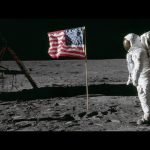
For the 55th anniversary of the Apollo 11 Moon landing, and in the midst of times that recall the era when the Moon landing took place, NASA Administrator Bill Nelson shares a message on the special power of space to bring people together—and the hope that this anniversary will be a time for reflection and healing.
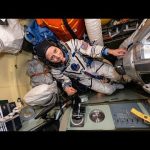
NASA astronauts Mike Barratt, Matt Dominick, Tracy C. Dyson, Jeanette Epps, Butch Wilmore, and Suni Williams share a Fourth of July message and extend their best wishes to those back on Earth in a video recorded on June 28, 2024.
The crew members are currently living and working aboard the International Space Station. Their missions aim to advance scientific knowledge and test new technologies for future human and robotic missions to the Moon and Mars, including NASA’s Artemis lunar missions.
From soaring temperatures affecting agriculture and the ocean, to the escalating frequency and intensity of heat waves, the challenges posed by rising temperatures across our planet’s interconnected systems have far-reaching impacts.
Join NASA Chief Scientist and Senior Climate Advisor Kate Calvin for this special edition of NASA Science Live, where she will be joined by experts to dive into the connection between Earth’s climate system and people.
Have questions? Share them in chat when we go live at 3:15 p.m. EDT (1915 UTC) on Friday, June 28 — or share them with #AskNASA on your social platform of choice!
We mourn the passing of Apollo Astronaut William “Bill” Anders at the age of 90.
He was backup pilot for the Gemini XI, Apollo 11 flights, and was lunar module pilot for Apollo 8 — the first lunar orbit mission. On Christmas Eve in 1968, Anders turned his camera toward Earth and captured the legendary Earthrise photo.
More partners in space exploration, new data measuring ocean health, air quality and our climate, and an upgrade to testing facilities for Artemis II … a few of the stories to tell you about – This Week at NASA!
Meet Hera, our very own asteroid detective. Together with two CubeSats – Milani the rock decoder and Juventas the radar visionary – Hera is off on an adventure to explore Didymos, a double asteroid system that is typical of the thousands that pose an impact risk to planet Earth.
In September 2022 NASA’s DART spacecraft tested if it was possible to divert an asteroid by giving it a shove – and found out that it was! Important knowledge, should we wish to avoid going the same way as the dinosaurs. Astronomers can observe from afar how the smaller asteroid’s orbit has shifted since DART’s impact, but there is still a missing piece of the puzzle if we want to fully understand how ‘kinetic impacting’ works in practice. Suitable for kids and adults alike, this episode of ‘The Incredible Adventures of Hera’ explains why ESA’s asteroid detective and its CubeSat assistants need to get up close and personal to shine light on this cosmic mystery.
Watch the other episodes of The Incredible Adventures of the Hera Mission:
We are Europe’s gateway to space. Our mission is to shape the development of Europe’s space capability and ensure that investment in space continues to deliver benefits to the citizens of Europe and the world. Check out https://www.esa.int/ to get up to speed on everything space related.
On April 8, 2024, North America’s last total solar eclipse until 2045 moved across the continent. It made landfall in Mexico, crossed the United States from Texas to Maine, and departed across Canada’s Atlantic coast.
This video offers viewers highlights of the eclipse from NASA’s live commentary. Different vantage points include the International Space Station, WB-57 aircraft, and 12 telescopes stationed across North America.
A total solar eclipse occurs when the Moon passes between the Sun and the Earth, completely blocking the face of the Sun. The sky darkens as if it were dawn or dusk.
Watch live as NASA astronaut Loral O’Hara, Roscosmos cosmonaut Oleg Novitskiy, and spaceflight participant Marina Vasilevskaya of Belarus return home from the International Space Station. Their Soyuz MS-24 spacecraft will head for a parachute-assisted landing on the steppe of Kazakhstan at 3:17 a.m. EDT Saturday, April 6 (0717 UTC).
O’Hara is completing a mission spanning 204 days in space that covered 3,264 orbits of the Earth and 86.5 million miles.
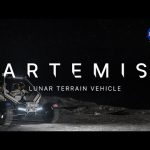
Live from Johnson Space Center in Houston, we’ll announce the company, or companies, selected to move forward in developing the LTV (Lunar Terrain Vehicle).
The LTV will help future Artemis astronauts search for water, ice, and other resources on the lunar surface, helping humanity establish a long-term presence on another planetary body for the first time.
Hear from:
• Vanessa Wyche, director, NASA Johnson • Jacob Bleacher, chief exploration scientist, NASA Headquarters • Lara Kearney, manager, Extravehicular Activity and Human Surface Mobility Program, NASA Johnson
NASA hosted a news conference from the Johnson Space Center in Houston April 3, 2024, to announce the companies selected to move forward in the development of the Lunar Terrain Vehicle under the LTVS (Lunar Terrain Vehicle Services) contract. The award leverages NASA’s expertise in developing and operating these next generation “Moon buggies” to build commercial capabilities that support scientific discovery and long-term human exploration on the Moon. NASA intends to begin using the LTV for crewed operations during the Artemis V mission on the surface of the Moon.
Astronaut Tracy C. Dyson, a spaceflight veteran who has logged over 188 days in orbit, is set to launch on her next mission to the International Space Station.
Dyson, cosmonaut Oleg Novitskiy, and spaceflight participant Marina Vasilevskaya of Belarus is set to lift off at 8:36 a.m. EDT (1236 UTC) from the Baikonur Cosmodrome in Kazakhstan aboard their Soyuz MS-25 spacecraft. This will be Dyson’s third spaceflight.
After two days in orbit, the Soyuz will arrive at the International Space Station’s Prichal module for a scheduled docking at 11:09 a.m. EDT (1509 UTC) Monday, March 25. Dyson is scheduled to spend six months aboard the station, conducting research to help us learn how to live in space while making life better back on Earth.
The March 21 launch of the crewed Soyuz-25 spacecraft to the International Space Station with NASA astronaut Tracy C. Dyson, Roscosmos cosmonaut Oleg Novitskiy, and spaceflight participant Marina Vasilevskaya of Belarus was scrubbed, and rescheduled for Saturday, March 23. Learn more: https://go.nasa.gov/3IMDTZy
Astronaut Tracy C. Dyson, a spaceflight veteran who has logged over 188 days in orbit, is set to launch on her next mission to the International Space Station.
Dyson, cosmonaut Oleg Novitskiy, and spaceflight participant Marina Vasilevskaya of Belarus is set to lift off at 9:21 a.m. EDT (1321 UTC) from the Baikonur Cosmodrome in Kazakhstan aboard their Soyuz MS-25 spacecraft. This will be Dyson’s third spaceflight.
After a two-orbit, three-hour journey, the Soyuz will arrive at the International Space Station’s Prichal module for a scheduled docking at 12:39 p.m. EDT (1639 UTC). Dyson is scheduled to spend six months aboard the station, conducting research to help us learn how to live in space while making life better back on Earth.
A total solar eclipse will cross North America on Monday, April 8, 2024, and we want to help you prepare! Find out when and where to look up, learn how to safely view an eclipse and discover ways you can get involved with NASA during this celestial event! Join us live on Wednesday, March 20, at 3 p.m. EDT (1900 UTC) as we help you get ready for the last total solar eclipse to cross the contiguous United States for the next 20 years. Have questions? Submit them during our live chat.
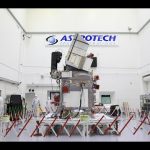
In its latest test of readiness for space, ESA’s Hera spacecraft for planetary defence is being operated for around three weeks in hard vacuum, while being subjected to the same temperature profiles it will experience during its journey to the Didymos binary asteroid system.
The 1.6 × 1.6 × 1.7 m spacecraft was slid inside the 4.5-m diameter, 11.8-m long Phenix thermal vacuum chamber at ESA’s ESTEC Test Centre in the Netherlands.
“You’re always a bit nervous when your baby gets moved about,” remarks Ian Carnelli, overseeing Hera for ESA. “Right now it’s being shut into a dark airless box for weeks on end, but we have confidence it will perform well.”
Hera can be seen receded into the rectangular ‘thermal tent’ within Phenix. The six copper walls of this internal box can be heated up to 100°C or cooled via piped liquid nitrogen down to –190°C, all independently from each other.
Then, after the main door of the stainless steel Phenix chamber was slid shut, the air within the chamber was pumped out during a lengthy 20 hours process down to approximately one billionth of outside atmospheric pressure. This will allow the Hera team from ESA, European Test Services operating the Test Centre and Hera manufacturer OHB to test the spacecraft’s thermal behaviour as the temperature changes around it.
Space is a place where it is possible to be hot and cold at the same time if one part of your spacecraft is in sunlight and another is in shade. And because there is no air, there is no conduction or convection to lose heat from your spacecraft. Instead thermal experts employ insulation and radiators to keep the body of a spacecraft within carefully chosen temperature limits. In general spacecraft electronics – just like their human makers – work best at room temperature.
“We already have detailed models of the spacecraft’s thermal behaviour, and this spacecraft-level thermal vacuum test lets us correlate these models with reality,” explains Hera’s Product Assurance and Safety manager, Heli Greus.
“More than 400 thermal sensors have been placed in and around Hera to give us precise knowledge of what is going on, and the test is being supervised on a 24/7 basis in case anything anomalous occurs. The spacecraft is now being put through a series of ‘cold plateaus’ and ‘hot plateaus’ representative of its mission, which will allow us to test the thermal limits of each specific unit aboard.”
Hera is Europe’s contribution to an international planetary defence experiment. Following the DART mission’s impact with the Dimorphos asteroid in 2022 – modifying its orbit and sending a plume of debris thousands of kilometres out into space – Hera will return to Dimorphos to perform a close-up survey of the crater left by DART. The mission will also measure Dimorphos’ mass and make-up, along with that of the larger Didymos asteroid that Dimorphos orbits around. Hera is due for launch in October 2024.
The ESTEC Test Centre in the Netherlands is the largest facility of its kind in Europe, providing a complete suite of equipment for all aspects of satellite testing under a single roof.
Today we mourn the passing of Thomas P. Stafford at the age of 93.
In December 1965, Stafford piloted Gemini VI, the first rendezvous in space, and helped develop techniques to prove the basic theory and practicality of space rendezvous.
Later he commanded Gemini IX and performed a demonstration of an early rendezvous that would be used in the Apollo lunar missions, the first optical rendezvous, and a lunar orbit abort rendezvous.
He served as the commander of the Apollo 10 ‘dress rehearsal’ mission preparing for the first Moon landing and as Apollo commander of the Apollo-Soyuz Test Project (ASTP) mission, a joint space flight culminating in the historic first meeting in space between American Astronauts and Soviet Cosmonauts, which ended the International space race.
Throughout his career, Stafford helped us push the boundaries of what’s possible in air and space, flying more than 100 different types of aircraft.
Credit: NASA Music: Universal Production Music Producer: Sonnet Apple
Live from the International Space Station, NASA astronauts Jeanette Epps and Loral O’Hara are joined by NASA experts live at the South by Southwest conference in Austin, Texas. The panel of explorers in orbit and on Earth talk about how you can get involved with space station research and technology.
Find out how to fly a scientific experiment, move your business forward, or find inspiration from the explorers living and working in space, as well as how to spot the station when it flies over your part of the globe. Whether you’re an entrepreneur, a professional researcher, or just plain curious, this session is for you.
NASA Administrator Bill Nelson discusses the agency’s goals for the benefit of humanity during the annual State of NASA address on Monday, March 11. Learn about our plans for promoting U.S. leadership in space exploration, improving life on Earth through innovation, humanity’s return to the Moon under the Artemis campaign, and more. Senior leaders from each of NASA’s mission directorates also will discuss advancements in their areas ranging from aeronautics and science research to space operations.
NASA’s Juno spacecraft has been in orbit around Jupiter for almost eight years, offering it the unique opportunity to make close flybys of two of the planet’s intriguing moons, volcanic Io and icy Europa.
Join NASA experts Thursday, March 7, as we delve into these enigmatic worlds to learn how scientists are unraveling their secrets. From Io’s tumultuous volcanic activity to Europa’s ice-covered ocean depths, discover the latest findings from the Juno spacecraft.
We’re recruiting for our next class of NASA astronauts. Selected candidates could fly on Artemis missions to the Moon and, eventually, Mars. Will you be one of them?
Applications are open from March 5 through April 2, 2024. Read the requirements and start your application by visiting https://go.nasa.gov/astro2024.
Don’t think you have what it takes? There’s no such thing as a typical astronaut. We’re seeking out team players, passionate people, candidates who thrive under pressure and excel in what they do.
Video Producer: Daniel Lauchu Executive Producer: Rebecca Sirmons Editors: Shane Apple and Daniel Lauchu Narrator: Morgan Freeman Music: Universal Production Music
Watch live with us as a crew of four launch on NASA’s SpaceX Crew-8 mission to the International Space Station. Liftoff is targeted at 10:53 p.m. EST (0353 UTC), Sunday, March 3.
The launch attempt March 2 was postponed due to unfavorable conditions in the flight path of the SpaceX Falcon 9 rocket and Dragon spacecraft.
The crew will lift off in their SpaceX Dragon spacecraft, powered by a Falcon 9 rocket, from Launch Complex 39A at NASA’s Kennedy Space Center in Florida. Members include: • NASA astronaut Matthew Dominick, commander • NASA astronaut Michael Barratt, pilot • NASA astronaut Jeanette Epps, mission specialist • Roscosmos cosmonaut Aleksandr Grebenkin, mission specialist
Over 200 science experiments and technology demonstrations will take place during Crew-8’s mission of approximately six months in space. Experiments will include using stem cells to create organoid models to study degenerative diseases, studying the effects of microgravity and UV radiation on plants at a cellular level, and testing whether wearing pressure cuffs on the legs could prevent fluid shifts and reduce health problems in astronauts. Learn more about the mission and science at: https://www.nasa.gov/missions/station/commercial-crew/what-you-need-to-know-about-nasas-spacex-crew-8-mission/
NASA will honor the next generation of Artemis astronaut candidates to graduate at 10:30 a.m. EST (1530 UTC) Tuesday, March 5, at the agency’s Johnson Space Center in Houston.
After completing more than two years of basic training, these candidates will earn their wings and become eligible for spaceflight, including assignments to the International Space Station, future commercial destinations, missions to the Moon, and eventually, missions to Mars.
Credit: NASA Producer/Editor: Dexter Herbert Producer: Gary Jordan Audio Post Production: Greg Wiseman Videographers: Charles Clendaniel and Chase Gibson Executive Producer: Sami Aziz
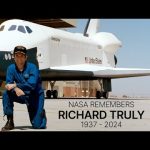
We’re saddened by the passing of Astronaut Richard Truly at the age of 86.
In 1965, Truly became one of the first military astronauts selected to the Air Force’s Manned Orbiting Laboratory program and transferred to NASA as an astronaut in August 1969. He served as capsule communicator for all three Skylab missions in 1973 and the Apollo-Soyuz mission in 1975. He was pilot for one of the two-astronaut crews that flew the 747/Space Shuttle Enterprise approach and landing test flights during 1977. He then was backup pilot for STS-1, the first orbital test of the Shuttle. His first space flight was as pilot of Space Shuttle Columbia (STS-2), significant as the first piloted spacecraft to be reflown in space. His second flight (STS-8) was as commander of Space Shuttle Challenger, the first night launch and landing in the Shuttle program.
The former Shuttle astronaut served as the first commander of the Naval Space Command in Dahlgren, Virginia, established Oct. 1, 1983.
Vice Admiral Richard H. Truly returned to NASA to become NASA’s Associate Administrator for Space Flight on February 20, 1986. In this position, he led the painstaking rebuilding of the Space Shuttle program. This was highlighted by NASA’s celebrated “return to flight” on September 29, 1988, when Discovery lifted off from Kennedy Space Center, Florida, on the first Shuttle mission in almost 3 years. He served as NASA’s eighth Administrator from February 1989 to 1992.
Credit: NASA Music: Universal Production Music Video Producer: Sonnet Apple
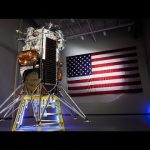
Intuitive Machines’ IM-1 mission made history on Feb. 22, with the first successful Moon landing by a company. NASA Administrator, Bill Nelson congratulates everyone involved in this great and daring quest.
NASA science and technology demonstrations now are gathering data on the lunar surface. The mission is expected to continue through the end of the month.
NASA innovates for the benefit of humanity, and with its Artemis CLPS (Commercial Lunar Payload Services) initiative, the agency is working with commercial companies to achieve rapid flights to the Moon. By sending research that advances capabilities for science, exploration, and commercial development of the Moon, CLPS is another example of how NASA is supporting long-term lunar exploration by enabling commercial services on the Moon.
Intuitive Machines’ IM-1 mission made history on Feb. 22, with the first successful Moon landing by a company. This televised news conference will discuss details of Odysseus’ landing as part of NASA’s CLPS (Commercial Lunar Payload Services) initiative and Artemis campaign.
Participants from NASA and Intuitive Machines will discuss next steps for NASA science instruments aboard, as well as details of the landing, which made last-minute use of NASA’s precision landing technology demonstration, NDL, or Navigation Doppler Lidar.
Participants in the news conference include: • Joel Kearns, deputy associate administrator for Exploration, Science Mission Directorate, NASA Headquarters in Washington • Prasan Desai, deputy associate administrator, Space Technology Mission Directorate at NASA Headquarters • Steve Altemus, chief executive officer and co-founder, Intuitive Machines • Tim Crain, chief technology officer and co-founder, Intuitive Machines
NASA astronauts Jasmin Moghbeli and Loral O’Hara, currently aboard the International Space Station, talk about the similarities between training for space travel and training for the Big Game. Spoiler: It’s all about teamwork.
The crew aboard the orbiting laboratory are studying a variety of microgravity experiments that benefit people on Earth, including research in human heart health, cancer therapies, space manufacturing techniques, and technology demonstrations.
Here’s more information about some of the research happening every day in low Earth orbit: https://go.nasa.gov/3SQdDDF
Targeted to launch on Tuesday, Feb. 6, NASA’s Plankton, Aerosol, Cloud, ocean Ecosystem (PACE) satellite mission will study how our oceans and atmosphere interact in a changing climate. Prelaunch activities include a briefing on the mission science on Sunday, Feb. 4 at 11 a.m. EST (1600 UTC) with the following NASA participants:
Kate Calvin, chief scientist and senior climate advisor Karen St. Germain, director, Earth Science Division Jeremy Werdell, PACE project scientist Andy Sayer, PACE atmospheric scientist Natasha Sadoff, Satellite Needs Program Manager
In April 2021, NASA’s Ingenuity Mars Helicopter became the first spacecraft to achieve powered, controlled flight on another world. With 72 successful flights, Ingenuity has far surpassed its originally planned technology demonstration of up to five flights. On Jan. 18, Ingenuity flew for the final time on the Red Planet.
Join Tiffany Morgan, NASA’s Mars Exploration Program Deputy Director, and Teddy Tzanetos, Ingenuity Project Manager, as they discuss these historic flights and what they could mean for future extraterrestrial aerial exploration. Have questions? Submit them in our live chat for the chance to have them answered during the show.
NASA Administrator Bill Nelson has announced that the Ingenuity Mars Helicopter has come to an end. The Ingenuity Mars Helicopter made history by achieving the first powered, controlled flight on another planet on April 19, 2021. Despite initial plans for up to five flights, the helicopter has exceeded expectations and executed an impressive 72 flights on the Red Planet. NASA pays tribute to its accomplishments, which have far exceeded what was thought possible and have paved the way for future flights in our solar system.
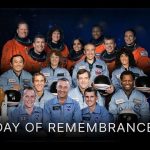
NASA remembers the crews of Apollo 1, Challenger STS-51L, and Columbia STS-107 during the agency’s Day of Remembrance on Jan. 25, 2024.
Our annual Day of Remembrance honors all members of the NASA family who lost their lives while furthering the cause of exploration and discovery. We pause to honor them and reflect on maintaining a strong safety culture.
Safety is a key NASA core value. NASA’s constant attention to safety is the cornerstone upon which we build mission success.
Every year, NASA holds a Day of Remembrance to commemorate those we have lost, reflect on why we explore, and commit to our safety practices.
In 2024, NASA Day of Remembrance falls on Thursday, Jan. 25. #NASARemembers the crews of Apollo 1, space shuttles Challenger and Columbia, and all members of the NASA family who lost their lives while furthering the cause of exploration and discovery.
Landing science on the Moon, demonstrating quiet supersonic aircraft, and launching two new Earth climate satellites, plus a mission to Europa, one of Jupiter’s icy moons, are just a FEW of the milestones we have planned for 2024.
To learn more about the missions mentioned in this video, take a deep dive into these links:
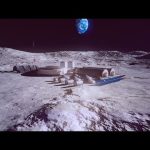
As NASA prepares to send humans back to the Moon, we will send science and technology instruments ahead of time to lay the foundation for a sustainable human presence. Through NASA’s Commercial Lunar Payload Services, or CLPS initiative, we are enabling American companies to send our science experiments and technologies to the lunar surface for us. This unique commercial delivery service is poised to change the way we work and perform science at the Moon, greatly expanding our capabilities for exploration. Learn more about this innovative approach: https://www.nasa.gov/commercial-lunar-payload-services/
Producers: Jessica Wilde, Scott Bednar Editor: Matthew Schara
NASA’s mission is to explore the unknown in air and space, innovate for the benefit of humanity, and inspire the world through discovery. NASA showed the world that anything is possible in 2023.
The lifetime of space missions can be measured in decades, not years. From designing, building, launching, sampling and finally returning home, follow the #NASAExplorers of OSIRIS-REx as they enter the final stretch of their quest to sample asteroid Bennu.
Created by: James Tralie Producers: James Tralie, Dan Gallagher, Lauren Ward, Katy Mersmann Scientists: Dante Lauretta, Mike Moreau, Jason Dworkin, Nicole Lunning Operations: Kenny Getzandanner, Richard Witherspoon, Anjani Polit Videographers: Rob Andreoli, John Philyaw, John Caldwell Animation: Walt Feimer, Michael Lentz, Jonathan North, Adriana Manrique Gutierrez, Krystofer Kim, James Tralie, Bailee DesRocher, Jacquelyn DeMink, Lisa Poje Sound Design: James Tralie Data Visualization: Kel Elkins NASA+ Executive Producer: Rebecca Sirmons
Music provided by Universal Production Music: “Precious Swirl” by Brice Davoli; “Touch of Eternity” by Sergey Azbel; “Unstoppable Urge” by Frederik Wiedmann; “Darkness to Light” by Benji Paul Merrison and Will Slater; “Ill Will” by Edgard Jaude; “Above the Sea of Fog” by Alan Myson; “A Human Solution” by Ty Unwin; “Darkened” by Alan Myson; “Texture” by Alan Myson; “Hope After Dark” by Cyrus Reynolds; “Out of Time” by Alan Myson; “The Untold Story” by Joni Amelia Fuller; “Confronting Your Fears” by Benji Paul Merrison and Will Slater; “Collapse” by Tom Sue and Zach Singer; “Rebellion” by Sergey Azbel; “Majestic Oceans” by Paul Englishby; “Wide Eyes” by Benji Paul Merrison and Will Slater; “Bleak Outlook” by Benji Paul Merrison and Will Slater; “Fifth Wave” by Alan Myson; “Preoccupied” by David Ashok Ramani and Jonathan Elias; “The Dark Veil” by Rob Manning; “Nutcracker – Waltz of the Flowers” by Piotr Tchaikovsky; “Limitless” by Alan Myson
It was Touch-and-Go there for a few seconds…literally!
OSIRIS-REx had only six seconds to collect a sample of asteroid Bennu – in a maneuver called TAG, or Touch-and-Go – while the #NASAExplorers behind the mission waited anxiously from 200 million miles away.
Created by: James Tralie Producers: James Tralie, Dan Gallagher, Lauren Ward, Katy Mersmann Scientists: Dante Lauretta, Mike Moreau Operations: Beau Bierhaus, Coralie Adam Broadcast Hosts: Michelle Thaller, James Tralie, Gary Napier, Nancy Neal Jones Videographers: Rob Andreoli, John Philyaw, John Caldwell Animation: Walt Feimer, Michael Lentz, Jonathan North, Adriana Manrique Gutierrez, Krystofer Kim, James Tralie, Bailee DesRocher, Jacquelyn DeMink, Lisa Poje Sound Design: James Tralie Data Visualization: Kel Elkins NASA+ Executive Producer: Rebecca Sirmons
Music provided by Universal Production Music: “Voyager” by Jeremy Stack; “Moment in Time” by David Thomas Connolly; “Held” by Benji Paul Merrison and Will Slater; “Unstoppable Urge” by Frederik Wiedmann; “King of the Mountain” by Steven David Fay; “Night Watch” by Jeremy Stack; “Shadow Shifter” by Michael James Burns; “Follow the Drinking Gourd” by Kavin Hoo; “Conquering” by Alan Myson; “Clair de Lune” by Claude Debussy; “Human Stories” by Dominic Francis Glynn; “Marked for Flight” by Kavin Hoo; “Never End” by Sergey Azbel; “Getting Things Done” by Theodore Vidgen; “Dark String Bend” by Benji Paul Merrison and Will Slater; “First Rains” by Benji Paul Merrison and Will Slater; “Natural Wonders” by Benji Paul Merrison and Will Slater; “Successful Return” by Alan Boyd; “Frosty Dawn” by Benji Paul Merrison and Will Slater; “Starfall” by Sergey Azbel; “Lost Thought” by Adriano Aponte
On 28 November 1983, the first European-built Spacelab was launched from @NASAKennedy aboard Space Shuttle Columbia.
Also on board was Ulf Merbold, who became our first astronaut in space. The 10-day Spacelab-1 mission marked our entry into human spaceflight activities.
Under a cooperation agreement with @NASA, we were to build a modular research laboratory that would fit inside the Shuttle’s cargo bay.
In 17 years, European Spacelab equipment flew on 36 missions. The two Spacelab modules eventually made 16 flights with five different Shuttle Orbiters.
Many of Spacelab’s features live on in space hardware that is flying today. Europe’s Columbus laboratory on the Station evolved from Spacelab.
★ Subscribe: http://bit.ly/ESAsubscribe and click twice on the bell button to receive our notifications.
We are Europe’s gateway to space. Our mission is to shape the development of Europe’s space capability and ensure that investment in space continues to deliver benefits to the citizens of Europe and the world. Check out https://www.esa.int/ to get up to speed on everything space related.
When it comes to space exploration, expect the unexpected. As OSIRIS-REx approached asteroid Bennu, scientists were surprised to find a loosely packed rubble pile. This week, #NASAExplorers get a closer look at Bennu and the surprises in store.
Watch this series and more on NASA+, our no cost, ad-free streaming service. No subscription required. https://plus.nasa.gov
Created by: James Tralie Producers: James Tralie, Dan Gallagher, Lauren Ward, Katy Mersmann Scientists: Dante Lauretta, Dani DellaGiustina, Mike Moreau Engineers: Anjani Polit, Ryan Olds, Sandy Freund Operations: Kenny Getzandanner, David Lorenz Videographers: Rob Andreoli, John Philyaw, John Caldwell Animation: Walt Feimer, Michael Lentz, Jonathan North, Adriana Manrique Gutierrez, Krystofer Kim, James Tralie, Bailee DesRocher, Jacquelyn DeMink, Lisa Poje Sound Design: James Tralie Data Visualization: Kel Elkins NASA+ Executive Producer: Rebecca Sirmons
Do you groan when you hear of a certain planet going into retrograde? Have you ever wondered what planets in retrograde actually means? Join planetary experts Thursday, Nov. 16, to learn about this fascinating phenomenon and other interesting facts about the orbits of planets. Submit your questions during our live chat for a chance to have them answered live on the show.