Tag: NASA’s Dart mission

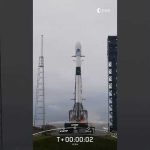
  • Liftoff! Europe’s first planetary defence mission 🚀 #shorts

    Liftoff! Europe’s first planetary defence mission 🚀 #shorts

    ESA’s Hera mission lifted off on a SpaceX Falcon 9 from Cape Canaveral Space Force Station in Florida, USA, on 7 October at 10:52 local time (16:52 CEST, 14:52 UTC).

    Hera is ESA’s first planetary defence mission. It will fly to a unique target among the 1.3 million asteroids in our Solar System – the only body to have had its orbit shifted by human action – to solve lingering unknowns associated with its deflection.

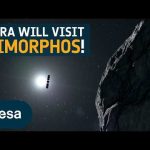
    Hera will carry out the first detailed survey of a ‘binary’ – or double-body – asteroid, 65803 Didymos, which is orbited by a smaller body, Dimorphos. Hera’s main focus will be Dimorphos, whose orbit around the main body was previously altered by NASA’s kinetic-impacting DART spacecraft.

    By sharpening scientific understanding of this ‘kinetic impact’ technique of asteroid deflection, Hera should turn the experiment into a well-understood and repeatable technique for protecting Earth from an asteroid on a collision course.

    —————————————————
    Copyright: SpaceX
    —————————————————

    ★ Subscribe: http://bit.ly/ESAsubscribe and click twice on the bell button to receive our notifications.

    Check out our full video catalog: http://bit.ly/SpaceInVideos
    Follow us on Twitter: http://bit.ly/ESAonTwitter
    On Facebook: http://bit.ly/ESAonFacebook
    On Instagram: http://bit.ly/ESAonInstagram
    On LinkedIn: https://bit.ly/ESAonLinkedIn
    On Pinterest: https://bit.ly/ESAonPinterest
    On Flickr: http://bit.ly/ESAonFlickr

    We are Europe’s gateway to space. Our mission is to shape the development of Europe’s space capability and ensure that investment in space continues to deliver benefits to the citizens of Europe and the world. Check out https://www.esa.int/ to get up to speed on everything space related.

    Copyright information about our videos is available here: https://www.esa.int/ESA_Multimedia/Terms_and_Conditions

    #ESA #HeraMission #Launch
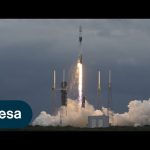
  • ESA’s Hera mission launch highlight

    ESA’s Hera mission launch highlight

    ESA’s Hera mission lifted off on a SpaceX Falcon 9 from Cape Canaveral Space Force Station in Florida, USA, on 7 October at 10:52 local time (16:52 CEST, 14:52 UTC).

    Hera is ESA’s first planetary defence mission. It will fly to a unique target among the 1.3 million asteroids in our Solar System – the only body to have had its orbit shifted by human action – to solve lingering unknowns associated with its deflection.

    Hera will carry out the first detailed survey of a ‘binary’ – or double-body – asteroid, 65803 Didymos, which is orbited by a smaller body, Dimorphos. Hera’s main focus will be Dimorphos, whose orbit around the main body was previously altered by NASA’s kinetic-impacting DART spacecraft.

    By sharpening scientific understanding of this ‘kinetic impact’ technique of asteroid deflection, Hera should turn the experiment into a well-understood and repeatable technique for protecting Earth from an asteroid on a collision course.

    —————————————————
    📸 ESA – S. Corvaja
    Copyright: ESA/SpaceX
    —————————————————

    ★ Subscribe: http://bit.ly/ESAsubscribe and click twice on the bell button to receive our notifications.

    Check out our full video catalog: http://bit.ly/SpaceInVideos
    Follow us on Twitter: http://bit.ly/ESAonTwitter
    On Facebook: http://bit.ly/ESAonFacebook
    On Instagram: http://bit.ly/ESAonInstagram
    On LinkedIn: https://bit.ly/ESAonLinkedIn
    On Pinterest: https://bit.ly/ESAonPinterest
    On Flickr: http://bit.ly/ESAonFlickr

    We are Europe’s gateway to space. Our mission is to shape the development of Europe’s space capability and ensure that investment in space continues to deliver benefits to the citizens of Europe and the world. Check out https://www.esa.int/ to get up to speed on everything space related.

    Copyright information about our videos is available here: https://www.esa.int/ESA_Multimedia/Terms_and_Conditions

    #ESA #HeraMission #Launch
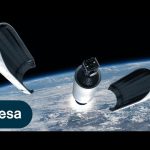
  • ESA’s Hera mission launch (Official broadcast)

    ESA’s Hera mission launch (Official broadcast)

    Hera, ESA’s first planetary defence mission, is headed to space.

    Hera will fly to a unique target among the 1.3 million known asteroids of our Solar System – the first body to have had its orbit shifted by human action – to probe lingering unknowns related to its deflection.

    —————————————————
    Credits: ESA/SpaceX
    —————————————————
    Chapters:
    00:00 Start of ESA WebTV programme – live from ESA’s European Space Operations Centre in Darmstadt, Germany
    18:30 SpaceX live broadcast begins
    36:15 Hera lift-off
    1:53:00 – Hera separates from Falcon 9 launcher: End of SpaceX live broadcast, ESA WebTV programme continues
    1:57:20 Acquisition of the first signals from the Hera spacecraft
    2:13:26 End of ESA WebTV programme

    ★ Subscribe: http://bit.ly/ESAsubscribe and click twice on the bell button to receive our notifications.

    Check out our full video catalog: http://bit.ly/SpaceInVideos
    Follow us on Twitter: http://bit.ly/ESAonTwitter
    On Facebook: http://bit.ly/ESAonFacebook
    On Instagram: http://bit.ly/ESAonInstagram
    On LinkedIn: https://bit.ly/ESAonLinkedIn
    On Pinterest: https://bit.ly/ESAonPinterest
    On Flickr: http://bit.ly/ESAonFlickr

    We are Europe’s gateway to space. Our mission is to shape the development of Europe’s space capability and ensure that investment in space continues to deliver benefits to the citizens of Europe and the world. Check out https://www.esa.int/ to get up to speed on everything space related.

    Copyright information about our videos is available here: https://www.esa.int/ESA_Multimedia/Terms_and_Conditions

    #ESA #HeraMission #Asteroid

  • Why are we going back to this asteroid?

    Why are we going back to this asteroid?

    Hera, ESA’s first planetary defence mission, is headed to space.

    Hera will fly to a unique target among the 1.3 million known asteroids of our Solar System – the first body to have had its orbit shifted by human action – to probe lingering unknowns related to its deflection.

    Hera is scheduled for launch on a SpaceX Falcon 9 rocket from Cape Canaveral Space Force Station in Florida, USA, today, Monday 7 October, at 16:52 CEST / 15:52 BST.

    —————————————————

    Credits: ESA – European Space Agency

    —————————————————

    Chapters:
    00:00 What is Hera?
    01:07 Why do we need to protect our planet?
    02:22 How did we pick this asteroid to explore?
    03:36 What are we expecting to see on Dimorphos?
    05:56 How do we get there?
    07:48 What type of technology do we need to inspect an asteroid?
    10:49 Conclusion

    ★ Subscribe: http://bit.ly/ESAsubscribe and click twice on the bell button to receive our notifications.

    Check out our full video catalog: http://bit.ly/SpaceInVideos
    Follow us on Twitter: http://bit.ly/ESAonTwitter
    On Facebook: http://bit.ly/ESAonFacebook
    On Instagram: http://bit.ly/ESAonInstagram
    On LinkedIn: https://bit.ly/ESAonLinkedIn
    On Pinterest: https://bit.ly/ESAonPinterest
    On Flickr: http://bit.ly/ESAonFlickr

    We are Europe’s gateway to space. Our mission is to shape the development of Europe’s space capability and ensure that investment in space continues to deliver benefits to the citizens of Europe and the world. Check out https://www.esa.int/ to get up to speed on everything space related.

    Copyright information about our videos is available here: https://www.esa.int/ESA_Multimedia/Terms_and_Conditions

    #ESA #HeraMission #Asteroid

  • What’s it like to work as a mission manager at the European Space Agency? 🛰️ #shorts

    What’s it like to work as a mission manager at the European Space Agency? 🛰️ #shorts

    Meet Ian Carnelli, project manager for Hera, our planetary defense mission that will very soon be launched into space.

    Hera will be, along with NASA’s DART spacecraft, humankind’s first probe to rendezvous with a binary asteroid system, a little understood class making up around 15% of all known asteroids.

    📹 ESA – European Space Agency
    📸 NASA/ESA

    #ESA #HeraMission #ProjectManager

  • This tiny spacecraft is about to change our understanding of asteroids! 🛰️ #shorts

    This tiny spacecraft is about to change our understanding of asteroids! 🛰️ #shorts

    Introducing Juventas… 🛰️

    A shoebox-sized spacecraft from our Hera mission that’s about to explore the binary asteroid system of Didymos and its moon, Dimorphos – a space rock the size of the Great Pyramid!

    Using its cutting-edge radar system, Juventas will reveal whether Dimorphos is a solid monolith or simply a loose pile of rubble. Plus, it’s going to gently land and measure the asteroid’s gravity—something never done before!

    This tiny spacecraft is set to rewrite what we know about asteroids and could one day help protect our planet.

    Stay tuned for more on Hera’s thrilling mission!

    📸 ESA – European Space Agency
    📹 ESA/Science Office

    #ESA #HeraMission #Asteroid

  • Studying the first crater ever made by humans ☄️ #shorts

    Studying the first crater ever made by humans ☄️ #shorts

    Our Hera spacecraft will soon start its journey to the distant asteroid moon Dimorphos orbiting around its parent body Didymos.

    One of the first features Hera will look for is the crater left on Dimorphos by its predecessor mission DART, which impacted the asteroid to deflect its orbit.

    Yet, more recent impact simulations suggest no crater will be found. The DART impact is likely to have remodelled the entire body instead – a significant finding for both asteroid science and planetary defence.

    📸 ESA – European Space Agency
    📹 ESA/NASA

    #ESA #HeraMission #Asteroid

  • Why have we chosen this random asteroid to explore? ☄️ #shorts

    Why have we chosen this random asteroid to explore? ☄️ #shorts

    The Hera mission is following up on NASA’s DART mission, which altered the orbit of Dimorphos, after a successful impact in 2022.

    Hera will soon study the aftermath of the impact.

    Launching this October, Hera will turn this grand-scale experiment into a well-understood and hopefully repeatable planetary defence technique.

    📸 ESA – European Space Agency
    📹 ESA/NASA

    #ESA #HeraMission #Asteroid

  • 2023: ESA’s year in space

    2023: ESA’s year in space

    2023’s highlight was the highly anticipated launch of Juice, Europe’s Jupiter Icy Moon Explorer. The Juice spacecraft was placed on course to Jupiter on the second-to-last Ariane 5 launch vehicle in April. After an eight-year journey, Juice will begin observing the giant gas planet and its three large ocean-bearing moons – Ganymede, Calisto and Europa.

    The Euclid space telescope was launched in July with the aim of unravelling the enigmas of ‘dark matter’ and ‘dark energy’. Euclid’s first images were released in November, revealing razor-sharp astronomical images with detail never before seen by a telescope across such a large patch of the sky.

    After almost five years in space, ESA’s Aeolus wind mission was retired. This trailblazing mission was tasked with observing wind patterns from space thereby improving weather forecasts and climate models.. Aeolus data and technology will have an important role to play in the accuracy of future weather forecasting. On 28 July, it burned up in an assisted re-entry – the first assisted re-entry by a mission which was not designed to do so.

    As space debris becomes an increasingly serious issue, ESA is determined to search for solutions. Together with its commercial and institutional partners, ESA has developed the ‘Zero Debris Charter’, launched this year. By signing the Charter, space entities worldwide can register their intent to work together towards the sustainable use of Earth’s orbital environment.

    Earlier in in 2023, MTG-I1, the first of the Meteosat Third Generation missions, sent back its first images. The satellite was launched in 2022 and carries two instruments: a flexible combined imager and a lighting imager. Both instruments performed beyond expectation and a stunning combined image from both was revealed.

    Earth observation is key to keeping our planet and the population as a whole, safe. Today, monitoring earthquakes, forest fires or flooding from space already helps to coordinate rescue response but the data can also be used to better understand phenomena such as climate change and support the IPCC climate reports.

    Last year, NASA’s Dart mission impacted on a small moonlet of the asteroid Didymos, changing its course. We’ll soon be launching ESA’s Hera spacecraft to collect data on the aftermath of this collision. The Hera spacecraft was integrated and underwent testing this year in ESA ESTEC’s test centre in the Netherlands.

    2023 also saw the first hardware tests for the second generation of Galileo satellites but even more importantly the Galileo High Accuracy Service was launched in January. This new service delivers centimetre accuracy from space further cementing Galileo’s reputation as the most accurate satellite navigation system in the world.

    ★ Subscribe: http://bit.ly/ESAsubscribe and click twice on the bell button to receive our notifications.

    Check out our full video catalog: http://bit.ly/SpaceInVideos
    Follow us on Twitter: http://bit.ly/ESAonTwitter
    On Facebook: http://bit.ly/ESAonFacebook
    On Instagram: http://bit.ly/ESAonInstagram
    On LinkedIn: https://bit.ly/ESAonLinkedIn
    On Pinterest: https://bit.ly/ESAonPinterest
    On Flickr: http://bit.ly/ESAonFlickr

    We are Europe’s gateway to space. Our mission is to shape the development of Europe’s space capability and ensure that investment in space continues to deliver benefits to the citizens of Europe and the world. Check out https://www.esa.int/ to get up to speed on everything space related.

    Copyright information about our videos is available here: https://www.esa.int/ESA_Multimedia/Terms_and_Conditions

    #ESA #2023 #Highlights