📚 Sources: The Battle of Aughrim by Michael McNally (EPUB ISBN: 978 0 7424 9658 0). Kingdom Overthrown by Gerald Fitzgibbon (EPUB ISBN: 978-1-84840-476-2). ‘The Battle of Aughrim 1691’ by G. A. Hayes-McCoy in Journal of the Galway Archaeological and Historical Society. The Battlefields of Ireland, from 1688-1691, including Limerick and Athlone, Aughrim and the Boyne by John Boyle (ASIN: B074D1KXR5).
📚 Sources: – Bloody Repulse at Fontenoy – Robert L. Durham – Warfare History Network (2022) – The Battle of Fontenoy 1745: Saxe against Cumberland in the War of the Austrian Succession – James Falkner (2019) – Fontenoy 1745: Cumberland’s bloody defeat (Campaign) – Michael McNally (2017)
The Copernicus Sentinel-2 mission takes us over Zeeland – the westernmost province in the Netherlands, in this week’s edition of the Earth from Space programme.
We are Europe’s gateway to space. Our mission is to shape the development of Europe’s space capability and ensure that investment in space continues to deliver benefits to the citizens of Europe and the world. Check out http://www.esa.int/ESA to get up to speed on everything space related.
The Copernicus Sentinel-1 mission takes us over part of the Dutch province of Flevoland – the newest province in the Netherlands and one of the largest land reclamation projects in the world, in this week’s edition of the Earth from Space programme.
We are Europe’s gateway to space. Our mission is to shape the development of Europe’s space capability and ensure that investment in space continues to deliver benefits to the citizens of Europe and the world. Check out http://www.esa.int/ESA to get up to speed on everything space related.
Astronauts on the Moon found themselves hopping around, rather than simply walking. Switzerland’s SpaceBok planetary exploration robot has followed their example, launching all four legs off the ground during tests at our technical heart.
SpaceBokis a quadruped robot designed and built by a Swiss student team from ETH Zurich and ZHAW Zurich, currently being tested using Automation and Robotics Laboratories (ARL) facilities at our technical centre in the Netherlands. The robot is being used to investigate the potential of ‘dynamic walking’ and jumping to get around in low gravity environments.
SpaceBok could potentially go up to 2 m high in lunar gravity, although such a height poses new challenges. Once it comes off the ground the legged robot needs to stabilise itself to come down again safely – like a mini-spacecraft.So, like a spacecraft. SpaceBok uses a reaction wheel to control its orientation
We are Europe’s gateway to space. Our mission is to shape the development of Europe’s space capability and ensure that investment in space continues to deliver benefits to the citizens of Europe and the world. Check out http://www.esa.int/ESA to get up to speed on everything space related.
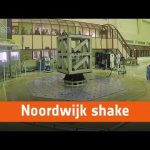
ESA’s Test Centre based in Noordwijk, the Netherlands, simulates every aspect of space for satellite testing – including recreating the equivalent vibration of a rocket launch. This is ESA’s most powerful shaker: the Hydra hydraulic shaker, able to generate vibration equivalent to a 7.5 Richter scale earthquake.
ESA is Europe’s gateway to space. Our mission is to shape the development of Europe’s space capability and ensure that investment in space continues to deliver benefits to the citizens of Europe and the world. Check out http://www.esa.int/ESA to get up to speed on everything space related.
ESA is Europe’s gateway to space. Our mission is to shape the development of Europe’s space capability and ensure that investment in space continues to deliver benefits to the citizens of Europe and the world. Check out http://www.esa.int/ESA to get up to speed on everything space related.
The date is fixed: you are invited to the annual ESA Open Day at ESTEC, ESA’s technical heart in the Netherlands, on Sunday, 7 October.
The theme this year is ‘A voyage through space with Europe’. We’ll have all ESA establishments represented on site, either with speakers giving talks or live link-ups to the different centres. You’ll be able to meet astronauts, scientists and engineers, plus some special guests. You’ll see how we design space missions, how we develop the technologies needed to go into space and how we simulate space on the ground. With the help of our colleagues from the other ESA centres, we’ll complete the life-cycle of a mission and see how it is launched and controlled once in space!
The date is fixed: you are invited to visit ESA’s technical heart in the Netherlands for its annual Open Day on Sunday, 8 October.
The theme this year is Bringing Space to Earth. Visit us to meet astronauts and mission experts, see how we simulate space on the ground, and discover the knowledge and technologies brought back to Earth from space.
For now, please save the date. You can register to attend #OpenESTEC from 3 July.
In place for more than half a century, the ESTEC European Space Research and Technology Centre in Noordwijk on the North Sea coast is ESA’s largest establishment, focused on developing technology, planning missions and testing satellites.The hub of our continent’s space effort, this is where the majority of European space projects are born, developed and tested in advance of their flights into orbit.