
These key excerpts from a July 24 science update at NASA headquarters, features team members of NASA’s New Horizons mission discussing surprising new images and science results from the spacecraft’s historic July 14 flyby of Pluto.
Tag: New Horizons (Space Mission)
-

New Horizons science update on This Week @NASA – July 24, 2015
A July 24 update at NASA headquarters, featured new surprising imagery and science results from the recent flyby of Pluto, by the New Horizons spacecraft. These included an image from the Long Range Reconnaissance Imager or (LORRI) – looking back at Pluto – hours after the historic flyby that revealed a haze in the planet’s sunlit atmosphere that extends as high as 80 miles above Pluto’s surface – much higher than expected. Models suggest that the hazes form when ultraviolet sunlight breaks apart methane gas. LORRI images also show evidence that exotic ices have flowed – and may still be flowing across Pluto’s surface, similar to glacial movement on Earth. This unpredicted sign of present-day geologic activity was detected in Sputnik Planum – an area in the western part of Pluto’s heart-shaped Tombaugh Regio. Additionally, new compositional data from New Horizons’ Ralph instrument indicate that the center of Sputnik Planum is rich in nitrogen, carbon monoxide, and methane ices. Also, Kepler discovers Earth’s “bigger cousin”, New crew launches to space station, EPIC view of Earth, Newman continues NASA center visits and Small Class Vehicle launch pad complete!
-
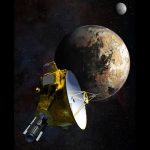
The Year of Pluto – New Horizons Documentary Brings Humanity Closer to the Edge of the Solar System
New Horizons is the first mission to the Kuiper Belt, a gigantic zone of icy bodies and mysterious small objects orbiting beyond Neptune. This region also is known as the “third” zone of our solar system, beyond the inner rocky planets and outer gas giants. Johns Hopkins University Applied Physics Laboratory (APL) in Maryland, designed, built and operates the New Horizons spacecraft, and manages the mission for NASA’s Science Mission Directorate in Washington. The Year of Pluto – NASA New Horizons is a one hour documentary which takes on the hard science and gives us answers to how the mission came about and why it matters. Interviews with Dr. James Green, John Spencer, Fran Bagenal, Mark Showalter and others share how New Horizons will answer many questions. New Horizons is part of the New Frontiers Program, managed by NASA’s Marshall Space Flight Center in Huntsville, Alabama.
-

NASA’s New Horizons Spacecraft: Getting to Pluto
In NASA’a second televised briefings on Tuesday, April 14, plans and upcoming activities about the agency’s mission to Pluto that will make the first-ever close flyby of the dwarf planet on July 14 were briefed.
Briefers described the mission’s goals and context, scientific objectives and encounter plans – including what images can be expected and when.
New Horizons already has covered more than 3 billion miles since it launched on Jan. 19, 2006. The spacecraft will pass Pluto at a speed of 31,000 mph taking thousands of images and making a wide range of science observations. At a distance of nearly 4 billion miles from Earth at flyby, it will take approximately 4.5 hours for data to reach Earth.
Participants for the 2:20-3:30 p.m. discussion were:
– James Green, director of Planetary Science, NASA Headquarters
– Glen Fountain, New Horizons Project Manager, Johns Hopkins University Applied Physics Laboratory, Laurel, Maryland
– Hal Weaver, New Horizons Project Scientist, Johns Hopkins University Applied Physics Laboratory, Laurel, Maryland
– Alan Stern, New Horizons Principal Investigator, Southwest Research Institute, Boulder, Colorado -

NASA’s New Horizons Spacecraft: Seeing Pluto as Never Before
In NASA first of two televised briefings on Tuesday, April 14, plans and upcoming activities about the agency’s mission to Pluto that will make the first-ever close flyby of the dwarf planet on July 14 were discussed.
Briefers described the mission’s goals and context, scientific objectives and encounter plans – including what images can be expected and when.
New Horizons already has covered more than 3 billion miles since it launched on Jan. 19, 2006. The spacecraft will pass Pluto at a speed of 31,000 mph taking thousands of images and making a wide range of science observations. At a distance of nearly 4 billion miles from Earth at flyby, it will take approximately 4.5 hours for data to reach Earth.
Participants for 1-2 p.m. discussion were:
– John Grunsfeld, astronaut and Science Mission Directorate associate administrator, NASA Headquarters, Washington
– James Green, director of Planetary Science, NASA Headquarters
– Alan Stern, New Horizons Principal Investigator, Southwest Research Institute, Boulder, Colorado
– William McKinnon, New Horizons Co-Investigator, Washington University in St. Louis
– Cathy Olkin, New Horizons Deputy Project Scientist, Southwest Research Institute, Boulder, Colorado