Tag: ocean

  • ESA’s Ocean Training Course: the highlights

    ESA’s Ocean Training Course: the highlights

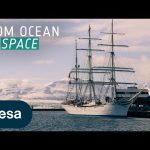
    After an extraordinary six-week voyage from northern Norway, the iconic Norwegian tall ship Statsraad Lehmkuhl has docked in Nice, France, concluding ESA’s 2025 Advanced Ocean Training Course. Braving everything from wild storms to calm seas, students aboard mastered techniques for collecting ocean measurements and harnessed satellite data to unlock insights into our blue planet. Led by experts, this real-world expedition offered more than education – it sparked curiosity and a deeper commitment to understanding and protecting our oceans.

    Read full story: https://www.esa.int/Applications/Observing_the_Earth/FutureEO/Tall_ship_brings_ESA_ocean_science_training_to_Nice

    Credits: ESA/Ocean Media Lab

    ★ Subscribe: http://bit.ly/ESAsubscribe and click twice on the bell button to receive our notifications.

    Check out our full video catalog: http://bit.ly/SpaceInVideos
    Follow us on Twitter: http://bit.ly/ESAonTwitter
    On Facebook: http://bit.ly/ESAonFacebook
    On Instagram: http://bit.ly/ESAonInstagram
    On LinkedIn: https://bit.ly/ESAonLinkedIn
    On Pinterest: https://bit.ly/ESAonPinterest
    On Flickr: http://bit.ly/ESAonFlickr

    We are Europe’s gateway to space. Our mission is to shape the development of Europe’s space capability and ensure that investment in space continues to deliver benefits to the citizens of Europe and the world. Check out https://www.esa.int/ to get up to speed on everything space related.

    Copyright information about our videos is available here: https://www.esa.int/ESA_Multimedia/Terms_and_Conditions
  • Europa Clipper: NASA’s Mission to Jupiter’s Ocean Moon (Mission Trailer)

    Europa Clipper: NASA’s Mission to Jupiter’s Ocean Moon (Mission Trailer)

    Our solar system has a number of worlds with water, but is Earth the only one with the right environment to support life? That’s the question NASA’s Europa Clipper aims to answer.

    Europa Clipper is the first mission dedicated to studying Jupiter’s moon Europa, which scientists believe has a salty ocean under its icy shell. While not designed to detect life, the spacecraft is equipped with nine science instruments and a gravity experiment, which will all help determine whether this moon could be habitable. Europa Clipper will orbit Jupiter and make 49 flybys of Europa, taking detailed measurements and high-resolution pictures.

    Europa Clipper is set to launch in October 2024 from NASA’s Kennedy Space Center in Florida, arriving at Jupiter in 2030. Watch it lift off live: https://plus.nasa.gov

    For more information on Europa Clipper: https://europa.nasa.gov/

    Credit: NASA/JPL-Caltech/KSC/APL/Airbus

    Download link: https://images.nasa.gov/details/Europa%20Clipper%20-%20NASA%E2%80%99s%20Mission%20to%20Jupiter’s%20Ocean%20Moon%20-%20Mission%20Trailer

    #NASA #Space #EuropaClipper

  • Rockin’ Pop-Up: Coastal Geology

    Rockin’ Pop-Up: Coastal Geology

    Explore the impacts that the ocean, weather, and tectonic activity have on our ever-changing coastline.

    About the series: Join the Geology Gents, Gavin and Graham, for weekly conversations about rocks live on Facebook. Each week we’ll explore a different geologic topic, from Santa Cruz formations to tips for being a more effective rockhound. Graham Edwards and Gavin Piccione are PhD candidates in geochronology with the Department of Earth and Planetary Sciences at UC Santa Cruz.

    Submit your questions ahead of time on Facebook or by emailing events@santacruzmuseum.org, or during the program live on Facebook. Feel free to include pictures of rocks you’d like identified! Pro-tip: the better the picture, the better the ID.

  • Earth views from space – 1 hour long in 4K!

    Earth views from space – 1 hour long in 4K!

    Watch over one hour of our planet, seen from the International Space Station, in 4K resolution. This compilation was made from video taken by ESA astronauts, mostly by Thomas Pesquet during his first mission, Proxima, and ESA astronaut Alexander Gerst on his second mission, Horizons, as well as footage from Samantha Cristoforetti’s Futura mission and Paolo Nespoli’s Vita mission.

    Flying 400 km above our amazing planet Earth, the Space Station travels at 28 800 km/h to stay in orbit. The videos are in real time and not sped up or edited. Most of the scenes were filmed in the European-built Cupola module, the Space Station’s observatory.

    On 21 April 2001, the first ESA astronaut Umberto Guidoni arrived at the Space Station. Since then, the Space Station has grown immensely, as have the number of Europeans to have worked in it, together with the science experiments performed in orbit.

    Europe contributes around 8% of the running costs of the International Space Station, but has built a large part of the structure, including ESA’s Columbus laboratory, the Cupola observatory, the Tranquillity and Harmony modules, as well as the computers that collect data and provide navigation, communications and operations for the Russian segment.

    ESA also provided the Space Station with supplies and boosted its orbit through five Automated Transfer Vehicles, the heaviest and most versatile Space Station supply ferry. This programme evolved into the European Service Modules that ESA is supplying for @NASA’s Artemis programme, taking humans forward to the Moon and thus continuing the exemplary international collaboration beyond Earth’s orbit.

    Since Umberto’s mission, there have been 26 further ESA astronaut missions to the International Space Station, with astronauts flying to Station on either the Russian Soyuz or US Space Shuttle spacecraft.

    Thomas Pesquet’s second mission, Alpha, is the 28th mission for ESA, with ESA astronaut Matthias Maurer already lined up for his first flight later this year, and ESA astronaut Samantha Cristoforetti scheduled for the 30th ESA International Space Station mission in 2022.

    ★ Subscribe: http://bit.ly/ESAsubscribe and click twice on the bell button to receive our notifications.

    Check out our full video catalog: http://bit.ly/SpaceInVideos
    Follow us on Twitter: http://bit.ly/ESAonTwitter
    On Facebook: http://bit.ly/ESAonFacebook
    On Instagram: http://bit.ly/ESAonInstagram
    On Pinterest: https://bit.ly/ESAonPinterest
    On Flickr: http://bit.ly/ESAonFlickr

    We are Europe’s gateway to space. Our mission is to shape the development of Europe’s space capability and ensure that investment in space continues to deliver benefits to the citizens of Europe and the world. Check out https://www.esa.int/ to get up to speed on everything space related.

    Copyright information about our videos is available here: https://www.esa.int/ESA_Multimedia/Terms_and_Conditions

    #ESA
    #InternationalSpaceStation
    #EarthFromSpace

  • Keeping an eye on ocean plastic pollution…from space!

    Keeping an eye on ocean plastic pollution…from space!

    Meet bag, bottle and straw, three bits of plastic left on the beach.
    They are only small, but they are heading into the ocean, where they could cause big damage. ESA is exploring how satellites can help detect and reduce plastic pollution in the ocean. From spotting build-ups of marine litter to tracking ocean currents, satellites could be game-changing in tackling this enormous environmental problem.

    Though engaging for children and adults alike, this video is designed with primary
    school students in mind. In particular, teachers can use it to introduce the topic of marine litter in subjects such as geography and science.

    Dutch version available here: https://youtu.be/ScSCXaSnjhE

    Credits: ESA – Science Office
    Project coordination: Nicole Shearer (EJR-Quartz for ESA) and Mariana Barrosa (Science Office) Scientific advice: Peter de Maagt and Paolo Corradi (both ESA), Joana
    Mira Veiga (Deltares)
    Educational advice: Petra de Clippelaar (BSO ‘t Vogelnest) and Connor Mackelvey (Iroquois Elementary School)
    Design and animation: David Santos and Rui Braz (both Science Office)

    ★ Subscribe: http://bit.ly/ESAsubscribe and click twice on the bell button to receive our notifications.

    Check out our full video catalog: http://bit.ly/SpaceInVideos
    Follow us on Twitter: http://bit.ly/ESAonTwitter
    On Facebook: http://bit.ly/ESAonFacebook
    On Instagram: http://bit.ly/ESAonInstagram
    On Pinterest: https://bit.ly/ESAonPinterest
    On Flickr: http://bit.ly/ESAonFlickr

    We are Europe’s gateway to space. Our mission is to shape the development of Europe’s space capability and ensure that investment in space continues to deliver benefits to the citizens of Europe and the world. Check out https://www.esa.int/ to get up to speed on everything space related.

    Copyright information about our videos is available here: https://www.esa.int/ESA_Multimedia/Terms_and_Conditions

    #ESAKids
    #PlasticPollution
    #EarthObservation

  • Ocean views from space | Meet the experts

    Ocean views from space | Meet the experts

    Earth observation satellites are guardians of our planet. Thanks to remote sensing technology and daily data collection, researchers are able to better monitor our planet’s oceans and rising sea levels from space. ESA senior advisor for Earth Observation programmes Jérôme Beneviste explains how ocean views from space play a role in climate change studies and natural catastrophe predictions.

    Learn more: http://bit.ly/ExpeditionHome12_18YearsOld

    ★ Subscribe: http://bit.ly/ESAsubscribe and click twice on the bell button to receive our notifications.

    Check out our full video catalog: http://bit.ly/SpaceInVideos
    Follow us on Twitter: http://bit.ly/ESAonTwitter
    On Facebook: http://bit.ly/ESAonFacebook
    On Instagram: http://bit.ly/ESAonInstagram
    On Flickr: http://bit.ly/ESAonFlickr

    We are Europe’s gateway to space. Our mission is to shape the development of Europe’s space capability and ensure that investment in space continues to deliver benefits to the citizens of Europe and the world. Check out http://www.esa.int/ESA to get up to speed on everything space related.

    Copyright information about our videos is available here: http://www.esa.int/spaceinvideos/Terms_and_Conditions

    #ESA
    #MeetTheExperts
    #ExpeditionHome

  • International Ocean Science Satellite Receives New Name

    International Ocean Science Satellite Receives New Name

    With every great name, comes a great story.

    And we’re teaming up with the European Space Agency to release the new name of Sentinel-6A/Jason-CS, a mission to extend long-term observations of global sea level change. Launching in 2020, this mission is a symbolization of international collaboration. Hear from NASA Administrator Jim Bridenstine, Dr. Thomas Zurbuchen and more during this special event on Jan. 28 at 9 a.m. EST.

  • Earth from Space: Italy and Mediterranean

    Earth from Space: Italy and Mediterranean

    Earth from Space is presented by Kelsea Brennan-Wessels from the ESA Web TV virtual studios. In this edition, Sentinel-3A treats us to a view stretching from Sardinia to Romania.

    Visit http://www.esa.int/spaceinimages/Images/2018/03/Italy_and_Mediterranean to download the image.

  • Earth from Space: special edition

    Earth from Space: special edition

    Discover more about our planet with the Earth from Space video programme. In this special edition, senior scientist at France’s Collecte Localisation Satellites, Marie-Hélène Rio, joins the show to discuss how data on ocean surface currents by the Sentinel-3 satellite mission are used by people working at sea.

    More about Sentinel-3:
    http://www.esa.int/Our_Activities/Observing_the_Earth/Copernicus/Sentinel-3

  • Earth from Space: Tonga

    Earth from Space: Tonga

    Earth from Space is presented by Kelsea Brennan-Wessels from the ESA Web-TV virtual studios. Discover the southern Pacific Ocean island, Tongatapu, in the one hundred ninety-fourth edition.

    See also http://www.esa.int/spaceinimages/Images/2016/07/Tonga to download the image.

  • ESA Euronews: A satellite revolution in oceanography

    ESA Euronews: A satellite revolution in oceanography

    Plymouth is one of England’s historic port cities, a place from which sailors, soldiers and scientists have set off to sea for centuries. Today there’s a new twist to the tale though, as oceanographers now have a huge fleet of satellites in space to add to their list of high quality data sources in order to study and understand our seas.

    The field of satellite ocean observation is due to get a boost later this year as ESA’s Sentinel-3 will join the fleet of Earth observers already in orbit. It’s part of Europe’s Copernicus programme, and heralds a new era in ocean observation by offering an uninterrupted flow of data from its speedy polar orbit, now and well into the future.

    This video is also available in the following languages:
    Spanish: https://youtu.be/zeIcm9wKUzg
    French: https://youtu.be/dw5pYO04xJA
    German: https://youtu.be/K1BCdQMT24Q
    Portuguese: https://youtu.be/xmUbJ0ckaZI
    Italian: https://youtu.be/TGY5LY63xKA
    Hungarian: https://youtu.be/BbQzTVDhWBI
    Greek: https://youtu.be/n_hCQeTqieA

  • Italy to Indian Ocean

    Italy to Indian Ocean

    Similar to ESA astronaut Samantha Cristoforetti’s night timelapse over Italy and Egypt (https://www.youtube.com/watch?v=Lgw36RCQPvM) but taken during the day, this video takes you on a 30-second journey over Italy, passing Greece while flying over the Mediterranean Sea to follow the Nile and finish at the Indian Ocean.

    Looking out from the International Space Station’s Cupola observatory while circling Earth at speeds of 28 800 km/h, the 5500 km flight took Samantha around 12 minutes. Images from a Space Station camera were joined together to create this video and make the flight seem even faster.

    The astronauts on the Space Station spend as much time as possible on science. During her 40-hour working week Samantha runs many experiments from Italy’s ASI space agency and ESA, and takes part in even more from scientists all over the world.

    Samantha is living and working on board the International Space Station as part of the six-strong Expedition 42 and 43 crew. Follow her Futura mission at http://samanthacristoforetti.esa.int.

  • Exploring Europa – Ocean Worlds of the Outer Solar System

    Exploring Europa – Ocean Worlds of the Outer Solar System

    Where is the best place to find living life beyond Earth? It may be a small, ice-covered moon of Jupiter or Saturn that harbors some of the most habitable real estate in our Solar System. Life loves liquid water and these moons have lots of it! Dr.Kevin Hand, Deputy Chief Scientist for Solar System Exploration at NASA’s Jet Propulsion Laboratory explains the science behind how these oceans exist and what we know about the conditions on these worlds. Dr. Hand focuses on Jupiter’s moon Europa, which is a top priority for future NASA missions and shows how the exploration of Earth’s ocean is helping our understanding of the potential habitability of worlds.

  • NASA’s Arctic Voyage Underway

    NASA’s Arctic Voyage Underway

    NASA’s first oceanographic research expedition left Alaska on June 15, 2010. The five-week ICESCAPE mission is headed into the Arctic to study sea ice and the changing ocean ecosystem. Listen to the scientists as they get ready to head to sea.

  • Introducing the GOCE Earth Explorer satellite

    Introducing the GOCE Earth Explorer satellite

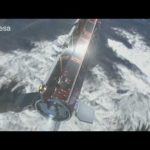
    To achieve its crucial scientific objectives, ESA’s ‘Gravity field and steady-state Ocean Circulation Explorer’, or GOCE, satellite must orbit as low as possible, in order to sense minute variations in the Earth’s gravitational field – at the edge of space and the limits of the atmosphere at only 268 km!