Tag: odyssey

  • Europe’s future space transport ecosystem

    Europe’s future space transport ecosystem

    ESA’s future launcher preparatory programme is crafting a space transportation ecosystem, guiding the companies and engineers of today to develop and test the technologies required to meet future needs.

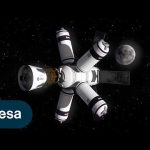
    Space transportation will be moving towards frequent reusable launchers supporting a complete industrial ecosystem around Earth. In the coming decades, the European Space Agency (ESA) foresees transportation hubs in orbit around our planet providing logistic services much like airports or train stations on Earth. These hubs will offer refilling and maintenance services for spacecraft and provide platforms for manufacturing and assembly and in space transportation to other destinations.

    To create this new transportation ecosystem, new technology developments are needed, such as automatic rendezvous and capturing of spacecraft, transfer of fuel and payloads between spacecraft, tugging spacecraft to other orbits around Earth or destinations in space.

    The end goal for companies working on a proof of concept is to fly a demonstrator mission in space. Together with ESA, industry will get to this point through a process that starts with discussing needs and proposing solutions, and is followed by proving their use-case and collaborating on standards and regulations.  Developing and demonstrating these new technologies is also expected to open commercial opportunities for European space transportation companies.

    Finally, the Odyssey project proposes to put all these key technologies together into one package by providing a dedicated service for transport vehicles and spacecraft in orbit: an uncrewed propellant depot offering refilling services. Called Odyssey (a loose abbreviation for Orbital Depot for Your Sustained Space Exploration & beYond) this depot would store propellant brought from visiting supply rockets and distribute it as needed to spacecraft on a stopover to destinations farther away such as the Moon or Mars, or to Earth-orbiting navigation satellites that have used all their propellant and need a refill to extend their working life.

    The Odyssey concept, if it can be demonstrated to be viable, would also be a contribution to a more sustainable use of space, by providing important elements of a future circular space economy.

    Credits: European Space Agency (ESA)

    Access the video on the ESA video library: https://www.esa.int/ESA_Multimedia/Videos/2025/09/Europe_s_future_space_transport_ecosystem

    ★ Subscribe: http://bit.ly/ESAsubscribe and click twice on the bell button to receive our notifications.

    Check out our full video catalog: http://bit.ly/SpaceInVideos
    Follow us on Twitter: http://bit.ly/ESAonTwitter
    On Facebook: http://bit.ly/ESAonFacebook
    On Instagram: http://bit.ly/ESAonInstagram
    On LinkedIn: https://bit.ly/ESAonLinkedIn
    On Pinterest: https://bit.ly/ESAonPinterest
    On Flickr: http://bit.ly/ESAonFlickr

    We are Europe’s gateway to space. Our mission is to shape the development of Europe’s space capability and ensure that investment in space continues to deliver benefits to the citizens of Europe and the world. Check out https://www.esa.int/ to get up to speed on everything space related.

    Copyright information about our videos is available here: https://www.esa.int/ESA_Multimedia/Terms_and_Conditions
  • Juice’s odyssey of exploration

    Juice’s odyssey of exploration

    A grand odyssey of exploration is about to begin. Humankind’s next bold mission to the outer Solar System, ESA’s Jupiter Icy Moons Explorer, Juice, is poised to explore giant planet Jupiter and its largest moons. These intriguing worlds have piqued our curiosity ever since Galileo first raised his telescope to the planet and discovered its four largest moons: Io, Europa, Ganymede and Callisto, three of which are thought to harbour underground oceans.

    Early space probes visiting the Jovian system have raised more questions than answers. But thanks to Juice, many of those answers are now within reach. ESA is launching the spacecraft in April 2023 on an eight-year journey to the distant planet.

    To uncover the hidden secrets of these mysterious worlds, Juice is equipped with the most powerful science instruments ever sent to the outer Solar System. The spacecraft will face many dangers along the way: radiation, extreme temperatures, and the vast gravitational pull of Jupiter, all while operating hundreds of millions of kilometres from Earth. But in the safe hands of ESA’s operators to guide it safely through these challenges, the dangers will be worth it for the science that Juice is destined to uncover.

    The countdown to this new era of Jupiter system exploration has begun. Stay tuned: www.esa.int/juice

    Credit: Produced by ESA/ATG medialab

    ★ Subscribe: http://bit.ly/ESAsubscribe and click twice on the bell button to receive our notifications.

    Check out our full video catalog: http://bit.ly/SpaceInVideos
    Follow us on Twitter: http://bit.ly/ESAonTwitter
    On Facebook: http://bit.ly/ESAonFacebook
    On Instagram: http://bit.ly/ESAonInstagram
    On LinkedIn: https://bit.ly/ESAonLinkedIn
    On Pinterest: https://bit.ly/ESAonPinterest
    On Flickr: http://bit.ly/ESAonFlickr

    We are Europe’s gateway to space. Our mission is to shape the development of Europe’s space capability and ensure that investment in space continues to deliver benefits to the citizens of Europe and the world. Check out https://www.esa.int/ to get up to speed on everything space related.

    Copyright information about our videos is available here: https://www.esa.int/ESA_Multimedia/Terms_and_Conditions

    #ESA
    #Juice
    #Jupiter

  • Juice’s Jovian odyssey

    Juice’s Jovian odyssey

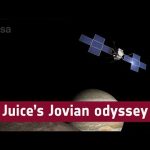
    Juice, ESA’s Jupiter Icy Moons Explorer, is set to embark on a seven-year cruise to Jupiter starting May 2022. The mission will investigate the emergence of habitable worlds around gas giants and the Jupiter system as an archetype for the numerous giant planets now known to orbit other stars.

    This animation depicts the journey to Jupiter and the highlights from its foreseen tour of the giant planet and its large ocean-bearing moons.

    An Ariane 5 will lift Juice into space from Europe’s Spaceport in Kourou. A series of gravity-assist flybys at Earth (3), Venus (1) and Mars (1) will set the spacecraft on course for its October 2029 rendezvous in the Jovian system.

    It is expected that a number of instruments will be activated during the gravity assists (indicated by the different coloured beams scanning across the planets) and measurements will be taken for calibration and to check the health of the instruments. The visualisations of the Earth flybys show the closest approaches over the planet according to current planning – over the South Pacific Ocean, Argentina and Peru, respectively. Throughout the animation, the instrument beam colours correspond to example observations by JANUS (green), MAJIS (red), UVS (purple), Gala (Blue) and RIME (grey), which are cameras, spectrometers, laser altimeter and radar.

    During the Venus flyby, limited observations can be made because the spacecraft will be oriented to protect it from the heat of the Sun experienced in the inner Solar System. The Mars flyby will see Juice fly over the planet’s south pole to make scientific observations.

    Juice will start its science mission about six months prior to arriving in orbit around the gas giant, making observations as it approaches its destination. Once in the Jovian system, a gravity-assist flyby of Jupiter’s largest moon Ganymede – the largest moon in the Solar System – helps Juice enter orbit around the gas giant 7.5 hours later.

    While in Jupiter orbit, the spacecraft will study the Jovian system as an archetype for gas giants, making observations of its atmosphere, the magnetosphere, its rings and satellites.

    During the tour, Juice will make two flybys of Europa, which has strong evidence for an ocean of liquid water under its icy shell. Juice will look at the moon’s active zones, its surface composition and geology, search for pockets of liquid water under the surface and study the plasma environment around Europa.

    A sequence of Callisto flybys will not only be used to study this ancient, cratered world that may too harbor a subsurface ocean, but it will change the angle of Juice’s orbit with respect to Jupiter’s equator, making it possible to investigate the polar regions and environment at higher latitudes.

    During the tour there will also be unique periods to observe events such as moon transits. The example in this animation shows Europa and Io passing in front of Jupiter on 27 January 2032. This type of event is rare, with less than 10 expected to occur during Juice’s tour of the Jovian system.

    A sequence of Ganymede and Callisto flybys will adjust the orbit of Juice to enable it to enter orbit around Ganymede, marking it the first spacecraft to orbit another planet’s moon (aside from our own). The elliptical orbit will be followed by a 5000 km altitude cicular orbit, and later a 500 km circular orbit.

    Ganymede is unique in the Solar System in that it is the only moon to have a magnetosphere. Juice will investigate this phenomenon and the moon’s internal magnetic field, and the interaction of its plasma environment with that of Jupiter. Juice will also study the moon’s atmosphere, surface, subsurface, interior and its internal ocean, investigating the moon as a planetary object and possible habitat.

    Over time the 500 km orbit will naturally decay – eventually there will not be enough propellant to maintain it – and it will make a grazing impact on the surface. The animation concludes with an example of what the approach to impact could look like.

    ★ Subscribe: http://bit.ly/ESAsubscribe and click twice on the bell button to receive our notifications.

    Check out our full video catalog: http://bit.ly/SpaceInVideos
    Follow ESA on Twitter: http://bit.ly/ESAonTwitter
    On Facebook: http://bit.ly/ESAonFacebook
    On Instagram: http://bit.ly/ESAonInstagram
    On Flickr: http://bit.ly/ESAonFlickr

    ESA is Europe’s gateway to space. Our mission is to shape the development of Europe’s space capability and ensure that investment in space continues to deliver benefits to the citizens of Europe and the world. Check out http://www.esa.int/ESA to get up to speed on everything space related.

    Copyright information about our videos is available here: http://www.esa.int/spaceinvideos/Terms_and_Conditions

    #JUICE
    #Jupiter
    #SolarSystem

  • NASA Explorers: Ice Odyssey

    NASA Explorers: Ice Odyssey

    To know the evolution of sea ice and how we observe it from space is to know Dr. Claire Parkinson. Meet the scientist who continues to have a profound effect on the study of climate change through her work monitoring the health of global sea ice.

  • 2018: A Race Odyssey (Part 1) | The Rundown With Robin Thede

    2018: A Race Odyssey (Part 1) | The Rundown With Robin Thede

    Black people are under-represented in STEM. But as technology progresses, is racism creeping into AI?

    HASHTAG: #TheRundownBET
    TW: @TheRundownBET – https://twitter.com/therundownbet?lan
    FB: @TheRundownBET – https://www.facebook.com/TheRundownBET/
    IG:@therundownBET – https://www.instagram.com/therundownbet/

    Still haven’t subscribed to BET on Youtube? ►► http://bit.ly/1U0v9xG

    Download the BET NOW app for full episodes of your favorite BET shows and exclusive content!

    Connect with BET
    Web: http://www.BET.com
    Facebook: http://www.facebook.com/BET
    Twitter: http://www.twitter.com/BET
    Instagram: http://www.instagram.com/BET
    Google+: http://www.bet.us/gplusBET